Lifetime Citizen Portal Access — AI Briefings, Alerts & Unlimited Follows
Alaska report finds stark disparities in Native incarceration, urges tribal courts, reentry housing and early intervention
Loading...
Summary
An Alaska Federation of Natives–led study commissioned under House Bill 66 found Alaska Native people are overrepresented in the state prison system and offered recommendations including expanding tribal courts, culturally grounded reentry housing, early childhood interventions and expanded treatment and mental-health services.
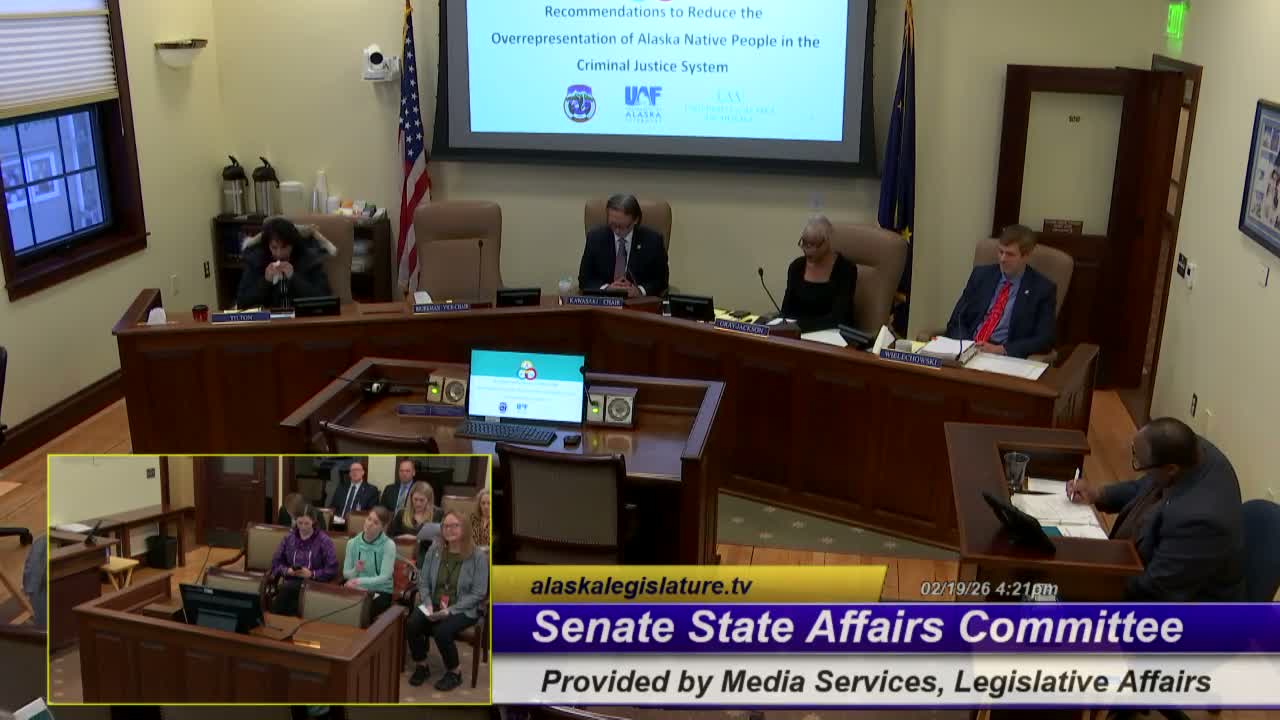
A report presented Thursday to the Alaska Senate State Affairs Committee lays out a range of measures state and tribal leaders can take to address what presenters described as a long-standing, disproportionate rate of incarceration among Alaska Native people.
Kendra Kloster, director of government relations for the Alaska Federation of Natives, said the study—commissioned under House Bill 66 (2024) and produced with University of Alaska researchers and the Department of Corrections—documents that Alaska Native people make up roughly 14 to 19 percent of the state’s population but account for about 44 percent of people in the state prison system. "These disparities begin long before justice-system involvement," Kloster said, citing historical trauma, inadequate access to services and behavioral-health challenges.
Dr. Katie Cueva, associate professor at the University of Alaska Fairbanks Center for Alaska Native Health Research, told the committee that Department of Corrections data show Alaska Native recidivism of about 60 percent and that the report emphasizes geographic and temporal variation in disproportionate outcomes. "We know there are places and programs that have lower disproportionality and we can learn from them," Cueva said.
The report reviews multiple evidence sources—interviews, surveys and a literature review that incorporated prior work going back decades—and produces multi-part recommendations. Presenters and advisory members urged investing upstream in prenatal care, culturally grounded early childhood education and parenting programs, and expanding trauma-engaged and culturally responsive mental-health services in villages and hubs.
A central theme was strengthening tribal justice systems. Rick Haskins Garcia, director of law, policy and tribal justice at the Alaska Native Women’s Resource Center, noted Alaska’s 229 federally recognized tribes can operate tribal courts with broad jurisdiction and that recent federal law (Violence Against Women Act 2022 Reauthorization) creates a pathway for tribes to exercise limited criminal jurisdiction over certain non‑Native offenders. Garcia recommended expanded funding and technical support so tribal courts and restorative practices can play a greater role in diversion, sentencing alternatives and reentry.
Presenters also emphasized reentry housing and parole/probation reform. The report highlights cases where people released to urban centers without housing or sufficient supports return to the streets and are then re-incarcerated for parole or probation violations. Kloster said the study recommends culturally grounded reentry housing with integrated services—substance misuse treatment, mental-health care and job support—to reduce forced homelessness and break a cycle of reincarceration.
Substance-misuse treatment inside facilities and immediately after release was another prioritized area. "Providing treatment to everyone who is incarcerated is one of the cheapest and most effective ways to address substance misuse in this population," Cueva said, noting long waits for treatment are common in Alaska and can perpetuate intergenerational trauma.
Workforce and remote-services recommendations include expanding job training and apprenticeship programs during incarceration, increasing Alaska Native representation among correctional staff and justice professionals, and investing in rural broadband so telehealth and remote education can reach remote communities.
Speakers acknowledged funding barriers: many federal grants are competitive, one-time awards and administratively burdensome. Dr. Charlene Upok of Data for Indigenous Justice urged the legislature to "be bold" and invest in tribally led solutions rather than rely on short-term grants. Garcia called for a second phase of work focused on deeper community engagement, implementation benchmarks and a permanent Alaska Native–led task force to coordinate across agencies and budget cycles.
Sen. Bjorkman asked whether therapeutic and tribal courts include reentry services and whether a state pilot for reentry/housing tied to statutory changes might be feasible; presenters said some local programs exist but that program evaluation and broader scalability were beyond the single study’s scope.
The committee did not take formal action on the recommendations during the hearing but scheduled further review: Chair Kawasaki said the Department of Corrections will give an overview on Feb. 24 and the committee plans additional budget-subcommittee discussion. The report and appendices were submitted for committee review.