AFN report to Alaska House outlines upstream causes and remedies for high Alaska Native incarceration rates
Loading...
Summary
Alaska Federation of Natives and university partners presented a report required by House Bill 66 (2024) showing Alaska Native people comprise roughly 42–44% of ADOC populations and recommending tribal courts expansion, early intervention, culturally grounded treatment, housing and job training to reduce disparities.
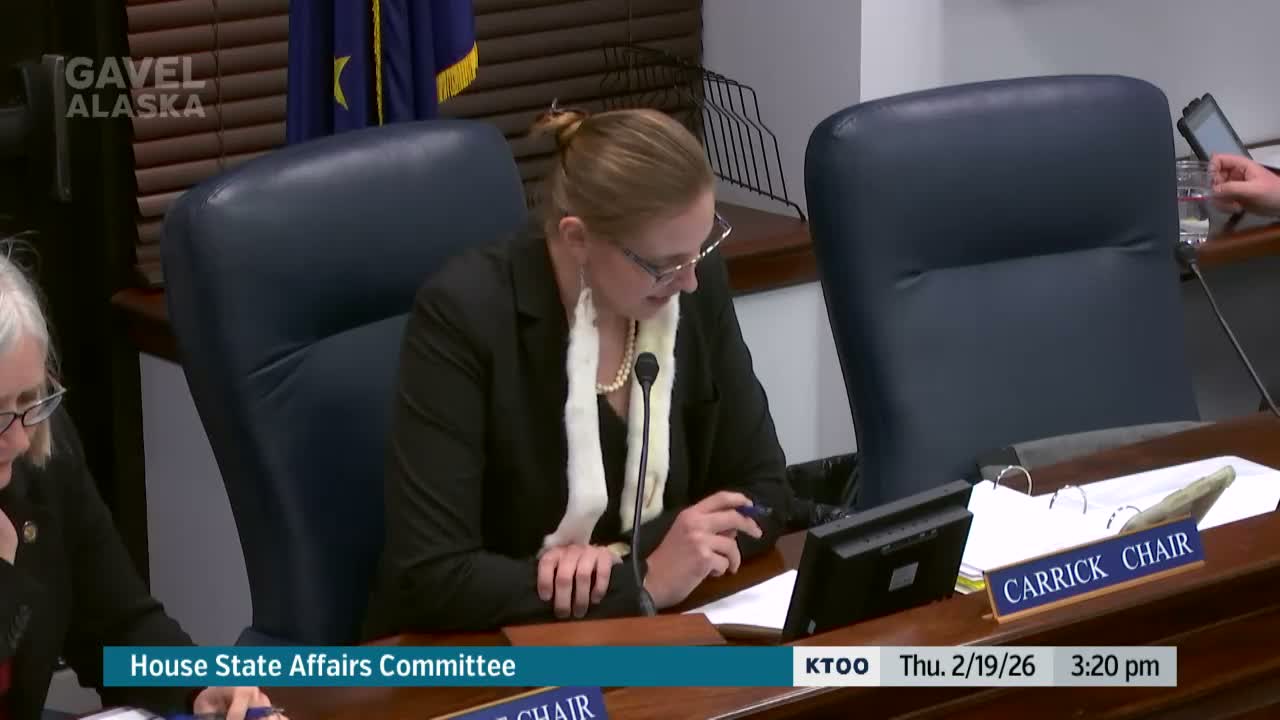
The Alaska Federation of Natives and research partners on Thursday presented to the Alaska House State Affairs Committee a report, prepared under House Bill 66 (2024), section 64, that analyzed drivers of the disproportionately high rates of incarceration among Alaska Native people and recommended a range of upstream interventions.
Kendra Kloster, government affairs director at the Alaska Federation of Natives, told the committee the report links long‑term harms — including boarding‑school era trauma and loss of language and culture — to present disparities. "While Alaska Native people make up anywhere from 14 to 19% of the population here, the incarceration rate is about 44%," Kloster said, emphasizing intergenerational drivers.
Sandy Martinson, deputy director of the Division of Institutions at the Alaska Department of Corrections, said DOC contracted with AFN and supported the study while maintaining a hands‑off posture to protect the study's integrity. Martinson and Deputy April Wilkerson were available to answer department‑specific questions.
Brad Merstle, director of the Alaska Justice Information Center, summarized a booking‑record analysis of a cohort of 12,700 unique individuals and said the system's inputs explain much of the disparity. "When we look at the inputs, what we find is 43% are Alaska Native or American Indian," Merstle said, adding that because DOC functions as a receiving institution the focus should include upstream prevention as well as in‑custody programs.
The report's recommendations, presented across several sections, include: expanding restorative justice and tribal‑court programs and diversion options; investing in early childhood and youth mental‑health screening; expanding culturally grounded substance‑misuse treatment inside custody and in the community; increasing reentry housing with integrated services and permitting remote probation/parole supervision to allow people to return to home communities; and building job‑training and career pathways to increase Alaska Native representation in legal and justice occupations.
On tribal jurisdiction, Rick Haskins Garcia, policy director for the Alaska Native Women's Resource Center, told the committee that tribal jurisdictional scope is usually set by tribes themselves and that the Violence Against Women Act reauthorization in 2022 created a pilot pathway for Alaska tribes to exercise criminal jurisdiction over non‑Native offenders in villages, subject to Department of Justice approval. He noted that no Alaska tribe currently exercises that criminal jurisdiction over non‑Native offenders.
Committee members pressed presenters on gaps the study did not fill. Vice Chair Story and others asked whether the report established a baseline inventory of current reentry and treatment programs inside DOC facilities; presenters said that comprehensive baseline was outside the project's scope and identified it as a follow‑up need for DOC, UAF and partners.
Presenters repeatedly emphasized culturally grounded models. Dr. Katie Cueva, associate professor at the UAF Center for Alaska Native Health Research, explained that Medicaid and reimbursement pathways should support Alaska Native‑led treatment models such as talking circles and land‑based activities so individuals without private funds can access culturally specific care.
Dr. Charlene Abuck, a member of the advisory team, closed by urging investment in tribal‑led solutions and describing incarceration's ripple effects in Native families: "These ripple effects that we see through the ways that it impacts our communities is very much something that is lived and felt," she said.
The committee did not take formal action on the report during the hourlong hearing. Chair Kerrick thanked the presenters, invited follow‑up written responses to committee questions, and said presenters were welcome to return for a deeper discussion. The committee adjourned at 4:13 p.m. and listed three first hearings for its next meeting (HJR22, HJR23, and HB 290/HCR 10 related items).