Alaska seeks more time to implement HR 1 SNAP changes; state warns of higher administrative costs
Loading...
Summary
Division of Public Assistance Director Deb Etheridge told lawmakers Alaska secured a SNAP good-faith waiver through Oct. 31, 2026, will not immediately apply the law’s narrower exemptions, and warned a federal administrative cost-share shift could raise Alaska’s FY cost roughly $10.7 million annually beginning Oct. 2027.
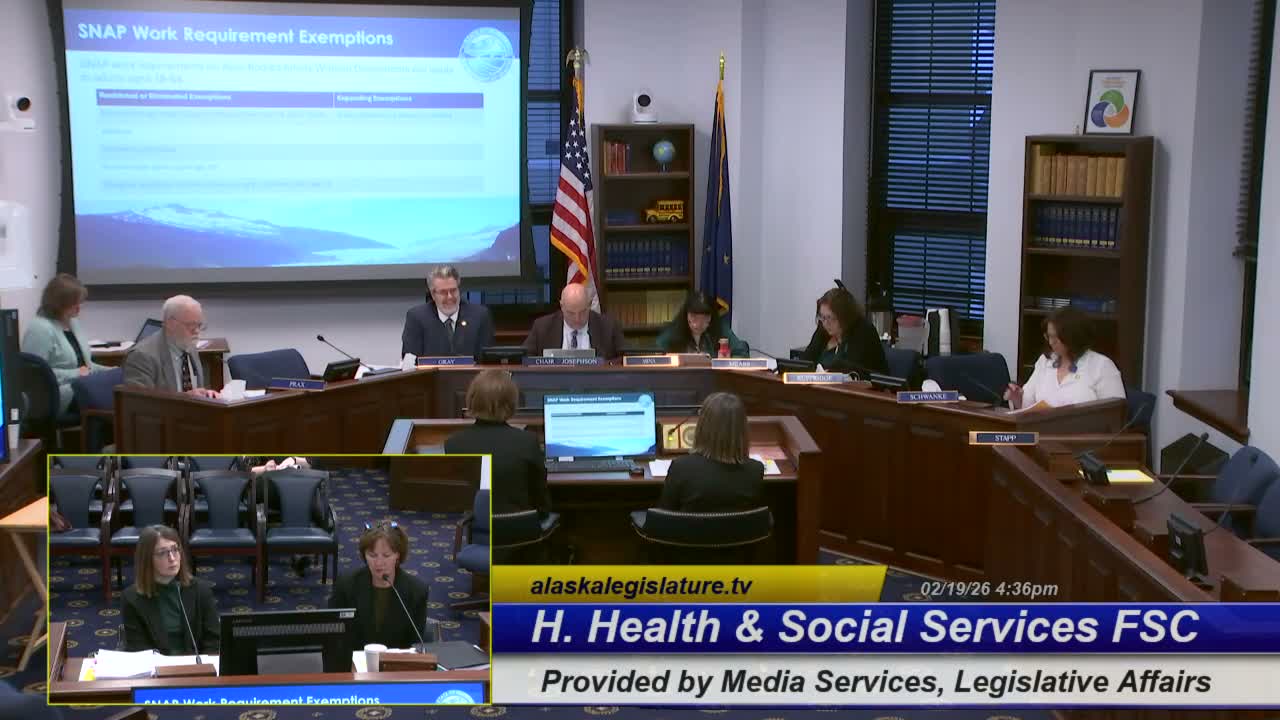
Deb Etheridge, director of the Division of Public Assistance, briefed the House Finance Health Subcommittee on Feb. 19 about how HR 1 changes supplemental nutrition assistance program (SNAP) rules and administrative funding. Etheridge said Alaska received a Food Nutrition Service good-faith waiver on Oct. 31, 2025, that covers implementation through Oct. 31, 2026, giving the state time to train staff and update systems.
Etheridge said HR 1 expanded the SNAP able-bodied-adult age range to 18–64 and narrowed some categorical exemptions (for example, the parent/caregiver exemption moves from children under 18 to children under 14). She said Alaska adopted the Alaska Native/American Indian exemption and is not immediately implementing the other narrower exemptions during the waiver period. Etheridge estimated the age-range expansion affects fewer than 800 Alaska households.
Why it matters: Etheridge alerted the committee to a separate HR 1 provision changing the federal-state administrative cost-share for SNAP (effective Oct. 2027). The change shifts a larger share of administrative expenses to states and, Etheridge said, will cost Alaska about $10.7 million annually when fully implemented (Oct. 2027–28), with fiscal-year 2027 covering three quarters of that amount.
Operational steps and automation: Etheridge and Deputy Commissioner Emily Ricci described ongoing IT modernization and automation (including an ability to text recipients, automated death-matches, and online applications). Officials said automation and expanded ex parte (data-driven) processing are central to avoiding burdens on clients and staff, but department leaders warned the rapid nationwide deadline and competing procurement demand may raise implementation costs.
What’s next: Etheridge said the waiver gives the state time to modify processes and training; if compliance cannot be achieved by Oct. 31, 2026, Alaska may seek extensions. The committee requested additional written details on modernization spending and the division’s progress toward lower error rates and faster processing times.