
Alaska officials outline how federal HR 1 will impose Medicaid work rules and a tighter renewal schedule
Get AI-powered insights, summaries, and transcripts
Subscribe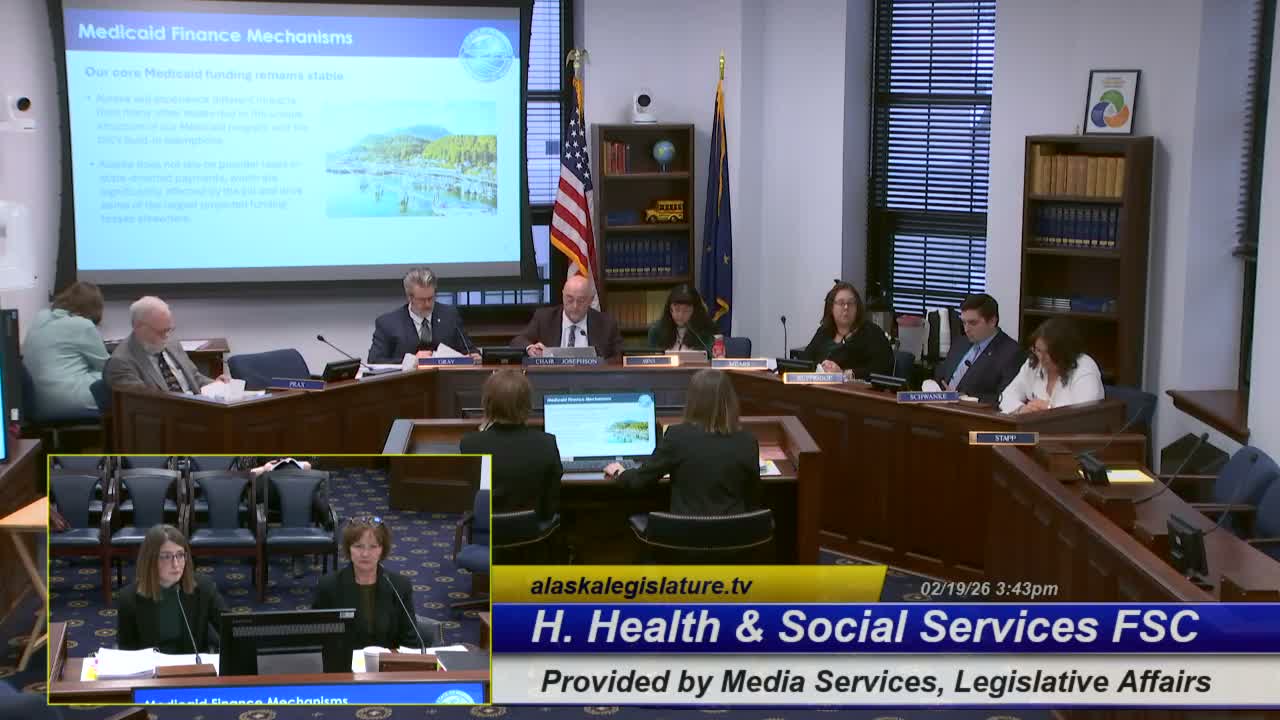
Summary
Department of Health officials told the House Finance Health Subcommittee that HR 1 will require most adults in Alaska’s Medicaid expansion population to meet 80 hours per month of work or qualifying activities beginning 01/01/2027, with twice-yearly renewals and CMS guidance due June 2026; department plans automated exemption checks and a modest state match for system upgrades.
Alaska Department of Health officials told the House Finance Health Subcommittee on Feb. 19 that federal HR 1 will require most adults covered by Medicaid expansion to complete the equivalent of 80 hours per month of work or qualifying activities beginning Jan. 1, 2027. Deputy Commissioner Emily Ricci said final federal rules are expected in June 2026 and that the state must begin communications to impacted individuals by September 2026.
The change affects the Medicaid expansion population — adults aged roughly 19–64 whose eligibility is based on income rather than categorical status — which Ricci said totals about 61,000 Alaskans. Under HR 1, those enrollees will face a shorter renewal cycle: expansion-eligible enrollees will be reviewed every six months rather than annually. Ricci said Alaska Native and American Indian enrollees are exempted from the six-month review and that a set of mandatory and optional exemptions in HR 1 will limit who must comply.
Why it matters: committee members pressed officials on the risk that paperwork burdens and new documentation rules could cause eligible people to lose coverage. Representative Gray cited an independent Manatt analysis showing high loss rates in other states when manual submissions were required; Ricci said Alaska’s initial analysis found data for automatic exemptions for roughly 69% of the expansion population but that more work is needed to estimate downstream costs to hospitals and emergency services if people cycle off coverage.
Officials described key open questions and planned state actions. Ricci said the Centers for Medicare & Medicaid Services (CMS) will issue more detailed guidance in June; until then Alaska is designing systems to automate exemption determinations using existing datasets (claims, income records, the national student clearinghouse) so fewer people must submit paperwork manually. Ricci said the department will pursue a phased good-faith waiver option only if compliance with federal requirements proves infeasible; CMS has signaled it will scrutinize such waiver requests.
The department emphasized protections for seasonal workers and other Alaska-specific circumstances. Ricci said seasonal income can be averaged over six months for eligibility purposes (the example cited equated the 80-hour-per-month threshold to about $580 per month under current federal minimum wage calculations), but she warned that operational definitions (how income and hours are documented) are still being developed. The department proposed midterm reporting to the legislature on outcomes from COVID-era system investments and on implementation choices related to exemptions and outreach.
What’s next: officials said they will finalize system plans after CMS issues guidance in June, begin targeted communications to impacted enrollees by September 2026, and implement the six-month redeterminations and community-engagement requirements effective Dec. 31, 2026, unless a waiver is approved. The committee will revisit Medicaid budget items and governor’s amendments at an upcoming meeting.