
Alaska committee reopens debate on autonomous-vehicle rules, industry warns operator mandate would 'effectively ban' commercial AVs
Get AI-powered insights, summaries, and transcripts
Subscribe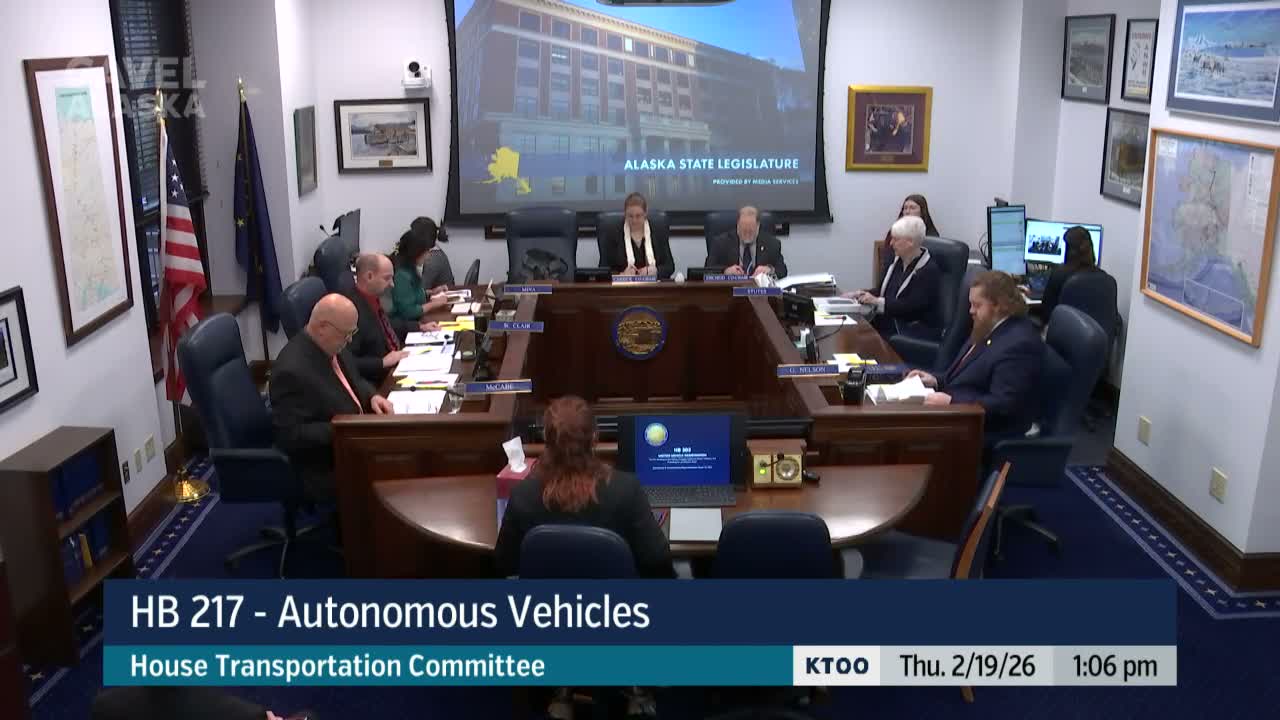
Summary
The Alaska House Transportation Committee reintroduced HB 217, which would require a human safety operator in autonomous vehicles used for interstate commerce or commercial transport; labor representatives supported the measure for safety and job protection, while industry groups warned it would stifle AV deployment and asked for more coordination on federal standards and liability rules.
Co-chair Representative Kerrick opened a reintroduction hearing on House Bill 217 on Feb. 19, 2026, saying the measure will return for further questions and invited testimony.
Griffin Cukayo, staff to Representative Kerrick, summarized the bill's core provisions: it would add a section to AS 28.9 requiring autonomous vehicles in Alaska to meet federal motor-vehicle standards; bar a vehicle registered in the state from engaging in interstate commerce, goods transport, or passenger service unless the trip is personal/noncommercial or a human safety operator is physically present and able to intervene; and set an order of liability for accidents that places the human safety operator first, followed by the vehicle modifier, the software programmer, and the manufacturer.
The bill received two invited testimonies. Patrick Fitzgerald, political coordinator for Teamsters Local 959, urged passage, saying HB 217 would protect road safety and workers’ jobs by mandating a safety operator in commercial AVs: “it is the best interest of the safety of Alaskans on the roadways and for job protection, then we establish a requirement for autonomous vehicles to have a safety operator,” Fitzgerald said.
Kurt Augustine, senior director of state affairs for the Alliance for Automotive Innovation, testified in strong opposition. Augustine warned that a requirement for a human operator to be physically present in commercial autonomous vehicles would “essentially be a de facto ban on AVs in Alaska” and would block benefits for disabled and rural residents who could gain access to transportation and deliveries. He also said the bill does not clearly adopt national design standards (for example, Society of Automotive Engineers standards) and criticized a provision that the bill appears to presume the human operator is the first line of liability in every accident.
Committee members pressed Augustine and staff on definitions and scope. Members sought clarity about whether drones or small sidewalk delivery robots would be covered; staff noted the bill focuses on interstate commerce and that drones are defined separately in statute, but the committee asked staff to tighten definitions to avoid ambiguity. Senator Robert Myers, carrying companion SB148 in the Senate, told the committee the bill uses a narrower federal-style definition of ‘‘commercial vehicle’’ that targets cargo vehicles with a gross vehicle weight rating over 10,000 pounds and passenger vehicles carrying more than 16 people.
Lawmakers raised competing policy priorities: some members cited examples where automation created higher-tech jobs after adoption, while others expressed concern that the bill's language could make AV deployment economically unviable for fleet services that could benefit rural areas. Members asked the chairs to invite the Alaska Department of Transportation’s modernization and innovation office to testify at the next hearing to address Alaska-specific conditions (winter roads, striping, maintenance) not covered in today's testimony.
The committee set HB 217 aside for now and announced plans to continue the hearing next week, with public testimony and additional invited witnesses expected.
The next procedural step is a follow-up hearing scheduled for Tuesday, Feb. 24 at 1:00 p.m. in Room 124 where members said they will pursue clarifications about federal standard references, liability order language, commercial definitions, and DOT operational concerns.