Get AI Briefings, Transcripts & Alerts on Local & National Government Meetings — Forever.
DEC reports falling cruise-ship exceedances, details inspection program and fees; penalties since 2018 totaled $495,187
Summary
DEC directors Jason Olds and Jean McCabe updated a legislative subcommittee on Feb. 19 about cruise-ship monitoring using EPA Method 9, inspection practices (twice-yearly boardings), a tiered per-voyage fee structure and a record year of observations in 2025; McCabe said penalties since FY2018 totaled $495,187.
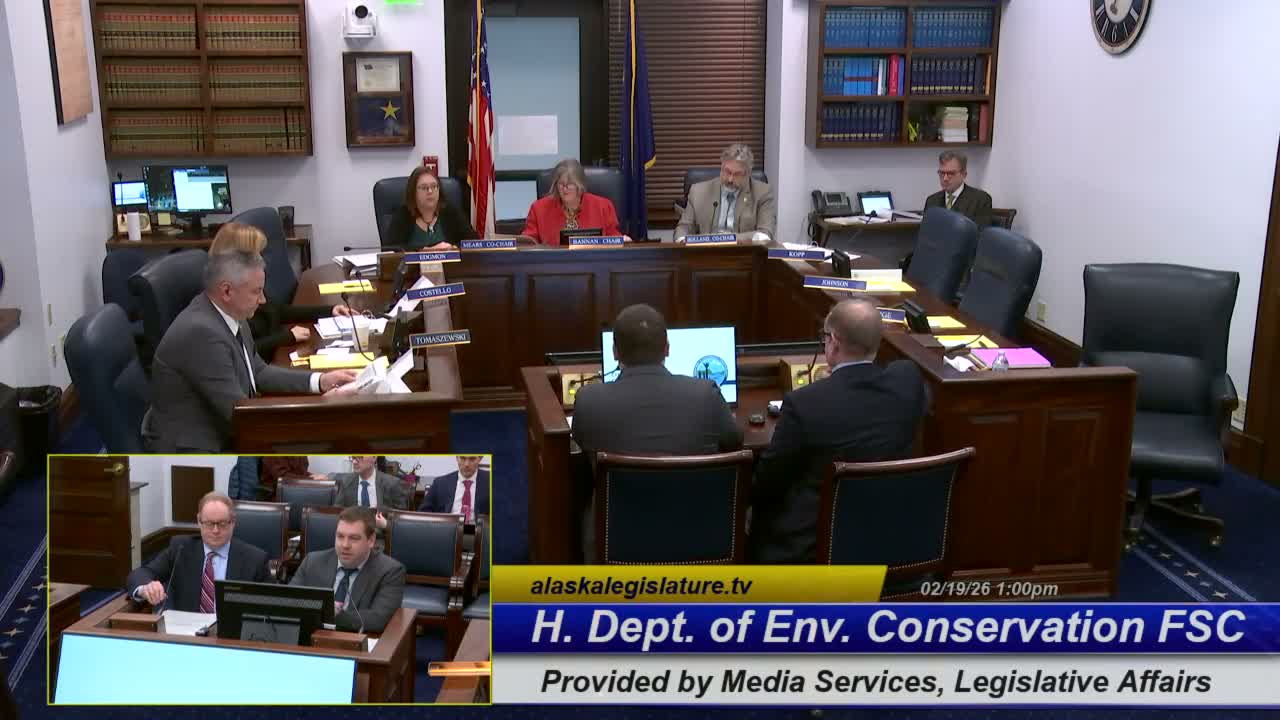
Jason Olds and Jean McCabe told the House Finance Department Environmental Conservation Subcommittee on Feb. 19 that Alaska's cruise-ship compliance program uses shore-based EPA reference Method 9 visual opacity observations, contracted opacity readers and community sensors to monitor vessel emissions and that DEC has seen improving compliance in recent years.
Olds described Method 9, a visual certification method that uses trained observers (calibrated semiannually) to evaluate visible emissions and noted that water vapor is excluded from the opacity standard. He said Method 9 observations are shore-based and separate from the Ocean Ranger onboard program. "Opacity, notably, is a surrogate for particulate matter pollution," Olds said, explaining why DEC applies the method to vessels.
Jean McCabe, director of the Division of Water, said every vessel must register annually to operate in Alaska waters (registration for 2026 must be complete by March 1) and that the Alaska large vessel general permit authorizes discharge of treated sewage and treated gray water for large cruise ships; other discharges are regulated by the federal vessel general permit and, in the future, by VIDA, which the U.S. Coast Guard will enforce.
McCabe described inspections on large vessels as occurring twice a year—once in port and once underway—with DEC inspectors boarding to observe discharges and review logs. She said DEC tries to give minimal notice for boardings when possible, but logistics and authorization needs can require coordination in remote ports. The program includes monitoring at major ports (Juneau, Ketchikan, Skagway) and smaller ports such as Whittier.
On funding, McCabe explained the Commercial Passenger Vessel Environmental Compliance Fund is funded by a tiered per-voyage fee based on berth counts (fees range from $75 for 50—99-passenger vessels up to $3,750 for vessels with 3,500+ passengers) and an Ocean Ranger fee of $4 per lower berth. She said the water-division inspection program is funded by that compliance fund and that DEC will provide exact annual revenue and program-cost figures to the committee.
McCabe said DEC's approach has emphasized compliance assistance since COVID and that the division assessed $495,187 in penalties for small and large cruise ships since fiscal year 2018. She also described a case involving the state ferry Kennecott where DEC worked with DOT on engine retrofits and a corrective action plan following observed opacity violations.
DEC is exploring whether cruise lines' onboard sensor data can supplement Method 9 observations and said collaboration could address technical differences and data regimes. Committee members asked DEC to supply detailed program costs and how inspection activity appears in budget documents; DEC agreed to provide those figures to committee offices.