
DEC outlines AO 360 plan to cut discretionary regulations 25% by 2027, pledges to protect environmental standards
Get AI-powered insights, summaries, and transcripts
Subscribe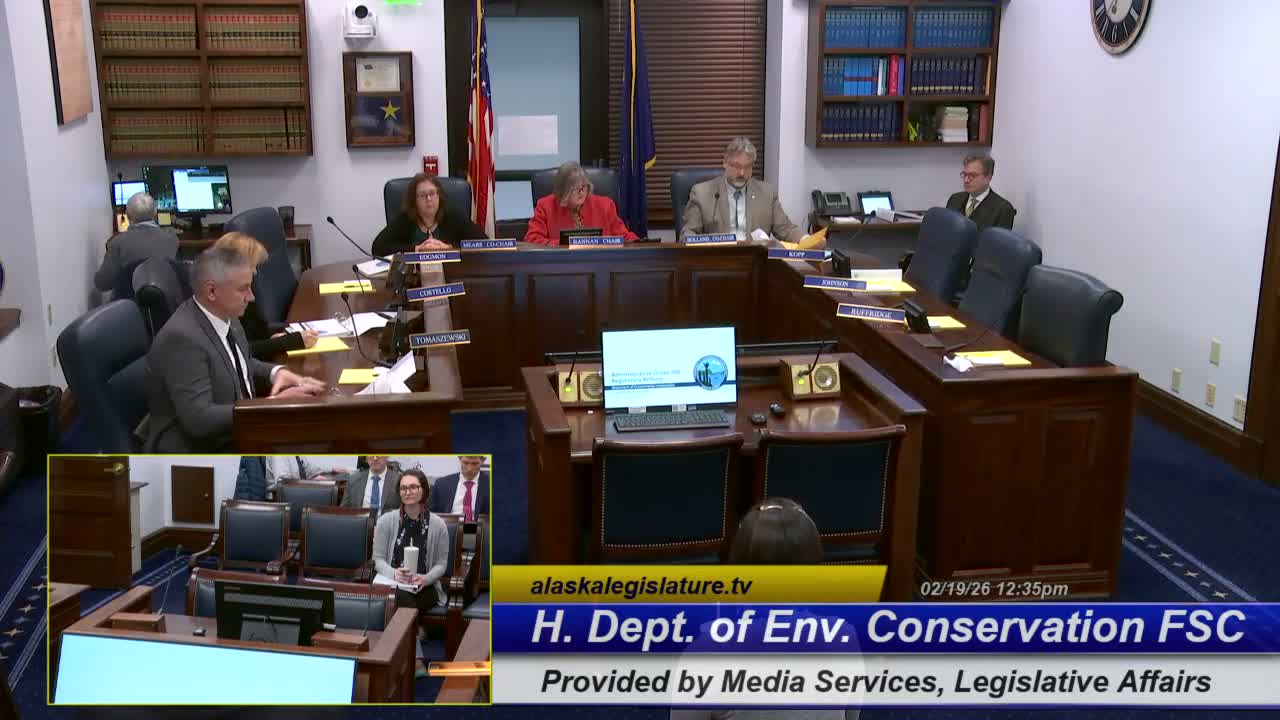
Summary
Deputy Commissioner Crystal Keeneman told a House Finance subcommittee Feb. 19 that the Department of Environmental Conservation has identified 40 regulatory packages and roughly 13,000 discretionary requirements as part of AO 360, aiming for a 15% reduction by 2026 and 25% by 2027 while maintaining environmental protections.
Deputy Commissioner Crystal Keeneman said Feb. 19 that the Alaska Department of Environmental Conservation is moving forward with the governor's administrative order AO 360 to reduce regulatory burden and streamline permitting processes while preserving statutory and federal environmental protections.
Keeneman told the House Finance Department Environmental Conservation Subcommittee that DEC reviewed regulations across air quality, water and wastewater, drinking water, solid and hazardous waste, contaminated sites, spill prevention and response, food safety and public health and identified opportunities to repeal, consolidate, streamline or modernize requirements. "We are federally and statutorily mandated to protect public health, Alaska's air, water, and lands," Keeneman said.
Keeneman said the AO 360 work was framed around three lenses: transparency (clear, predictable regulations faithful to legislative intent), adherence to statute (not expanding DEC's authority) and environmental integrity. The department identified about 40 distinct regulatory packages to go through the public regulatory process and estimated roughly 13,000 discretionary regulatory requirements that were reviewed for potential reduction. She described the 40 packages as a "small percentage" of the department's full code and said changes can include deletions, consolidations or rewrites rather than wholesale repeals.
Keeneman said the department finalized its regulatory reform package in December and submitted it to the Department of Law and the governor on Jan. 5; the packages are now being drafted and will follow the standard public-notice and stakeholder process. She emphasized that the public process and timelines remain unchanged and that the department plans to engage stakeholders "early and often."
On budget implications, Keeneman told the subcommittee there were no current budget requests tied to the reform work, saying the effort is still early and that any future resource implications would be addressed through OMB and the regular budget-development process. She also described DEC as a "small but mighty team" of about 559 employees with roughly a 6.5% vacancy rate and said the regulatory review has largely been absorbed into day-to-day operations by experienced regulatory staff.
Keeneman said DEC reviews enabling legislation and historical committee minutes when necessary to ensure regulations reflect legislative intent and credited long-tenured staff for tracing statutory history. Jessalyn Rintola, a Juneau-based regulations specialist, was identified as one of the staff members who helped synthesize division input.
The subcommittee pressed for further detail on the scope of the 40 packages and how they map to the department's total regulatory code; Keeneman pointed committee members to DEC's AO 360 web page and offered to provide additional specifics. The department will advance the packages through the usual regulatory process, publish public notices and solicit stakeholder comments before final rule actions.
The subcommittee scheduled a closeout meeting for the following Thursday to continue oversight and to receive any requested follow-ups.