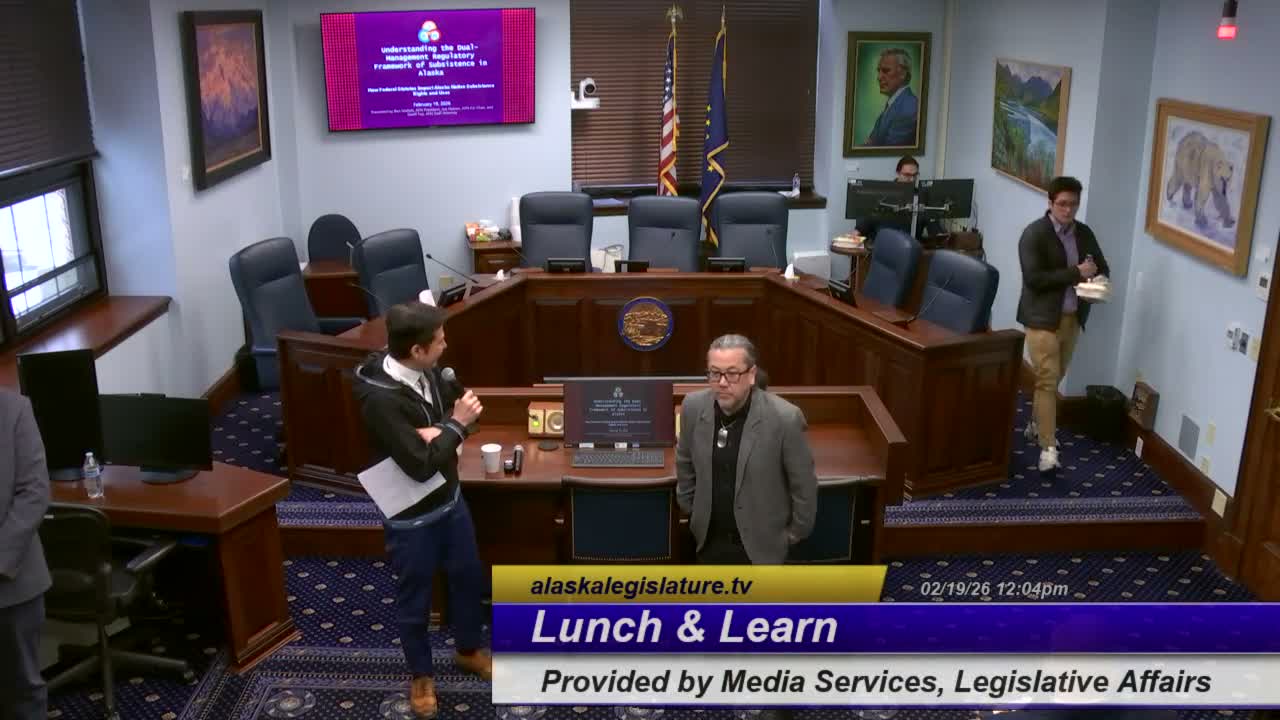
AFN workshop outlines legal history and options to simplify Alaska's bifurcated subsistence system
Loading...
Summary
At an Alaska Federation of Natives workshop, AFN staff attorney Jeff Toye and leaders including Joe Nelson and Ben Lott reviewed the history of ANCSA and ANILCA, described court rulings that created a patchwork of state and federal rules, and presented reform options including co-management and a possible constitutional amendment.
At a workshop hosted by the Alaska Federation of Natives (AFN), AFN staff attorney Jeff Toye and AFN leaders laid out why Alaska has a split subsistence system and sketched options for simplifying management.
Jeff Toye summarized the legal arc that produced the current patchwork. He said the Alaska Native Claims Settlement Act (ANCSA, 1971) established native corporations and extinguished certain land- and harvest-related claims, and that later federal law—the Alaska National Interest Lands Conservation Act (ANILCA, 1980)—created an explicit rural subsistence preference on federal lands and waters. "Subsistence in the statutes has a much longer, much more Alaska specific, much more comprehensive definition," Toye told attendees, explaining the term covers traditional and customary uses including food, shelter and cultural consumption.
Toye reviewed court decisions and agency structures that followed. He described a 1989 Alaska Supreme Court ruling (McDowell) that limited the state's ability to apply the federal rural priority under state law because the state constitution guarantees equal access to natural resources. That ruling, Toye said, helped produce the current bifurcated system: federal subsistence rules apply on federal lands and waters, and state rules apply elsewhere. He summarized the Katie John case series that extended rural fishing priority to some navigable waters appurtenant to federal lands, and noted Sturgeon v. Frost and a recent US v. Alaska decision changed the contours of federal authority in places such as riverways and parks.
Speakers emphasized the practical consequences. Toye described "invisible walls" across the landscape where a moose or fish moving from federal to state land can change which rules apply, creating confusion for harvesters and heavy burdens on small communities that must engage with multiple boards and councils. He noted the Federal Subsistence Board is advised by ten Regional Advisory Councils, while the state relies on a Board of Fish and Board of Game advised by dozens of local advisory committees.
Ben Lott, identified in the workshop as AFN president, outlined options AFN is exploring. Federal approaches mentioned include revisiting ANCSA provisions, examining who qualifies to harvest under Title VIII (rural, native, or combinations thereof), and using cooperative agreements and compacting to expand tribal or local roles. Lott also flagged co-management and increased local scientific capacity—"How can we get our own biologists managing our lands?"—as priorities to strengthen rural economies and reduce administrative burdens.
Joe Nelson framed a constitutional amendment as the clearest path to unify law across jurisdictions. He and other presenters said an amendment would be only the start: statutory and regulatory changes would follow, and success would require coordinated legislative strategy and executive leadership. "The shortest path there is a constitutional amendment," Nelson said, while acknowledging it would trigger many downstream changes.
Community members also spoke. Peter Williams, who identified himself as representing an Arctic Slope association, urged unity and intergenerational stewardship and recounted decades of participation in regional advisory councils.
Presenters repeatedly emphasized education and engagement as near-term tasks: providing slide materials and recordings, training rural residents to testify before boards and councils, and building a common baseline of understanding across regions so communities can meaningfully participate in technical rulemaking.
The workshop closed with organizers directing attendees to AFN materials and the AFN annual conference referenced in the presentation. No formal votes or legislative actions were taken at the session; presenters described options and next steps rather than enacting policy.