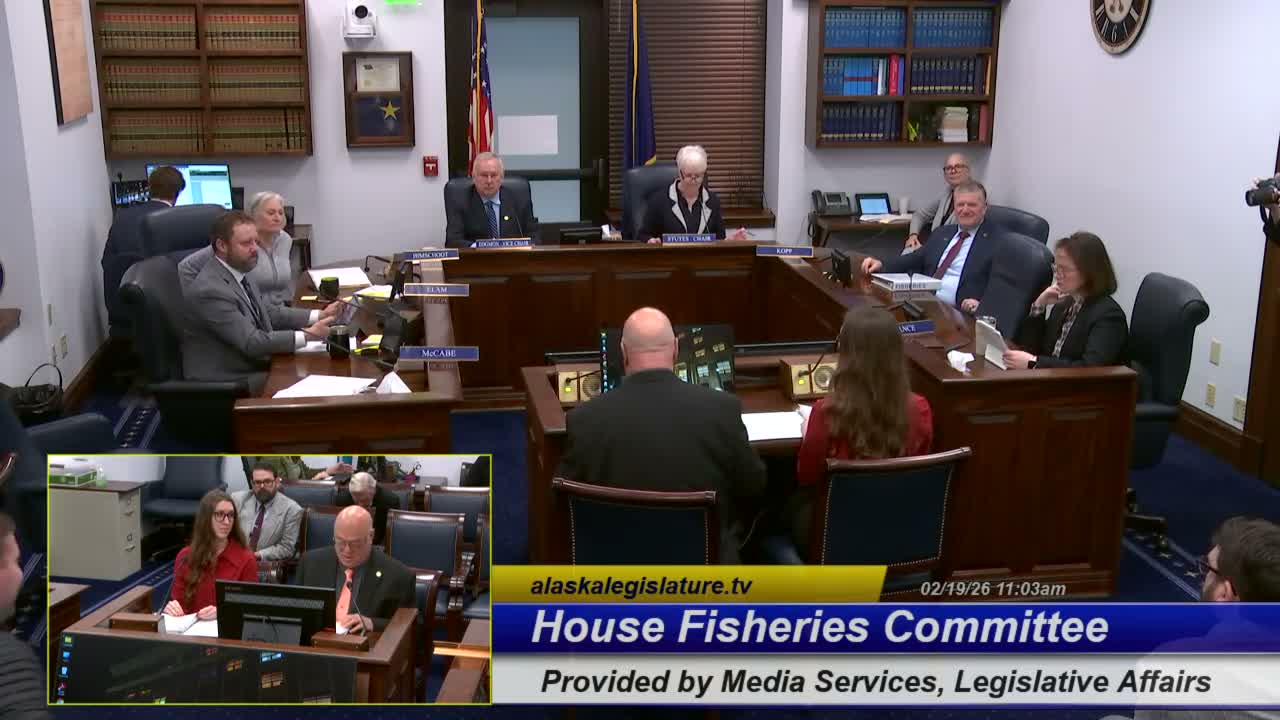
House committee hears bill to levy $1 angler surcharge to fund updated sport‑fishing economic study
Loading...
Summary
Representative Kevin McCabe introduced HB 304 to require the Department of Fish and Game to produce a biennial report on the economic impacts of sport fishing funded by a $1 surcharge on sport‑fishing licenses; the department’s fiscal note estimates about $465,000 annual revenue and roughly $350,000 contracting cost per study.
Representative Kevin McCabe presented House Bill 304 to the Alaska House Special Committee on Fisheries on Feb. 19, proposing a $1 sport‑fishing angler access surcharge on licenses to fund a biennial economic impact report on sport fishing.
"HB 304 requires the commissioner of Fish and Game to produce and publicly release a biennial report on economic impacts of sport fishing," McCabe said, noting the last statewide study was produced in 2007 and that up‑to‑date data are necessary for allocation, conservation and infrastructure decisions. The bill would deposit surcharge revenue into a dedicated subaccount within the Fish and Game Fund, subject to legislative appropriation, and includes a sunset of Jan. 1, 2032.
Staffer Ellisheva Almeda read the bill’s sectional overview, explaining that sections 1–2 add legislative intent and the reporting requirement, section 3 creates the new subaccount, sections 4–5 update reciprocal license statutes, section 6 establishes the $1 surcharge with exemptions for reduced‑fee or free licenses, and sections 7–11 set the sunset and regulatory authority.
Joe Felkel, legislative liaison for the Alaska Department of Fish and Game, told the committee he prepared the fiscal note and estimated the surcharge would generate roughly $465,000 annually. He said contracting a statewide study would likely cost about $350,000 in services plus about $75,000 in department personal services to coordinate the contractor, and that the department would contract the study when sufficient funds accumulated in the subaccount. Felkel also clarified that some draft language referencing angler access was residual verbiage from an earlier bill and not intended to authorize access funding in this version.
Committee members asked whether the Department of Labor or other state economists could participate; Commissioner Doug Vincent‑Lang (participating remotely) said the department would coordinate with other agencies and likely help provide data to a contractor. Members also questioned the cadence of reporting and whether the survey should be biannual, triennial or less frequent; the commissioner and Felkel said contractors previously recommended intervals between two and five years and that committee flexibility may be warranted.
Representative McCabe acknowledged an unintended leftover reference to angler access and said he expects to offer an amendment to remove that language. The bill would increase resident and nonresident license costs by $1 (with exempted categories such as low‑income and disability licenses). The committee did not vote on HB 304 and set it aside pending amendments and fiscal details.