
Cleveland council hears Innovation & Technology budget, 3-1-1 staffing and AI governance plans
Get AI-powered insights, summaries, and transcripts
Subscribe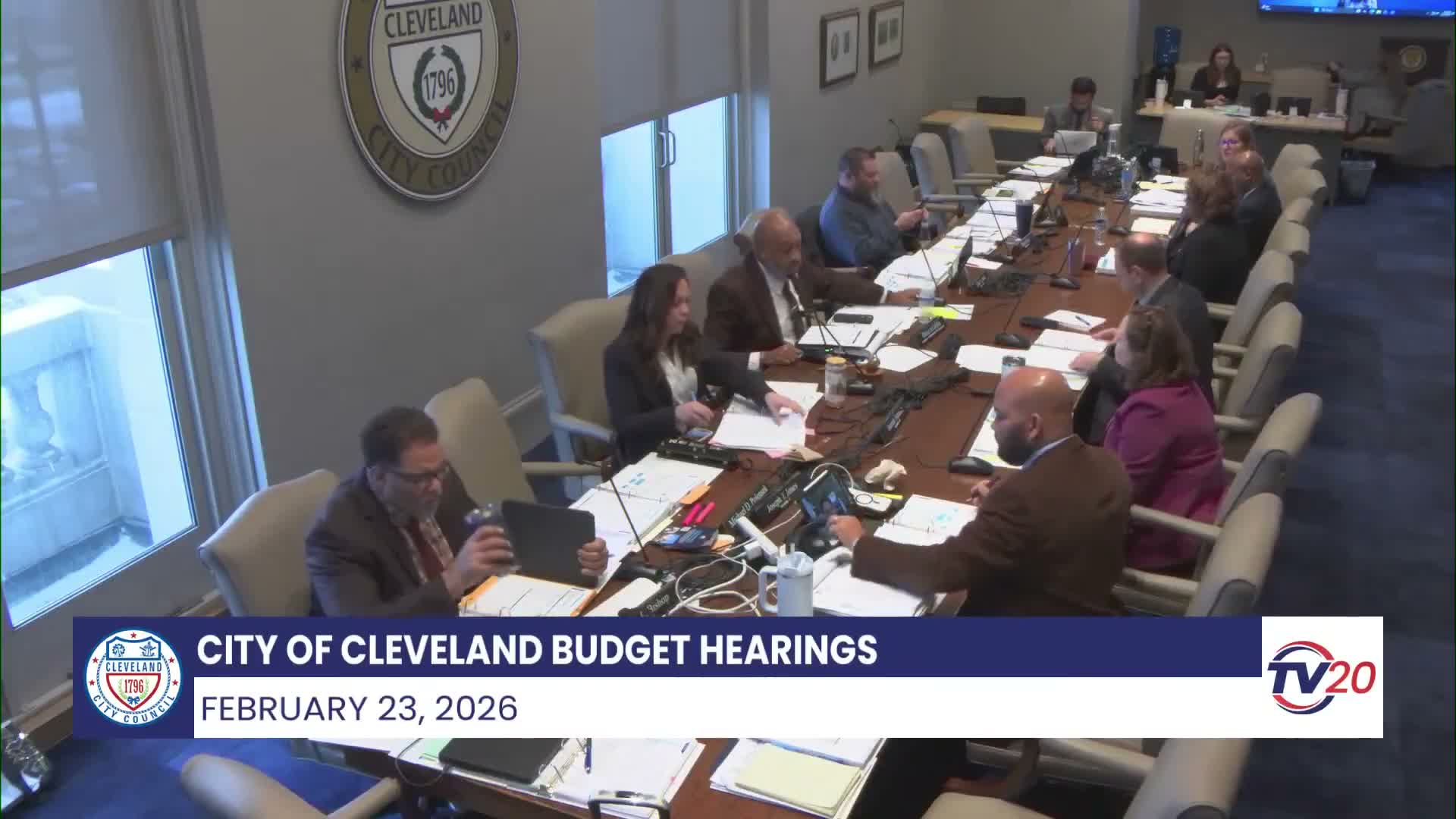
Summary
City officials presented the Department of Innovation & Technology's 2026 budget and priorities — including a governance-first AI rollout, continued cybersecurity work, an expanding 3‑1‑1 call operation and questions about telephone-exchange billing and surveillance cameras.
Cleveland City Council’s finance committee reviewed the Department of Innovation & Technology’s 2026 budget and operations, hearing officials outline priorities ranging from AI governance and cybersecurity to 3‑1‑1 customer service improvements and citywide camera maintenance. The department presented budgeted totals of $25,440,175 for Innovation & Technology (total expenditures, 2026) and $12,066,276 for the telephone exchange/3‑1‑1 internal service fund.
The department’s interim chief innovation and technology officer, Liz Crowe, told the committee the office now comprises three units: information technology services, the 3‑1‑1 nonemergency call center and Urban Analytics & Innovation. "We were reorganized in early 2025," Crowe said, framing the goals for integrated systems and data-driven performance metrics.
Roy Wilson, director of the Office of Information Technology and Services, described a cautious "crawl, walk, run" approach to adopting artificial intelligence. "We are looking at establishing a very robust governance," Wilson said, adding the city plans to begin with employee productivity tools such as Microsoft Copilot and to phase in larger large-language-model pilots after governance and data readiness are in place. He also emphasized work to meet Ohio requirements for cybersecurity under recent state guidance and to complete Workday implementations with HR and Finance.
Kate Warren, director of 3‑1‑1, described the call center’s workload and service model. "Using 3‑1‑1 is a way for residents of the city to be civically engaged," Warren said. She told councilors that 3‑1‑1 handled nearly 150,000 phone calls in 2025, producing roughly 50,000 service tickets; the most common reports were missed waste pickups and waste-cart concerns. Warren said 3‑1‑1 operates 24/7 and provides language access through a vendor language line.
Council members pressed for detail on multiple budget lines and operations: why telephone-exchange revenue appears as a large number, how charges are allocated back to departments, and how training and staffing for 3‑1‑1 are funded. Finance staff explained that telephone exchange is an internal service fund that rebills other departments and is intended to net near zero; the revenue *recorded* supports telephone-exchange operations and the associated costs are reflected elsewhere in operating budgets.
On infrastructure and public-safety systems, technology leaders reported the city has deployed about 100 license‑plate readers through the Flock program and maintains roughly 3,338 video-surveillance/security cameras citywide. Officials said their operational target is about 95% uptime; recent storms briefly increased the number of cameras reported out of service.
Council members also renewed a recurring request for constituent case-management tools. Crowe said 3‑1‑1 was designed as a ticketing and routing system, not a council office case-management platform, and advised council offices to define precise requirements if they want an independent system. "It is council’s decision to choose a case management system," Crowe said, adding the administration can support architecture and integration discussions and pursue a procurement if council directs it.
Next steps: staff agreed to provide ward‑level dashboards and call‑volume breakdowns accessible on the city’s Open Data portal, and to deliver a clearer breakdown of telephone/circuit and hosting fees on request. Several council members signaled they will press for follow‑up briefings on AI ethics, camera maps by ward, and options for a council-focused constituent management system.
The finance committee took no formal vote during the presentation; budget reconciliation and follow-up reports were scheduled for subsequent committee meetings.