Get Full Government Meeting Transcripts, Videos, & Alerts Forever!
Get email alerts on the Water Management topic
No spam. Unsubscribe anytime.
Nye County hearing on Basin 162 water transfers highlights local concern and no formal county action
Summary
At a lengthy public hearing, the Nye County Water District defended moving pumpage from the north to the south end of Basin 162 to protect wells while vowing to oppose solar development; residents raised metering, trucking and cumulative‑use concerns. The commission took no formal action but directed staff to draft letters and return.
Daniel Weeks, general manager of the Nye County Water District, told commissioners at the Dec. 3 meeting that the district supports redistributing pumpage within Basin 162 — shifting extra withdrawals to the valley’s south end — to reduce drawdown near heavily used wells in the north. He said the district funded a Basin‑162 groundwater model grant and has pressed for consistency among state and county planning documents; he noted the board “does not support 162 solar development” while urging the state engineer to allow pumpage relocation if it will happen regardless.
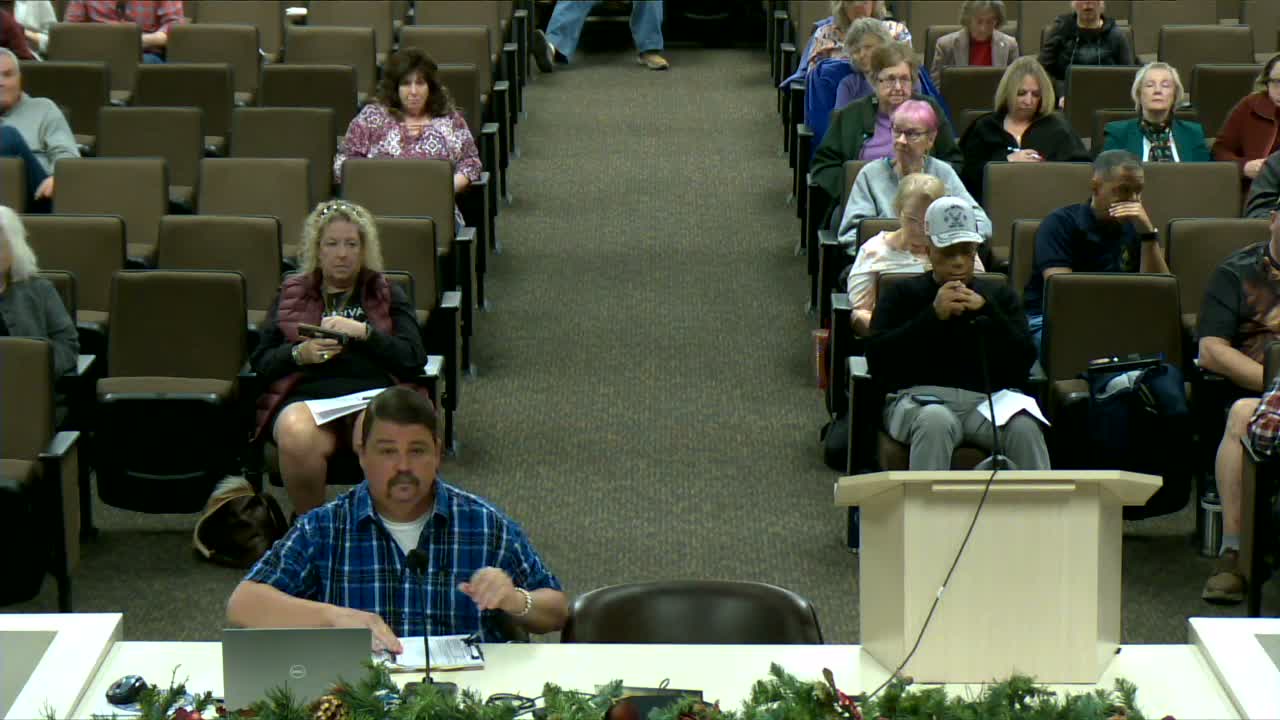
The presentation and subsequent public hearing drew dozens of residents. Heather Gang asked the district to explain apparent discrepancies on the state engineer’s website about where individual temporary applications would move water. Mike Fender and other speakers pressed for meters and quarterly reporting on water use for wells intended to supply commercial projects, saying they could not find clear usage records online. Several speakers warned trucking water from the north to the south would increase wear on county roads and questioned whether transfers would increase total pumpage rather than merely relocate it.
Public Works director Tom Bowling confirmed that agricultural, municipal and many quasi‑public wells are metered and that monthly reporting is required for those meters; he said staff were advising landowners to install meters on wells associated with temporary applications. Weeks and commissioners described the district’s strategy as a “lesser‑of‑two‑evils” approach: if the state engineer will approve legal water uses, the county prefers pumping where long‑term impacts are lower.
Commissioners acknowledged substantive public concern and debated whether to send a letter supporting or opposing the state engineer’s handling of the temporary applications. A motion to direct staff to prepare a letter declining to support the state engineer’s request was made and discussed; a later motion to support the Water District’s recommendation was also moved. The board ultimately recorded no formal, final action on the item and directed staff to prepare language and return at a later date.
Next steps: staff will draft proposed correspondence and options for a follow‑up hearing; the state engineer’s timetable and any DWR determinations remain the controlling administrative steps for temporary water applications.