DHS details plan for Medicaid community engagement hours, soft launch and vendor outreach ahead of 2027 implementation
Loading...
Summary
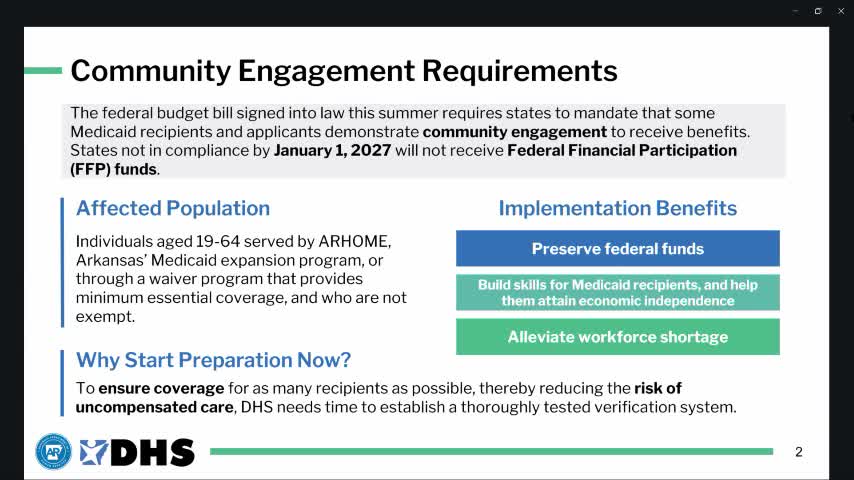
DHS told the subcommittee that Medicaid community engagement requirements apply to expansion recipients, will require roughly 80 hours a month of work or equivalent activities for many adults aged 19–64, and that DHS plans ex parte verification, a soft launch in July and procurement of an outbound verification vendor.
Mary Franklin and DHS staff told a legislative subcommittee that Medicaid community engagement requirements created by recent federal legislation will apply to the state's expansion Medicaid population (referred to in testimony as "Our Home" and "Arkansas Health and Opportunity for Me"). Franklin said the rule will generally apply to individuals ages 19–64, require approximately 80 engagement hours per month in employment, education, training or community service for nonexempt recipients, and must be implemented by Jan. 1, 2027.
DHS described a three-part verification strategy: first, maximize ex parte verification by checking existing data sources (including SNAP records and other administrative data) before asking clients for proof; second, require clients to submit verification where data are insufficient; and third, engage a customer service center vendor (currently out for bid) to perform outbound phone, text and email outreach when additional documentation is needed. Franklin said DHS plans a soft launch starting in July to check data sources and notify clients about their status before penalties take effect in January 2027.
Franklin listed likely exemption categories, including disabled veterans, caregivers, pregnant and postpartum women and individuals with medically complex conditions that prevent work. She said DHS will develop optional medical forms to streamline reviews of medical exemptions but will not require a single form. The department is also working with the state longitudinal data system and other partners to expand ex parte verification.
Legislators raised concerns about the July–January preparation window and whether clients in smaller communities can find work or verified volunteer opportunities in time. Franklin said DHS will run communications, stakeholder meetings and a media campaign modeled on the recent "unwinding" outreach, and that county staff plus vendor partners will help reach clients. She emphasized that federal guidance from CMS is still evolving and DHS will adjust implementation rules when full guidance arrives.
DHS committed to provide landing‑page materials and communication toolkits to legislators and agreed to continue working with committee members to ensure outreach reaches rural and hard‑to‑serve areas.