Get Full Government Meeting Transcripts, Videos, & Alerts Forever!
Get email alerts on the SB 1510 Enrolled Agent Parity topic
No spam. Unsubscribe anytime.
Committee hears support for enrolled‑agent parity as part of omnibus SB 1510
Summary
Witnesses urged the Senate Finance and Revenue Committee to adopt the dash‑2 amendment to SB 1510, arguing federal oversight of enrolled agents obviates Oregon’s separate state exam and that other sections of the omnibus bill address film incentives, cargo‑container property tax rules and a two‑year pass‑through tax extension.
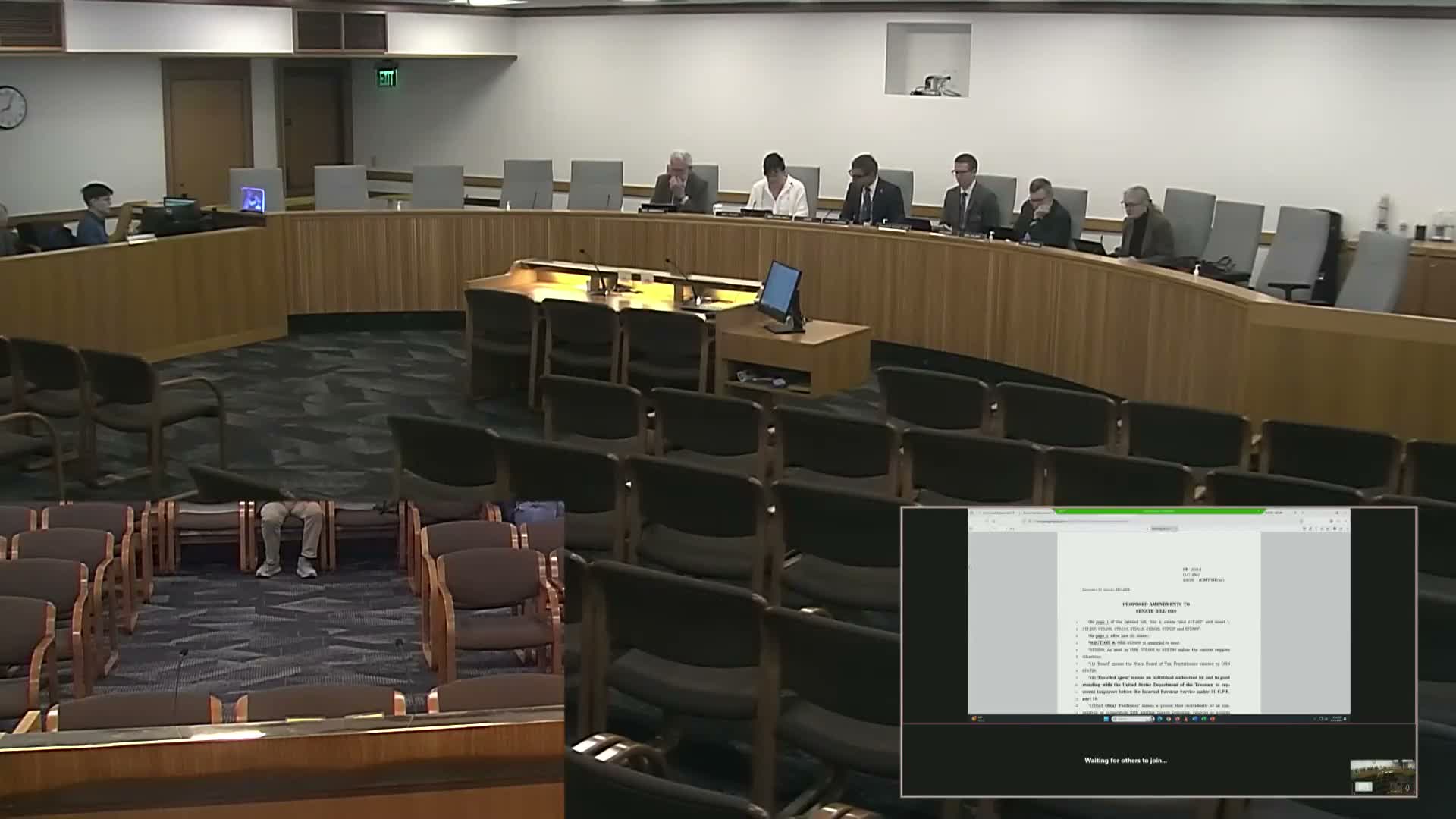
The Senate Committee on Finance and Revenue heard testimony Feb. 6 on Senate Bill 1510, an omnibus tax measure that includes a dash‑2 amendment to recognize federally‑licensed enrolled agents (EAs) under state law and other provisions touching corporate tax definitions, film incentives, property‑tax exemptions and a temporary extension of the pass‑through business alternative income tax.
Kyle of the Legislative Revenue Office gave an overview of the bill’s structure. He said the introduced bill updates Oregon statutory references to new federal terminology for global intangible low taxed income (GILTI), makes corrective changes to the earned income tax credit provisions, broadens one film‑production incentive auction to include commercials, and includes property‑tax exemption rules and annual filing requirements. The dash‑1 and dash‑2 amendments add a six‑year sunset extension for cargo‑container exemptions, tribal fuel‑license tax language, a two‑year extension of the pass‑through business alternative income tax, and registration requirements for enrolled agents with the State Board of Tax Practitioners.
A majority of public witnesses supported the dash‑2 amendment. Adrian Stinson, an enrolled agent and small‑business owner, said federal oversight ‘‘is designed specifically for tax preparation and taxpayer representation’’ and that duplicative state licensure ‘‘does not meaningfully increase consumer protection, but it does reduce access to qualified professionals.’’ Cody Key, another enrolled agent, said Oregon is an outlier in requiring a separate state exam for EAs and that removing redundant licensing would ‘‘protect consumers and support small businesses while maintaining strong oversight and accountability.’’ Donna Byrne, a licensed attorney and enrolled agent, said the change would let EAs train and supervise employees without the current state exam barrier.
National and professional groups also testified. Megan Killian of the National Association of Enrolled Agents said the dash‑2 amendment aligns Oregon with national practice and permits enrolled agents to represent taxpayers before the Oregon Department of Revenue. Joyce Chang (California Society of Enrolled Agents) emphasized that Treasury Circular 230 already imposes continuing education and ethics standards on EAs.
Other provisions drew separate support. Jeff Newgard of the Smart Growth Coalition asked the committee to correct a statutory apportionment reference tied to GILTI so the law matches the 2019 policy decision; Mark Landauer of the Oregon Public Ports Association urged support for extending the cargo‑container property‑tax exemption under ORS 307.835 to keep Oregon ports competitive; and Tim Williams of the Oregon Film and Video Office supported adding commercial production to a film incentive program to broaden tools for retaining and attracting production.
The committee closed the public hearing on SB 1510 without taking a vote and moved to public hearings on other bills.
The measure remains at the public‑hearing stage; next steps will depend on amendments the committee chooses to adopt or introduce.