Get Full Government Meeting Transcripts, Videos, & Alerts Forever!
Get email alerts on the Measure 110 topic
No spam. Unsubscribe anytime.
Audit: Measure 110 invested nearly $800 million but structural weaknesses and data gaps limit assessment; OHA outlines implementation steps and disputes some of
Summary
A Secretary of State performance audit concluded Measure 110 invested roughly $800 million but found leadership turnover, data limitations and uneven local implementation undermined results; OHA agreed with three recommendations, disagreed with three, and described Submittable, ROADS and a contingency fund as part of its response.
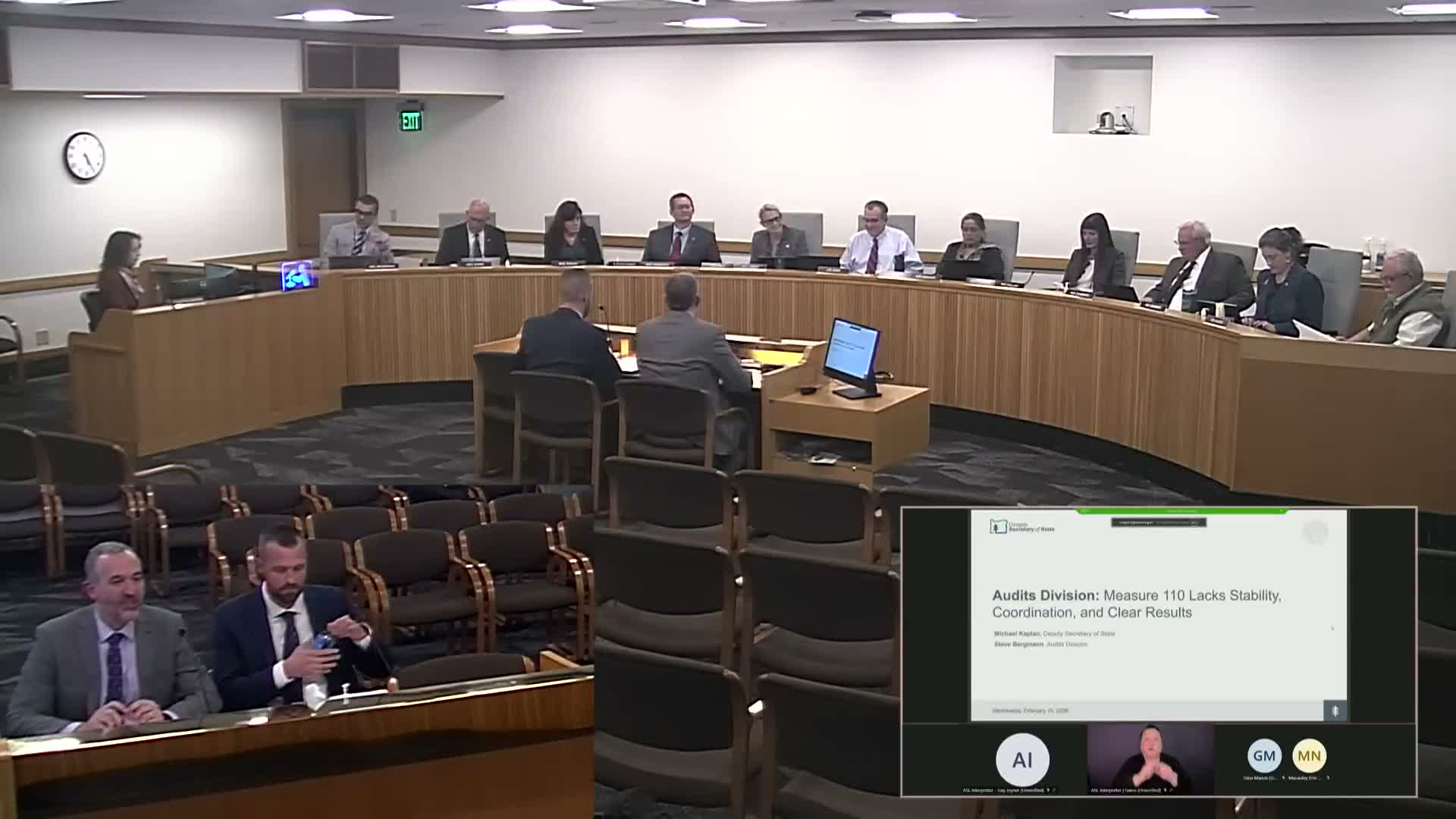
A Secretary of State performance audit presented Tuesday to the Joint Legislative Audit Committee concluded that Measure 110'funded programs received nearly $800 million since 2021 but persistent structural and data problems have limited evaluation of program outcomes.
Audits Division Director Steve Bergman told the committee the December 2025 audit examined Measure 110 implementation at the Oregon Health Authority from 2021 through July 2025 and found that leadership turnover, unclear project management and multiple legislative changes hindered effective implementation. "Despite these investments, our audit found that the program has not delivered on its promise," Bergman said.
The audit cataloged four primary weaknesses: leadership and implementation failures early in the program; a lack of strategic integration with Medicaid and other systems that left Measure 110 services isolated; flawed or missing data that limit the state's ability to measure outcomes; and inconsistent deflection programs across counties producing inequitable access.
Bergman said Measure 110 has channeled nearly $800,000,000 to Behavioral Health Resource Networks (BRNs) since 2021, including $391,000,000 in 2025 alone, and that the audit issued six recommendations to improve program effectiveness. OHA agreed with recommendations 1 (develop an implementation roadmap), 2 (clarify culturally specific service definitions) and 3 (standardize interim data reporting), and disagreed with recommendations 4 (retrospective baseline analysis using proxy data), 5 (publish a yearly performance report against a retrospective baseline) and 6 (build data-sharing infrastructure as articulated in the audit).
OHA witnesses said they are taking steps to address many audit concerns. Ebony Clark, OHA's behavioral health director, and Abby Stamp, OHA's BRN executive director, described a project manager assigned to roadmap work, commitments to publish a public dashboard and operational changes to standardize reporting. Stamp said Submittable is the established grant-management platform for interim reporting and that ROADS (Resilience Outcomes Analysis and Data Submission) will collect deeper, client-level information; OHA said providers will begin reporting on ROADS in July 2026.
Gina Mason, who identified herself as part of OHA's data systems team, said Submittable and ROADS flow into OHA's data environment and that Snowflake is used as a reporting platform. "It's not a data silo," Mason said.
On disagreements with the audit, OHA argued that a valid retrospective baseline or proxy-data study is exceptionally difficult because existing systems cannot reliably isolate Measure 110'funded services from the broader substance-use-disorder continuum, and because pandemic-era data disruptions and other program changes limit comparability. Erin McAuley of OHA's Office of Health Analytics told the committee that looking forward at ROADS data and clarified variables is the most viable path.
Budget volatility was also a central concern. Committee members asked how OHA will manage potential declines in cannabis tax revenue that help fund BRNs. OHA said it had established a contingency fund to manage forecast dips; officials first referenced a $17,000,000 figure for the contingency and later a presenter corrected that the contingency figure is $7.5 million and that the amount changes with forecast updates.
Legislators pressed for specifics about the standardized interim data reporting (what systems, what metrics, and where to find the reports). OHA said the audit and its report contain detail on the required metrics, that Submittable has nearly two quarters of data from the current grant cycle that began July 1, 2025, and that ROADS reporting and a public dashboard are under development for later this year. OHA also told the committee a legislative data report will be released in April 2026.
The committee closed the Measure 110 informational meeting with staff noting a scheduled 18-month audit follow-up under the new policy and invitations for OHA to return with additional data and implementation updates.