Get Full Government Meeting Transcripts, Videos, & Alerts Forever!
Get email alerts on the Audit Division topic
No spam. Unsubscribe anytime.
Secretary of State auditors outline sharper focus on core audits and new follow-up policy
Summary
Audits Division leaders told the Joint Legislative Audit Committee the division has refocused on core financial, performance and IT audits, implemented a formal recommendation follow-up policy (effective 07/01/2025), and expects to follow up on performance/IT recommendations 6 months after corrective-action dates or 18 months after publication.
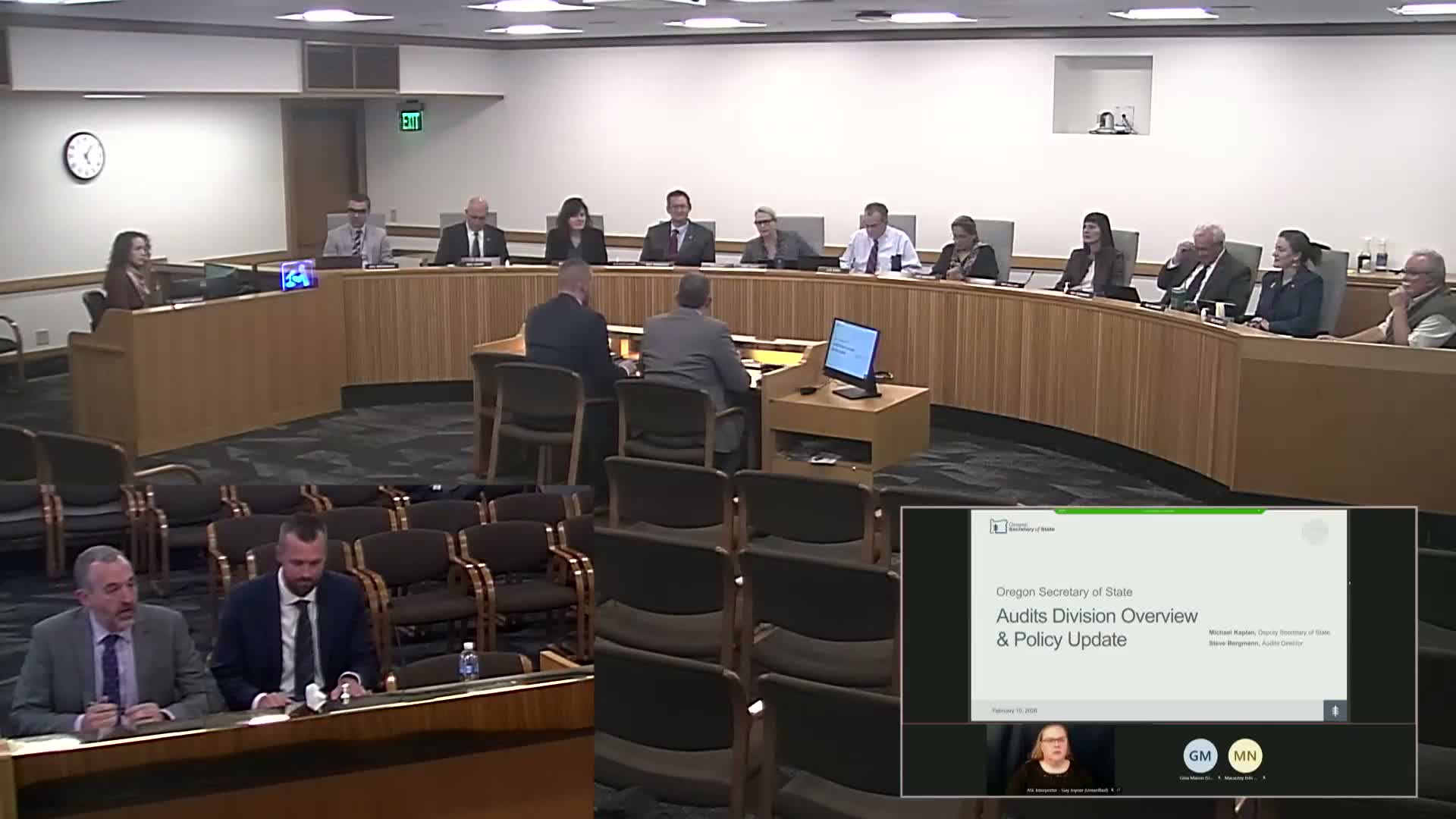
The Joint Legislative Audit Committee heard an overview Tuesday of the Secretary of State Audits Division's retooled priorities, staffing and a new audit recommendation follow-up policy.
Deputy Secretary Michael Kaplan and Audits Division Director Steve Bergman told the committee the division has refocused its work to improve audit quality and public accountability after leadership turnover in 2025. Bergman said the division now has 72 staff and is funded largely by assessments billed to state agencies (about 90 percent) with the remainder through direct-bill arrangements; municipal audits are funded through continuous appropriation under ORS 297.
"We are committed to excellent performance by improving our skills and competence within our staff," Kaplan said.
Bergman walked the committee through recent operational changes: a new risk methodology for selecting performance audits, discontinuation of noncore projects (including an in-house analytics server and an in-house municipal audit reporting system), and a renewed emphasis on core financial, performance and IT audits. Bergman said this year's annual comprehensive financial report audit involved work at 27 separate agencies and 271 accounts; auditors identified 40 audit adjustments totaling $2,400,000,000. He also noted the state received $20,700,000,000 in federal funding in fiscal 2024, underscoring the scope of federal compliance work.
The division has formalized an audit recommendation follow-up policy that took effect July 1, 2025. Under the policy, performance and IT audit recommendations will be followed up either six months after a corrective-action plan's implementation date or 18 months after report publication, whichever is sooner. If recommendations remain unimplemented, the division will follow up annually and publicly report results; the division will notify the Legislative Fiscal Office before follow-up engagements as required by statute.
"We will still follow up on recommendations when an auditee disagrees, and we will publicly report our results," Bergman told the committee.
Lawmakers asked procedural questions about the audit process. Bergman confirmed draft reports are shared with agencies before publication, and agencies typically have five to 10 working days to respond to draft findings and proposed facts. He stressed that auditors aim to report objective interpretations of statute and that disagreements with agencies are escalated to the legislature for oversight.
Committee members also asked about the division's funding model and whether the Legislative Fiscal Office can handle follow-up work; Kaplan said the division would not comment on LFO capacity but offered to work with LFO as needed.
The co-chairs closed the informational meeting and scheduled a follow-up discussion of the division's risk methodology at the committee's next session.
The committee recessed after the briefing; staff said the division would present additional policy details, including the annual keeping Oregon accountable report, at future meetings.