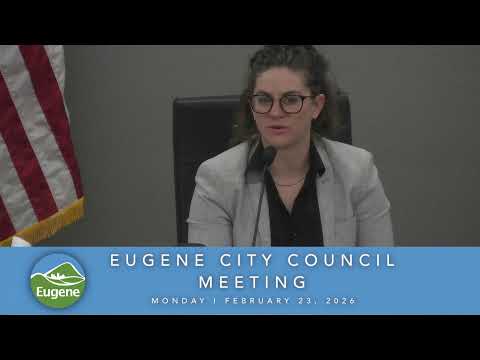
Council approves utility bond measures, adopts longer investment horizon and designates municipal court as court of record
Loading...
Summary
On Feb. 23, the Eugene City Council approved resolutions authorizing electric and water utility revenue bond sales, adopted revisions to the city investment policy to extend maximum portfolio maturity, and adopted an ordinance making municipal court a court of record; all actions carried by recorded votes.
The Eugene City Council on Feb. 23 approved a package of administrative and financial actions, including authorizing utility revenue bond sales, adopting a revised investment policy and approving an ordinance designating the municipal court as a court of record.
At the start of the meeting the council approved Consent Calendar 1, which included resolutions authorizing the issuance and sale of electric utility system revenue bonds (about $113,000,000 requested for electric projects, including the Carmen Smith hydro generation project) and water utility system revenue bonds (about $218,000,000 requested for water projects including Willamette Treatment Plant work and College Hill Reservoirs). Deborah Hart, identified in the meeting as EWEB’s assistant general manager, and Aaron Balmer, identified as EWEB’s finance manager, described the proposed projects and said proceeds would fund capital projects and some refunding for interest savings. The consent calendar motion passed unanimously (vote recorded as 8–0).
City Manager introduced changes to the city’s investment policy recommended by the Investment Advisory Board and reviewed by the Oregon Short Term Fund Board. Staff said the revisions extend the portfolio maximum maturity from 3 years to 5.25 years and broaden the permitted sources of environmental, social and governance (ESG) ratings on corporate debt to allow additional third parties. Council voted to adopt the updated investment policy (vote recorded as 8–0).
Council also considered an ordinance to make the Eugene Municipal Court a court of record, adding a new code section and citing the relevant state statute identified in the meeting materials. The council moved to adopt the ordinance and the recorded vote was reported as 8–2–0. The meeting minutes did not identify which members cast the recorded dissenting votes.
Council staff closed the business portion of the agenda and opened the scheduled public comment period; the remainder of the meeting consisted of 23 public comments on a range of topics.
Actions recorded: the bond resolutions were approved as part of Consent Calendar 1 (vote 8–0); the investment policy revision was adopted (vote 8–0); the municipal court ordinance was adopted (reported vote 8–2–0).