Get Full Government Meeting Transcripts, Videos, & Alerts Forever!
Get email alerts on the Emergency Management topic
No spam. Unsubscribe anytime.
House Emergency Management and Veterans Committee advances several bills, refers funding questions to Ways and Means
Summary
The House Committee on Emergency Management and Veterans on Feb. 12 advanced multiple emergency-preparedness and veterans-related bills, adopting technical and funding amendments and referring most measures to the Joint Committee on Ways and Means for budget review.
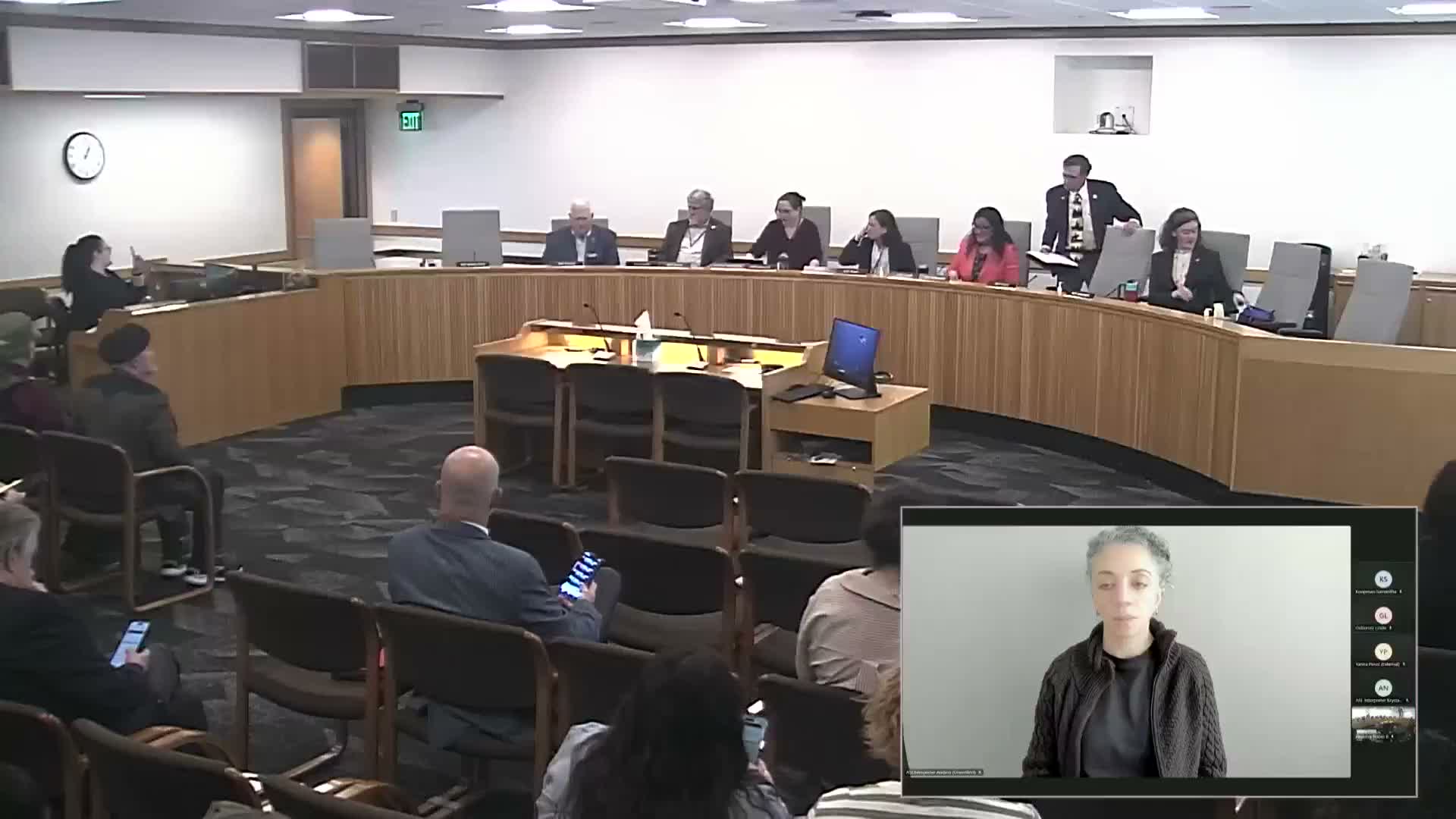
SALEM, Ore. — The House Committee on Emergency Management and Veterans advanced a slate of emergency-preparedness and veterans-related measures on Feb. 12, approving amendments and sending the bills to the Joint Committee on Ways and Means for funding review.
Committee staff summarized each measure before members voted. LFO staff told the committee House Bill 4,091 would bar another state’s militia or armed forces from entering Oregon to perform military duties unless approved by the governor or while in federal active-duty status; staff reported no fiscal or revenue impact. The committee voted to move HB 4,091 to the House Committee on Rules after members said an expected amendment had not been filed in time.
House Bill 4,032 directs the Oregon Department of Energy to evaluate and prioritize geographically dispersed emergency fuel sites; members adopted a dash-1 amendment that adds a $250,000 appropriation for the department and then referred the bill to Joint Ways and Means with a due-pass recommendation.
Lawmakers also moved House Bill 4,033, which transfers responsibility for the Oregon Volunteers in Disaster (ORVID) database from the Higher Education Coordinating Commission to the Oregon Department of Emergency Management and declares the measure an emergency effective on passage. Chair Tran said knowing volunteer locations matters for deployment, stating, “Knowing where the volunteers are will save lives.” The committee adopted the dash-1 amendment that removes a requirement for OEM to establish prescribed collaboration procedures, and officials said the bill will go to Ways and Means for funding.
The committee adopted two amendments to House Bill 4,044, which would establish an Office of Resilience and Emergency Management within the Department of Human Services and create an Oregon Individual Assistance program. One amendment renames and clarifies the individual assistance program; a second (dash-5) appropriates $500,000 to the Oregon Department of Emergency Management to stand up program operations. Representative Graber cautioned that creating new offices should not “bifurcate emergency management” in ways that weaken the overall institution.
Members considered House Bill 4,100, a proposal that would require owners or operators of bulk oil and liquid fuel terminals to obtain a certificate of financial responsibility from the Department of Environmental Quality. The dash-3 amendment substantially changed provisions related to self-insurance and removed an earlier standby trust-fund requirement. During discussion, Logan Gillis of DAQ said, “I believe the concern was of local preemption,” and indicated that the advisory board’s composition remained unchanged; committee members noted counties had not submitted a suggested amendment addressing preemption concerns.
The committee also moved House Bill 4,121, creating statewide emergency-preparedness offices and authorities, and House Bill 4,132, the 2026 Oregon Veterans Services supplemental investments initiative (effective July 1, 2026). The dash-1 amendment to HB 4,132 removed provisions related to an employer incentive fund and a school-district unfunded-liability fund; Representative Evans criticized some stakeholders’ handling of last-minute submissions but the committee adopted the amendment and referred the bill to Ways and Means.
In a public hearing and work session, members adopted House Concurrent Resolution 201 to honor the Oregon Fire District Directors Association (OFDDA) on its anniversary and to recognize decades of volunteer service by fire district directors. State Fire Marshal Mariana Reese Temple congratulated the association, and Chief Ben Stange of Polk County Fire District No. 1 urged continued collaboration and training support for districts.
Votes at a glance: • HB 4,091 — Referred to House Committee on Rules (motion passed; decision recorded by roll call; tally not specified in the transcript). • HB 4,032 (as amended, dash-1; $250,000 appropriation) — Referred to Joint Committee on Ways and Means (due pass). • HB 4,033 (as amended, dash-1; emergency) — Referred to Joint Committee on Ways and Means (due pass). • HB 4,044 (as amended, dash-2 and dash-5; $500,000 appropriation) — Referred to Joint Committee on Ways and Means (due pass). • HB 4,100 (as amended, dash-3) — Referred to Joint Committee on Ways and Means (due pass). • HB 4,121 (as amended) — Referred to Joint Committee on Ways and Means (due pass). • HB 4,132 (as amended, dash-1; effective 07/01/2026) — Referred to Joint Committee on Ways and Means (due pass). • HCR 201 — Adopted to the floor with do-adopt recommendation (recorded by roll call; tally not specified in the transcript).
What’s next: Most measures were referred to the Joint Committee on Ways and Means for funding and prioritization; bills that included emergency declarations or appropriations will require Ways and Means review before final enactment. The transcript records roll-call recordings for votes but does not provide complete tallies in every instance.