Get email alerts on the Energy Transmission Interconnection topic
No spam. Unsubscribe anytime.
Committee backs narrower path for co‑located clean energy projects, adopts HB 4,076 dash‑1
Summary
The House Climate, Energy and Environment Committee heard public testimony and adopted the dash‑1 amendment to House Bill 4,076, which creates a narrow pathway for 'surplus interconnection' projects to receive Energy Facility Siting Council goal compliance if they can connect within 2 miles of an existing facility; the measure was moved to the floor with a do‑pass recommendation.
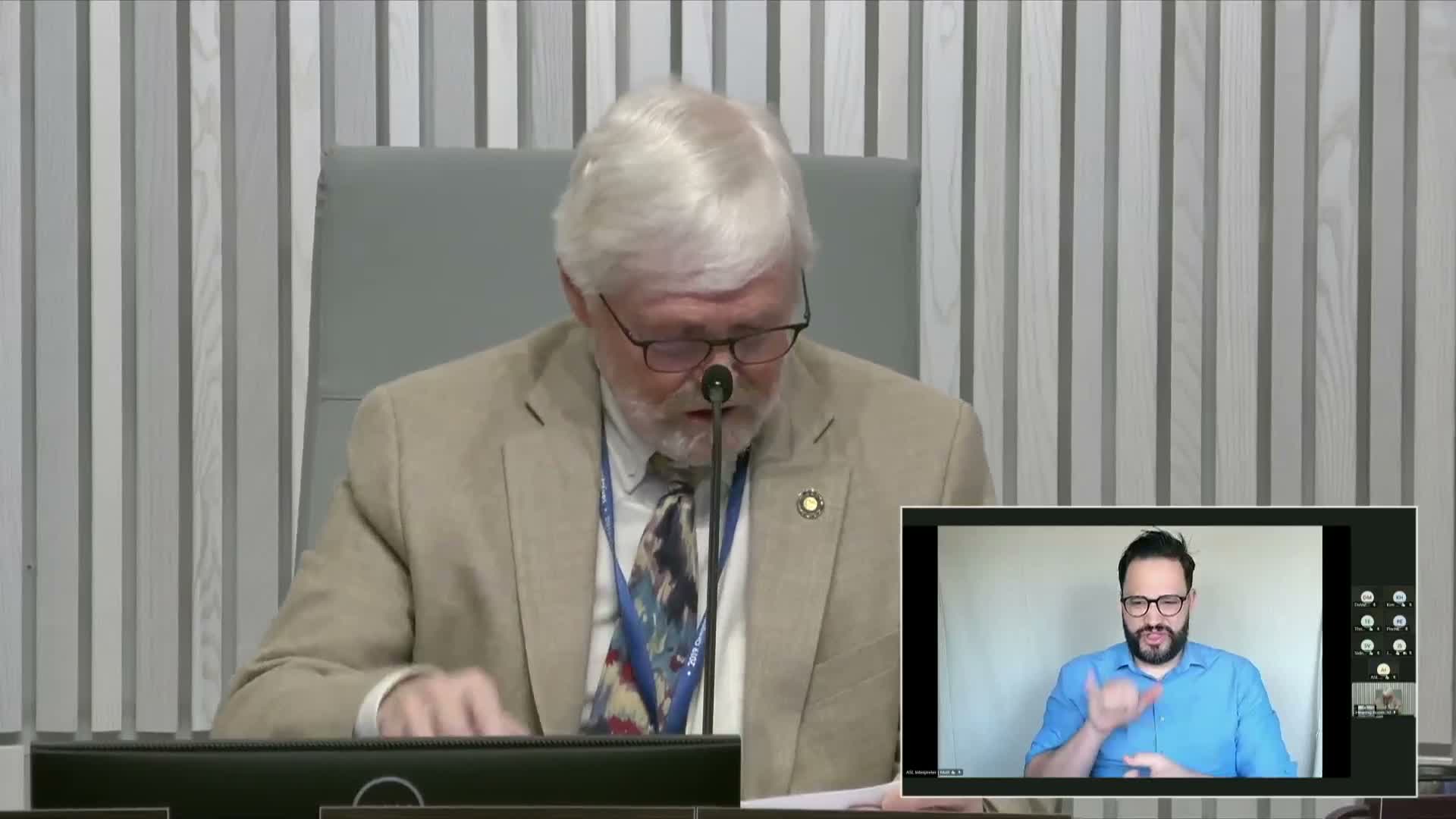
The House Climate and Energy Committee on Thursday considered House Bill 4,076, a measure that would let certain new solar and storage projects use underutilized interconnection capacity at existing energy facilities and obtain Energy Facility Siting Council (FSEC) goal compliance if they do not require transmission lines more than 2 miles from an existing certified site. Chair Lively opened the public hearing and the committee later adopted the bill’s dash‑1 amendment and moved the measure to the floor with a do‑pass recommendation.
Scott Bolton, representing Bright Knight Power, testified in support, saying the dash‑1 amendment ‘‘allows more room to work with’’ and gives developers ‘‘a little bit longer [to] maneuver’’ so projects can avoid sensitive farmland or wildlife habitat while using existing interconnection points. Bolton described surplus generation as a way to co‑locate solar and batteries at an existing interconnection to ‘‘raise the capability of clean generation and add more quicker into Oregon’s system’’ and argued it can lower costs by making better use of existing transmission instead of building new lines.
Diane Brandt, policy and legislative affairs director at Renewable Northwest, urged support as well, saying the amendment provides ‘‘a reasonable pathway for alleviating these pressure points’’ in permitting and interconnection that slow projects. Brandt told the committee HB 4,076 ‘‘does not circumvent the FSEC process’’ and that projects would still undergo the usual standards review and public participation.
Sydney Villanueva, testifying for the Northwest and Intermountain Power Producers Coalition, said the bill aligns Oregon’s siting framework with federal policy including FERC’s recent direction to make surplus interconnection available so storage and co‑located resources can interconnect more quickly.
Jacob Stevens, CEO of New Sun Energy, registered targeted opposition and urged technical drafting changes so the rule would not create ‘‘hyper‑narrow winners’’ that favor incumbent utilities. Stevens recommended allowing other demonstrations of existing transmission capacity (for example, signed interconnection agreements or county‑permitted projects) to qualify so that competition is preserved.
Committee members asked technical questions about how large surplus projects could be on the ground, whether the change is temporary, and whether county projects would be eligible. Scott Bolton said project footprints would vary and that the amendment does not change other siting considerations such as neighbor impacts or environmental review. Representative Helm asked whether the amendment applies to county projects; Bolton replied it applies to the FSEC site‑certificate amendment process.
After discussion and several members urging that language be broadened slightly in the Senate to include additional project types, the committee adopted the dash‑1 amendment without objection and voted to move HB 4,076, as amended, to the floor with a do‑pass recommendation. Chair Lively said he would carry the bill to the floor.
The committee’s action sends the narrowly tailored change to the next stage of consideration; proponents said it would help speed low‑cost clean resources onto the grid by better using existing interconnection capacity, while opponents urged drafting fixes to protect competition and broaden eligibility. The committee record shows the public record and roll calls for each motion in the transcript.
AI generated
The text on this page is AI generated. Summaries, highlights, analysis, and video transcripts are all produced from the original source material.
AI can make mistakes, so if you spot one, and we will fix it for everyone.
Note: the source content is unaltered by us. Any content source we link to, be it a video, an audio recording, or a document, is presented exactly as its publisher released it. That publisher is usually a government body, sometimes an individual official or another organisation.