Get Full Government Meeting Transcripts, Videos, & Alerts Forever!
Get email alerts on the Criminal Justice Sentencing topic
No spam. Unsubscribe anytime.
DOC urges statutory clarity after Torres Lopez ruling that altered credit-for-time‑served calculations
Summary
At an informational hearing, the Oregon Department of Corrections detailed how the Torres Lopez Supreme Court decision forced a review of ~11,000 judgments, produced 388 eligible credit determinations, and left dozens of people either returned to custody or with remaining time. DOC asked the Legislature to codify processes for consistent credit calculations and limited authority to retake custody in cases of erroneous releases.
The Oregon Department of Corrections told the House Committee on Judiciary that a July 2025 Oregon Supreme Court decision (Torres Lopez) narrowed the agency’s interpretation of how courts can order credit for time served, and that retroactive application of that ruling required DOC to review roughly 11,000 judgments to determine eligibility.
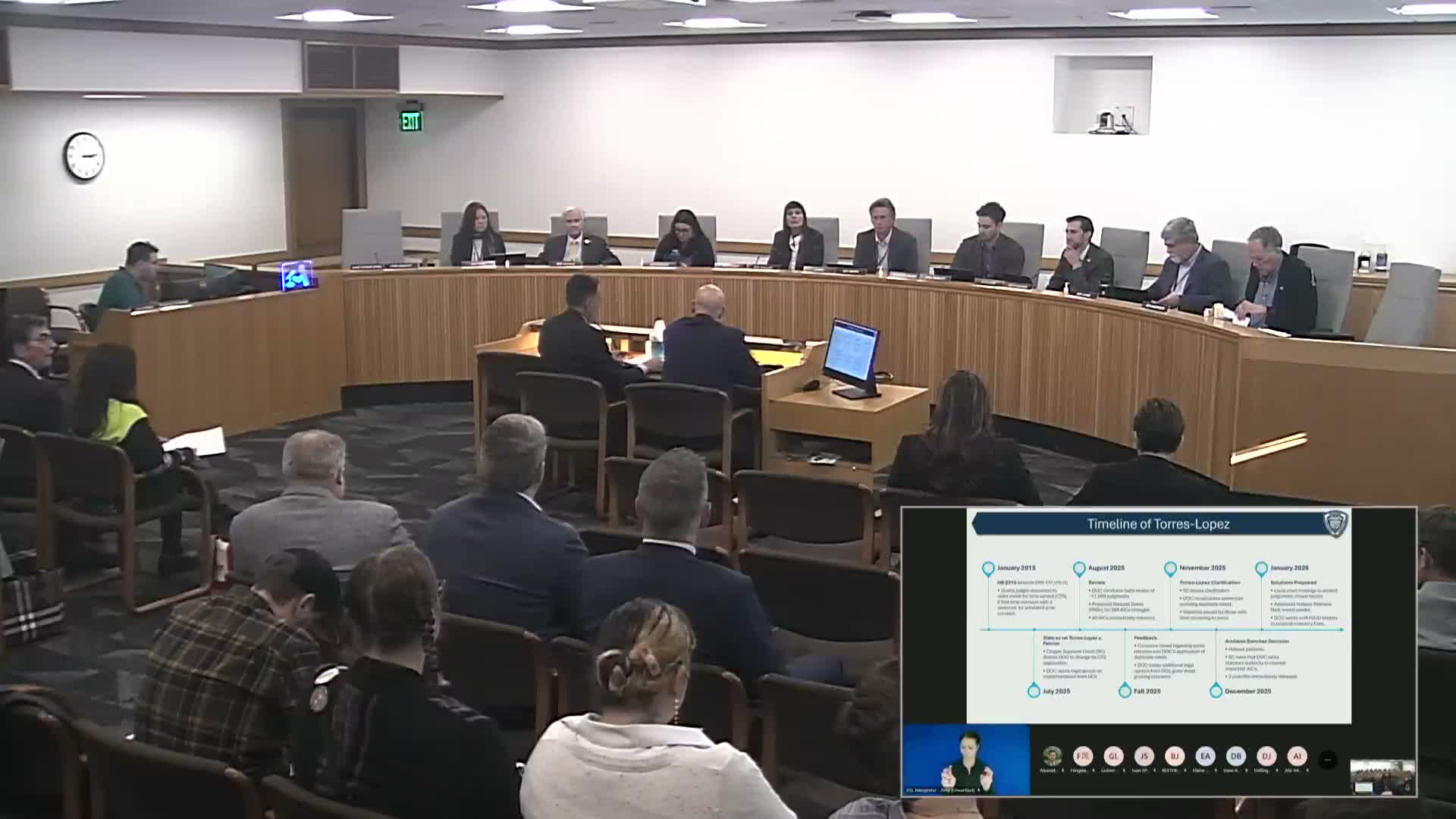
"We learned, via the Torres Lopez decision, that DOC took a narrower interpretation than was intended," Director Mike Reese said, framing the hearing as a request for legislative help to provide certainty in sentence calculations and return processes. Assistant Director Larry Bennett walked members through DOC’s timeline: a 2015 statutory change led DOC to award unrelated credit when apparently ordered by a sentencing document, then recent court guidance narrowed that approach and prompted a large‑scale review.
Bennett said the review identified 388 individuals who were eligible under DOC’s interpretations. DOC issued warrants in cases where it believed people had been released in error (about 37–38 warrants), and 22 people were brought back into custody before subsequent habeas petitions led to releases in a number of cases. "In the 6 habeas cases that were filed, the Supreme Court ordered that DOC release these individuals immediately, and we did so," Bennett said. He added that one habeas petition was denied and that person remained in custody.
Committee members pressed DOC on language such as "released in error," with members noting that at the time DOC relied on prevailing legal interpretation. Reese and Bennett said appellate disagreement—from some courts siding with DOC to the Supreme Court's later clarity—created individualized outcomes and legal uncertainty. DOC described current counts as about 12 people returned and 18 people in the community with time left on their sentences; some of the returned individuals have habeas proceedings pending.
DOC asked the committee for statutory clarity in three areas: (1) a narrowly tailored mechanism to bring people back into custody when a written judgment unambiguously orders additional credit or shows an administrative error; (2) explicit authority for courts to correct ambiguous judgments; and (3) codified expectations for communication among courts, DOC, prosecutors and victims so credit calculations are consistent going forward. DOC said the draft bill includes a 30‑day buffer so the process would not be initiated for people with less than 30 days remaining.
The informational hearing closed without a committee vote; staff said the committee would consider possible legislative language to provide the requested certainty.