Get Full Government Meeting Transcripts, Videos, & Alerts Forever!
Get email alerts on the Immigration Enforcement topic
No spam. Unsubscribe anytime.
Sonoma County Truth Act forum: Sheriff defends policies as residents press for sanctuary ordinance
Summary
At a Truth Act community forum, Sheriff Ingram said Sonoma County provides less ICE information than the public would receive and that two 2024 transfers to ICE followed judicial warrants; dozens of residents urged the Board to adopt a non‑collaboration/sanctuary ordinance and demanded greater transparency about enforcement funding.
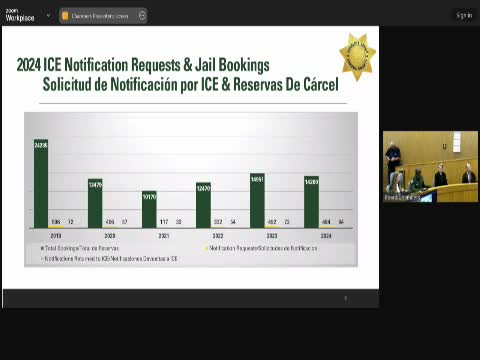
Sheriff Aaron Ingram told the Sonoma County Board of Supervisors and a packed public forum that the sheriff’s office provided information to Immigration and Customs Enforcement on 64 of 484 requests in 2024 and transferred two people to ICE in 2024 — transfers he said were the result of federal judicial warrants. ‘‘We do not collaborate with ICE,’’ Ingram said, adding the office ‘‘give[s] ICE less information than we would give any member of the public.’’
The forum — convened to meet Truth Act requirements and explain how local law enforcement interacts with ICE — drew repeated public pleas for a sanctuary or non‑collaboration ordinance. Dozens of residents, service‑providers and advocates described fear among immigrant families and urged the Board to use its budget authority and other tools to limit cooperation with federal immigration enforcement. ‘‘The hypocrisy has to end,’’ said Alegria de la Cruz, a litigator and daughter of farmworkers, calling on supervisors to ‘‘lean into your power’’ on behalf of immigrant neighbors.
Why it matters: California law requires a public forum when a local law enforcement agency gives ICE access to individuals in custody. The session is a transparency measure — not a decision meeting — but it became a venue for residents to press the Board for policy changes and for supervisors to explain legal constraints on directing an independently elected sheriff.
What the sheriff reported: Ingram presented what he described as the sheriff’s more restrictive local policy, explaining deputies ‘‘shall not inquire into an individual's immigration status’’ and that the department will not hold people on federal immigration detainers absent a judge’s warrant. He summarized 2024 data cited in the presentation: 14,260 jail bookings, 484 ICE information requests, 64 instances where the department provided information, and two transfers to ICE that year tied to federal warrants. The sheriff said the majority of cases involved male individuals and listed the crime types and age ranges reported in the department’s slides.
Public demands and concerns: Public commenters repeatedly urged the Board to act, with calls for a formal non‑collaboration ordinance and for transparency about how narcotics‑unit funds are spent. Speakers raised personal stories and community impacts — from children afraid to attend school to workers worried about raids during harvest — and pressed the Board on whether budgetary leverage could be used to influence the sheriff. ‘‘Please agendize a sanctuary ordinance prohibiting the sheriff and all agencies in the county from providing any information to ICE or any federal agency in the absence of a judicial warrant,’’ one commenter demanded.
Board response and limits: Board members acknowledged community fear and expressed sympathy while noting legal limits. Deputy county counsel had earlier told the Board that, as a general law county, Sonoma County has restricted authority over independently elected officials; one counsel quote summarized an Attorney General opinion noting the Board ‘‘has no power to perform county officers’ duties for them or to direct the manner in which those duties are performed.’’ Several supervisors said they will pursue non‑legislative actions the Board can take from the dais, such as expanded employee education about rights, strengthened partnerships with nonprofits and clearer public communications.
Federal pressure and litigation: Vice Chair Hermosillo and other supervisors cited recently reported federal appropriations for the Department of Homeland Security — a figure quoted in discussion as ‘‘$165,000,000,000’’ — and the potential for increased ICE staffing. Sheriff Ingram said California sheriffs have received letters from the federal administration asking for information and that some letters threatened litigation or other consequences. Chair Hopkins and county counsel said Sonoma County is already pursuing legal responses and will continue to litigate to protect county authority and residents’ rights.
Procedural action: Early in the meeting the Board approved the evening’s agenda by motion; the procedural vote carried unanimously.
What’s next: The Board did not adopt any ordinance at the forum. Supervisors said the discussion would continue in future sessions and that staff will follow up with steps to educate county employees, improve community outreach, and coordinate with legal counsel on pending federal demands.
— Reporting by public comment and Board statements at the Sonoma County Truth Act forum. The forum included a sheriff’s presentation of 2024 Truth Act data, an extended public comment period, and subsequent board discussion; no ordinance or binding policy change was adopted at the meeting.