Get Full Government Meeting Transcripts, Videos, & Alerts Forever!
Get email alerts on the Planning Process topic
No spam. Unsubscribe anytime.
Riverside County planning staff outline reforms to general‑plan amendment cycle; residents push back
Summary
At a Feb. 4 workshop, Riverside County planning staff proposed eliminating the 8‑year foundation general plan amendment cycle, disbanding the GPAC advisory body, adding 10 eligibility screen questions, and extending deadlines for implementing projects. Dozens of residents urged keeping the cycle or adding safeguards and stronger notice.
Riverside County planning staff presented proposed reforms to the Foundation General Plan Amendment (FGPA) process at a Feb. 4 Planning Commission workshop and drew extensive public comment that was largely skeptical of sweeping changes.
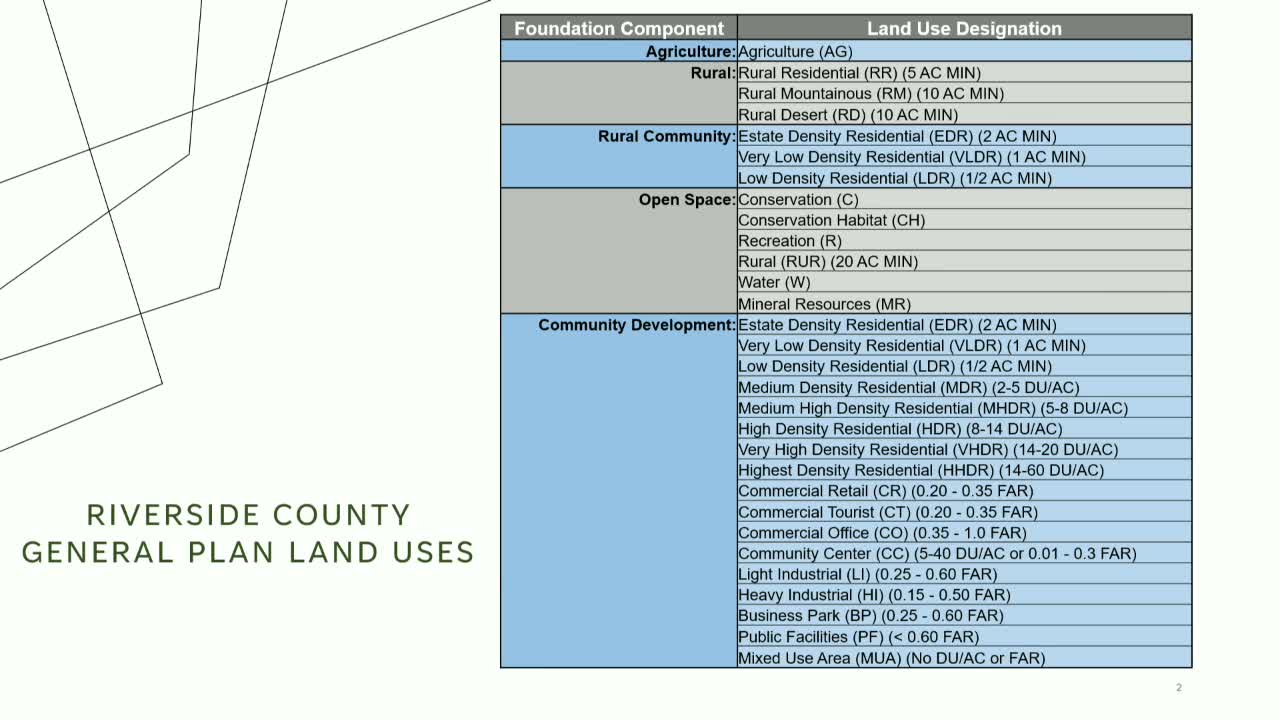
John Hildebrand, the county planning director, outlined a package that would eliminate the current 8‑year batching cycle for foundation changes, remove the General Plan Advisory Committee (GPAC) hearing body, consolidate GPA types from five to three, and add a set of 10 eligibility screening questions applicants would answer at initiation. Hildebrand described the changes as intended to reduce administrative bottlenecks created when dozens of proposals arrive at once, to better align county practice with state housing law and RHNA obligations, and to give decision makers more upfront information about constraints such as utilities, access and habitat conservation compatibility.
Under the proposal, initiation would remain a preliminary, non‑project stage; staff said initiation would not change zoning or authorize construction. Hildebrand also proposed extending the timeframe for applicants to file a required implementing project from six months to one year with a possible six‑month extension to give developers time to assemble consultants and technical studies.
The presentation listed the 10 eligibility considerations that applicants would address at initiation: the presence of similar nearby developments; adequate primary/secondary access; availability of utilities (water, sewer, power); fire‑severity zone and mitigation needs; whether the site is in a policy overlay or special district; sphere of influence or airport influence areas; biological constraints including MSHCP/criteria cells; whether the site lies within an agricultural preserve subject to diminution; the county’s 7% conversion limit on ag areas; and other constraints staff consider relevant.
More than two dozen speakers commented. Residents and community councils from Sky Valley, the Temecula wine country and Mead Valley urged retaining the 8‑year cycle and the GPAC or, if the county shortens the cycle, adopting stronger safeguards. Speakers cited inadequate noticing, limited local infrastructure (no sewer or reliable power in some areas), the burden on volunteers and small communities to monitor frequent filings, and the risk of piecemeal conversion of open land to industrial uses in disadvantaged neighborhoods.
"Foundation component changes are not routine. They are the most consequential land‑use decision this county makes," said one Temecula wine‑country speaker, arguing the 8‑year structure and GPAC were intended to prevent speculation and sprawl. Multiple commenters called for expanded notice (larger radii and longer lead time), required outreach to MACs and community councils, and explicit environmental‑justice or healthy‑community screenings.
Conservation and some planning advocates offered conditional support. Dan Silver of the Endangered Habitats League said he would not oppose removing the foundation cycle provided the eligibility tests and findings remain robust; he recommended limiting foundation changes to proposals that demonstrably advance one of three goals: community centers, basic employment structure, or rural/open‑space protection.
Industry representatives supported change. Lou Monville of the Riverside County Building Industry Association said the 8‑year cycle can conflict with state housing law and that reform could help deliver housing while still accommodating habitat conservation and infrastructure planning.
Hildebrand acknowledged the public concerns and pledged additional outreach, including district‑level workshops, and a review of noticing rules. He proposed aligning FGPA noticing with other project notice practices and a minimum 20‑day notice period consistent with many CEQA thresholds, and said applicants already pay noticing costs. Commissioners asked staff to strengthen eligibility findings, ensure community engagement through MACs or community councils, and consider carrying over extraordinary‑circumstance findings into the revised findings to preserve general‑plan integrity.
The workshop produced no formal action. Staff said they would revise the proposed language and return for additional workshops and hearings after further outreach.