Get Full Government Meeting Transcripts, Videos, & Alerts Forever!
Get email alerts on the Procurement topic
No spam. Unsubscribe anytime.
Board debates lowering job‑order contracting limits and increases transparency steps; continues review
Summary
A lengthy workshop on the county Contract Policy Manual focused on job‑order contracting (JOC), A&E task orders, term lengths, and sole‑source rules. Staff proposed more transparency while departments warned lower caps could delay projects; the board asked staff to return with revised language.
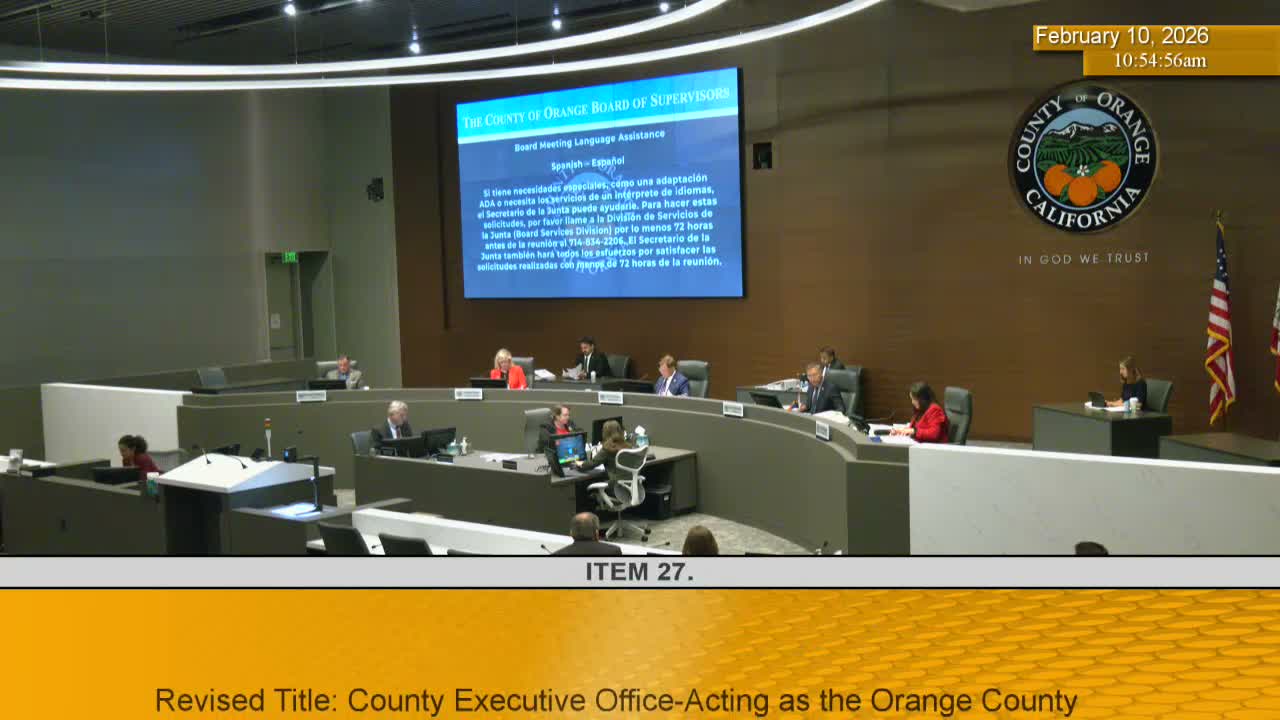
The Board of Supervisors held an extended workshop on revisions to the county Contract Policy Manual that would change thresholds and term limits for job‑order contracting (JOC) and architect/engineer (A&E) task‑order programs.
Jacob Johnson, vice president of government affairs for Gordian (a vendor for JOC programs), told the board that reducing contract limits "will almost certainly not be helpful to Orange County or the taxpayers it serves," arguing JOC saves time and administrative cost. (Public comment, SEG 1777‑1847.)
County procurement officer Maria Grama outlined the history of the county's JOC program (adopted formally in 2015 after a pilot) and legal counsel William Ning explained the legal framework for A&E qualifications and JOC selection under the Public Contract Code (SEG 1974‑2004). Ning told the board that architecture and engineering contracts must use qualifications‑based selection under the Brooks/Minneapolis wording cited in the meeting and that JOC is governed by Public Contract Code section 20,128.5.
Department directors including Brian Wade (Sheriff's Department) and Kevin Onuma (Public Works) said the current thresholds provide flexibility to respond quickly to maintenance needs and that lowering caps could force more frequent board approvals and longer delays. Wade said some projects could take 6 to 18 months longer if departments had to rebid work rather than use the JOC lists, and he described practical constraints such as special background checks for vendors working in secure facilities (SEG 2031‑2060; SEG 2199‑2260).
Several supervisors supported increased transparency and tools to prevent contract splitting and unchecked sole‑sourcing. Proposals discussed included reducing a not‑to‑exceed cap (currently adjusted under Public Contract Code) to a lower standard, setting a task‑order notification threshold (for example, notifying the board of task orders over $1,000,000), shortening contract terms from five to three years in some cases, and requiring more frequent departmental reporting and access to scoring sheets on request.
After hours of testimony and debate, the board moved and subsequently voted to continue the item so staff could return with revised contract‑policy language that reflected the board's direction on reporting, notification, and safeguards to avoid splitting and to ensure oversight.
Next steps: procurement staff will return with recommended text that balances oversight and the departments' need for timely contract execution.
Sources: Remarks from Jacob Johnson (Gordian) SEG 1777‑1847; Maria Grama and William Ning (procurement/legal) SEG 1950‑2008; departmental examples and questions from Brian Wade and Kevin Onuma SEG 2021‑2260; board debate and motion to continue SEG 3710‑3860.