Get Full Government Meeting Transcripts, Videos, & Alerts Forever!
Get email alerts on the Human Trafficking topic
No spam. Unsubscribe anytime.
Orange County leaders mark Human Trafficking Prevention Month, highlight rising youth exploitation and a new UCI data pilot
Summary
County supervisors, nonprofit leaders and researchers marked January as Human Trafficking and Modern Slavery Prevention Month, cited local increases in minor victims and unveiled a UCI data integration pilot intended to identify victims earlier and tailor interventions.
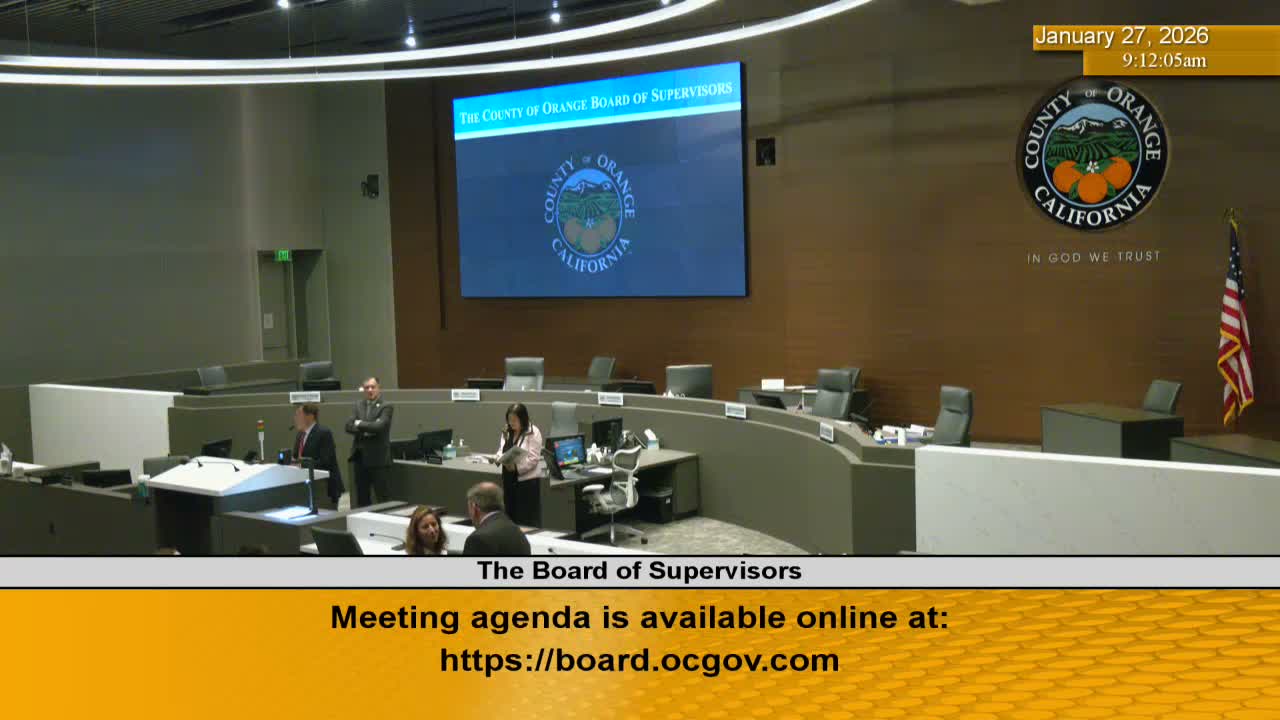
Orange County officials on Jan. 27 recognized National Human Trafficking and Modern Slavery Prevention Month and urged residents to report suspected cases, as county and nonprofit partners described shifts in how trafficking affects younger people and outlined efforts to identify victims earlier.
The board’s chair opened the presentation by defining human trafficking as the deprivation of a person’s liberty for exploitative labor or commercial sex through force, fraud or coercion and cited statewide and global figures. The chair gave the national hotline number, (888) 373-7888, and invited task-force partners to the dais.
Katrina Foley, County Supervisor and vice chair, said the 2026 prevention theme is “connection saves lives,” and urged residents and institutions to strengthen warning‑sign detection and personal networks. “The 2026 theme for human trafficking prevention month is connection saves lives,” Foley said.
Professor Jody Quas, dean of Social Ecology at the University of California, Irvine, described a pilot that integrates cross‑agency data to better understand victim characteristics and shifting patterns of exploitation. “What we’re finding in our county is… the ages of victims is going down for exploitation,” Quas said, explaining that technology‑facilitated exploitation and sextortion are growing concerns.
Reema Nashibi, founder and president of Global Hope 365, said the county task force’s 2025 report shows the share of identified victims who are minors rose from 36% in 2023 to 50% in 2025, a trend she attributed largely to sextortion. Nashibi called for a countywide prevention program and stiffer accountability for buyers and traffickers: “We are thankful for Senator Shannon Grove and Assemblymember Maggie Crowell for AB 379… which has become the law,” Nashibi said, referencing recent state criminal changes.
Nonprofit partners (including Waymakers and the Salvation Army), the Orange County Superior Court and local law‑enforcement representatives were named as task‑force participants; county staff noted that in 2023–24 agencies assisted 411 victims, with roughly half minors, according to the task‑force report read at the meeting. The board encouraged residents who suspect trafficking to call the national hotline or text the hotline number.
There were no policy votes tied to the presentation. Officials said the data pilot’s purpose is to shape targeted prevention and early‑intervention services and to help agencies prioritize youth at greatest risk.
The board moved on to its regular agenda after the presentations; staff said materials and the task‑force report are available through county channels.