
Committee adopts amendment and recommends HB 2418 to rules after debate over local costs
Get AI-powered insights, summaries, and transcripts
Subscribe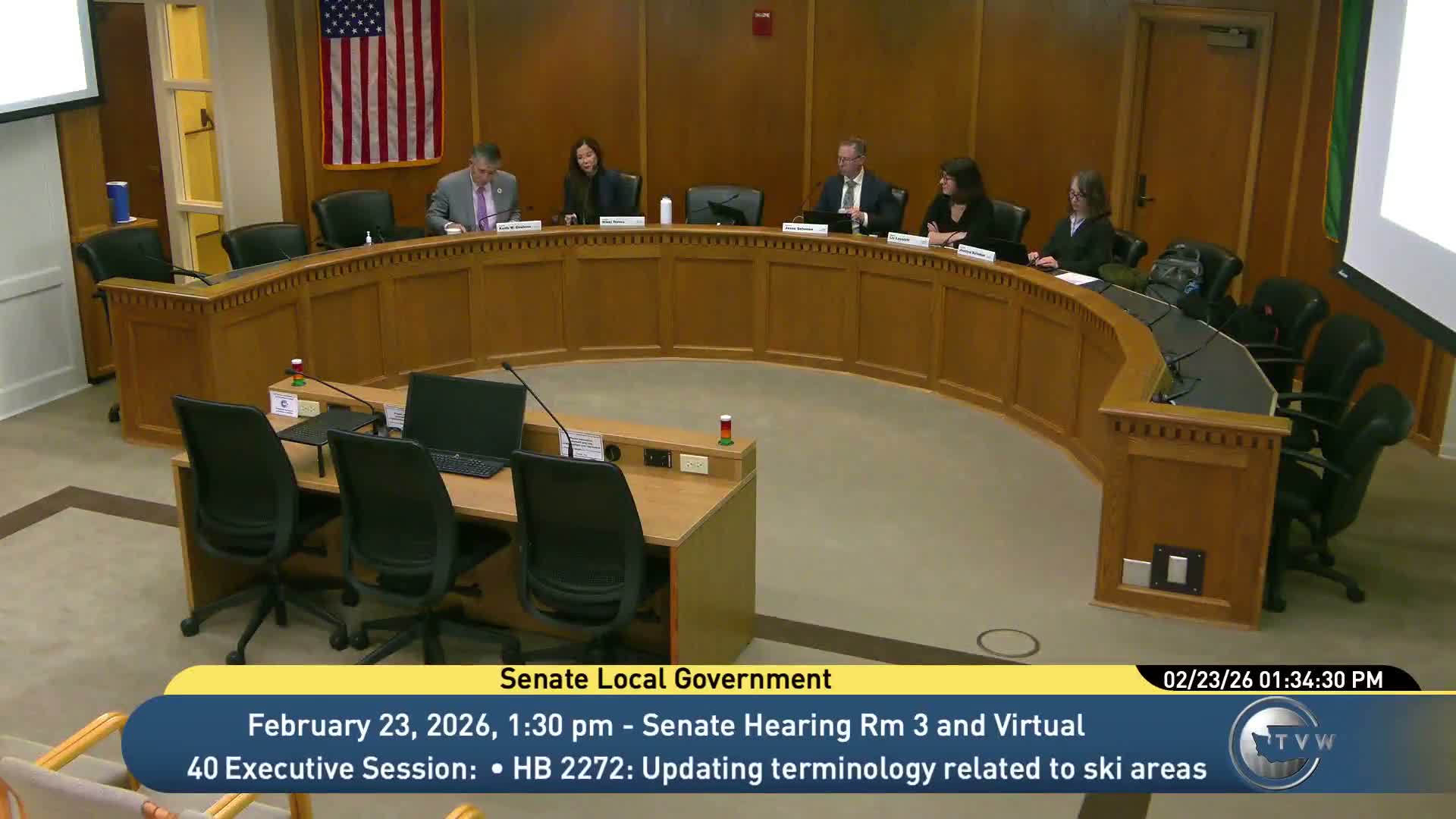
Summary
The Senate Local Government Committee adopted a striking amendment to engrossed second substitute House Bill 2418, which tightens procedural completeness rules for permit reviews, sets business-day review deadlines, and requires refunds if deadlines are missed; the committee passed the bill by voice vote after a senator raised local-government cost and implementation concerns.
The Senate Local Government Committee adopted a striking amendment to engrossed second substitute House Bill 2,418 and recommended the bill to the rules committee by a voice vote. Committee staff described the amendment — offered by Senator Solomon — and the bill's key provisions before debate and voting.
Staff summarized the bill as clarifying that a county or city's determination of procedural completeness is not a substantive review and as requiring certain government entities other than counties and cities to complete reviews of residential project permit applications within specified deadlines. Staff said the bill provides that if a deadline is missed, the government entity must refund 20% of the permit review fee. "The bill specifies that a determination of procedural completeness made by a county or city on a project permit application must be based on whether the permit is procedurally complete and is not a substantive review of the application," a staff member said.
The proposed striking amendment clarifies that a referral to a special purpose district or public utility district is complete when it "includes all materials required to constitute a complete application under the district's adopted procedures," and it replaces some calendar-day timeframes with business-day deadlines — for routine infrastructure extensions and for more complex infrastructure reviews — and modifies single point-of-contact duties while clarifying those designations do not confer independent final-decision authority absent local ordinance.
Staff also described fiscal impacts: the fiscal note on the engrossed version showed general fund state costs of $113,531 in the 2025-27 biennium, nearly $73,000 for the Department of Commerce, about $40,500 for the Department of Ecology, and $100,000 for Commerce in 2027-29; staff reported local government costs of just over $2,000,000 (about $1.8 million in ordinance costs for cities and $270,000 for counties).
Senator Torres said she would be "without rec today" and raised concerns that local governments may need more time and staff to implement the ordinance despite appreciating the collaboration that produced the bill. "I know that there's 2,000,000 in, local government and costs and also an emergency clause on this," Torres said, adding that local governments might not have sufficient staff while updating comprehensive plans. The chair responded that permit review processes are a core local government function and urged support. The committee voted by voice; the chair announced the bill passed subject to signatures.
The committee adopted the striking amendment, moved the bill as amended, and forwarded it to the rules committee for further action.