
CARB outlines Cap and Invest amendments as legislators press for faster action and clarity on allocations
Get AI-powered insights, summaries, and transcripts
Subscribe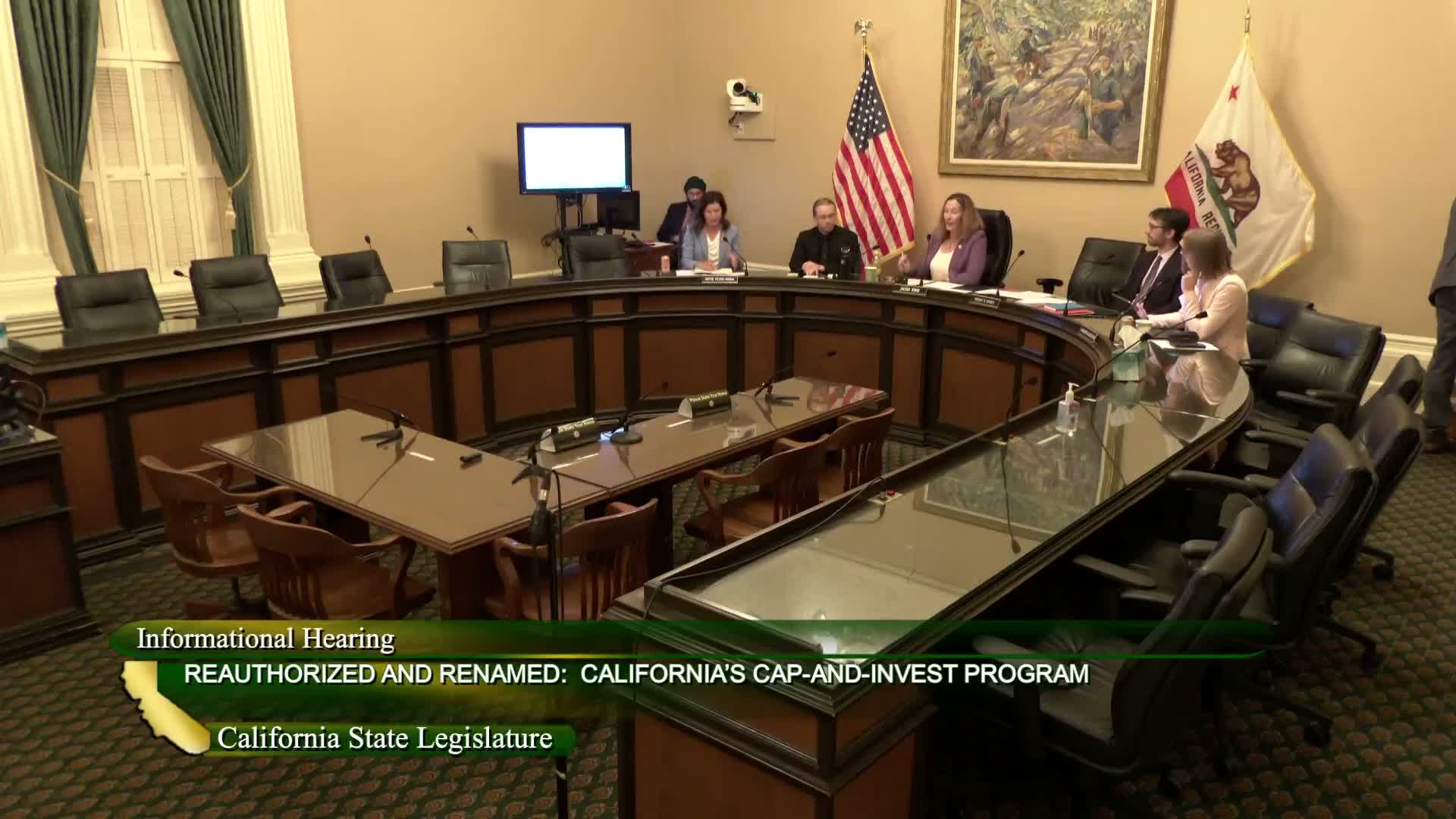
Summary
At a joint legislative hearing, California Air Resources Board officials defended draft amendments to the Cap and Invest program, committing to a May board timeline and describing measures to protect ratepayers while acknowledging trade-offs between allowance allocations for utilities, industry, and the Greenhouse Gas Reduction Fund.
California Air Resources Board officials told a joint legislative committee Feb. 25 that proposed amendments to the state’s Cap and Invest program are intended to uphold the program’s climate goals while protecting household affordability and market stability.
Chair Sanchez and Deputy Executive Officer Reginder Sahota said CARB’s draft updates implement provisions of last year’s reauthorization—Assembly Bill 1207 and Senate Bill 840—and include steps to extend allowance budgeting beyond 2030, retire allowances used for offsets, and transfer free allowances from natural gas utilities to electric utilities to support electrification.
“Cap and Invest has been operating successfully for 13 years with nearly 100% compliance,” Chair Sanchez said, citing the program’s record of meeting California’s 2020 climate target early and directing billions to climate investments and bill credits.
CARB staff presented an economic analysis asserting the overall benefits outweigh costs, estimating $124 billion in compliance costs over 20 years and $180 billion in statewide benefits, including avoided health-care costs. The agency said it aims for a completed rulemaking that would take effect Sept. 1, 2026, and that it will present a final package for board consideration following a public comment period that runs through March 9.
Legislators pressed CARB on timing and market certainty. Senator Stern and others urged staff to meet a May deadline so the market can link reliably with other jurisdictions that are watching California’s timetable. Sahota reiterated CARB’s commitment to the May schedule and said staff have built flexibility into the process to respond to stakeholder input prior to the board vote.
Committee members also asked detailed questions about how the draft handles carbon capture and removal, leakage risk for industry, and accounting for imported fuels. Sahota said SB 905 rulemaking for carbon capture is expected later this year and that the cap-and-invest proposal contains placeholder language recognizing carbon capture and removal while staff continue to refine parameters with project proponents.
On imports and lifecycle emissions, CARB officials explained that cap-and-invest establishes compliance at the point where finished fuels enter California’s economy (the “rack”) and that lifecycle carbon accounting remains the focus of the Low Carbon Fuel Standard and related modeling such as the Opti model. CARB invited use of SB 253 reporting and improved LCFS data to reduce uncertainty about out-of-state production and imports.
CARB emphasized it is seeking to protect ratepayers by allocating free allowances sufficient to cover compliance costs for utilities, while also responding to legislative direction to transition natural gas allowance value toward electricity over time. Staff asked utilities and other stakeholders to submit additional data during the public-comment period if they believe early investments merit a smoothing mechanism in allocation.
The hearing closed with CARB inviting further engagement and the committee moving to a panel of analysts and public commenters to probe technical, economic, and equity implications of the draft.
Next steps: CARB said it will consider comments received by March 9, refine the staff proposal as needed, and bring the rulemaking package to the board in May for potential adoption.