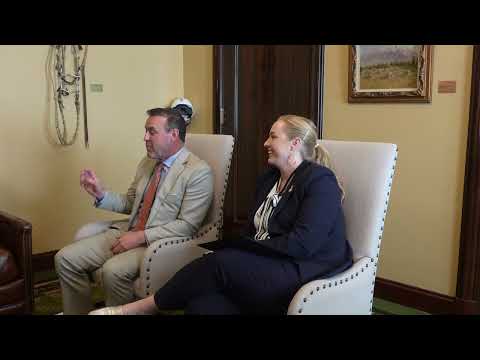
Utah Republican leaders call federal redistricting ruling a setback, explore legal options
Loading...
Summary
House Republican leadership called a three-judge federal ruling on redistricting a "huge setback" for this election cycle and said they are reviewing legal and procedural options while pointing to Proposition 4 as the voter-driven path forward.
Unidentified Representative (Speaker 2) told reporters that the three-judge federal panel ruling on the state's redistricting was "certainly not the end of the road" but described it as "a huge setback for this election cycle." He said leadership is "looking at what the options are" and emphasized that "ultimately...it'll be the people's decision with Proposition 4 being on the ballot."
The exchange opened when a reporter asked whether the federal panel's map would stand for 2026. An unidentified speaker (Speaker 3) pressed whether the court-ordered map would be the map for the election; Speaker 2 acknowledged the potential and criticized Judge Gibson for not allowing an appeal to the state Supreme Court. "We're really disappointed that she's not let that go forward to the Supreme Court to be reviewed," he said, framing reliance on a single-judge decision as problematic for statewide outcomes.
Representative Frugg (identified in the transcript as Speaker 4) distinguished the remedial court process from a full redistricting cycle and argued Proposition 4 does not authorize a judge to draw maps. Frugg said, quoting public-opinion figures cited in the briefing, that "Only 8 percent of Utahns think a judge should actually be the one drawing our maps," and criticized the judge for applying standards she said were not contained in Prop 4 or statute.
Speakers discussed procedural options including whether to seek a three-judge constitutional court review. Speaker 3 noted a filing had been made over the weekend to challenge aspects of the law and to seek transfer to the state constitutional court; Speaker 2 said leadership believes a three-judge review would be faster and provide broader review than a single-judge decision. The group also flagged uncertainty about administrative steps such as whether candidate filing deadlines might be moved; Speaker 2 said "we're having that conversation" but no final decision had been reached.
The briefing included questions about how ongoing litigation interacts with the ballot process: speakers repeatedly distinguished the remedial process for the 2021 map from a full cycle redistricting and said they expect the issue to ultimately be addressed by the state's highest courts. No formal legal action on behalf of the House was announced during the briefing.
Next steps described by speakers included continuing legal review and monitoring filings moved to or challenged before the constitutional court, and the recognition that Proposition 4 — if adopted by voters — would be a separate mechanism that determines how maps are drawn in future cycles.