Get Full Government Meeting Transcripts, Videos, & Alerts Forever!
Get email alerts on the Housing Infrastructure Fund topic
No spam. Unsubscribe anytime.
Business Oregon recommends 11 infrastructure awards from $10M Housing Infrastructure Fund, seeks expenditure limitation
Summary
Business Oregon told a Ways and Means subcommittee it reviewed 31 HIF applications and recommends 11 awards that would obligate the full $10 million in lottery bond proceeds to infrastructure projects enabling an estimated 722 housing units; the agency asked for expenditure limitation to execute contracts after a May 2026 bond sale.
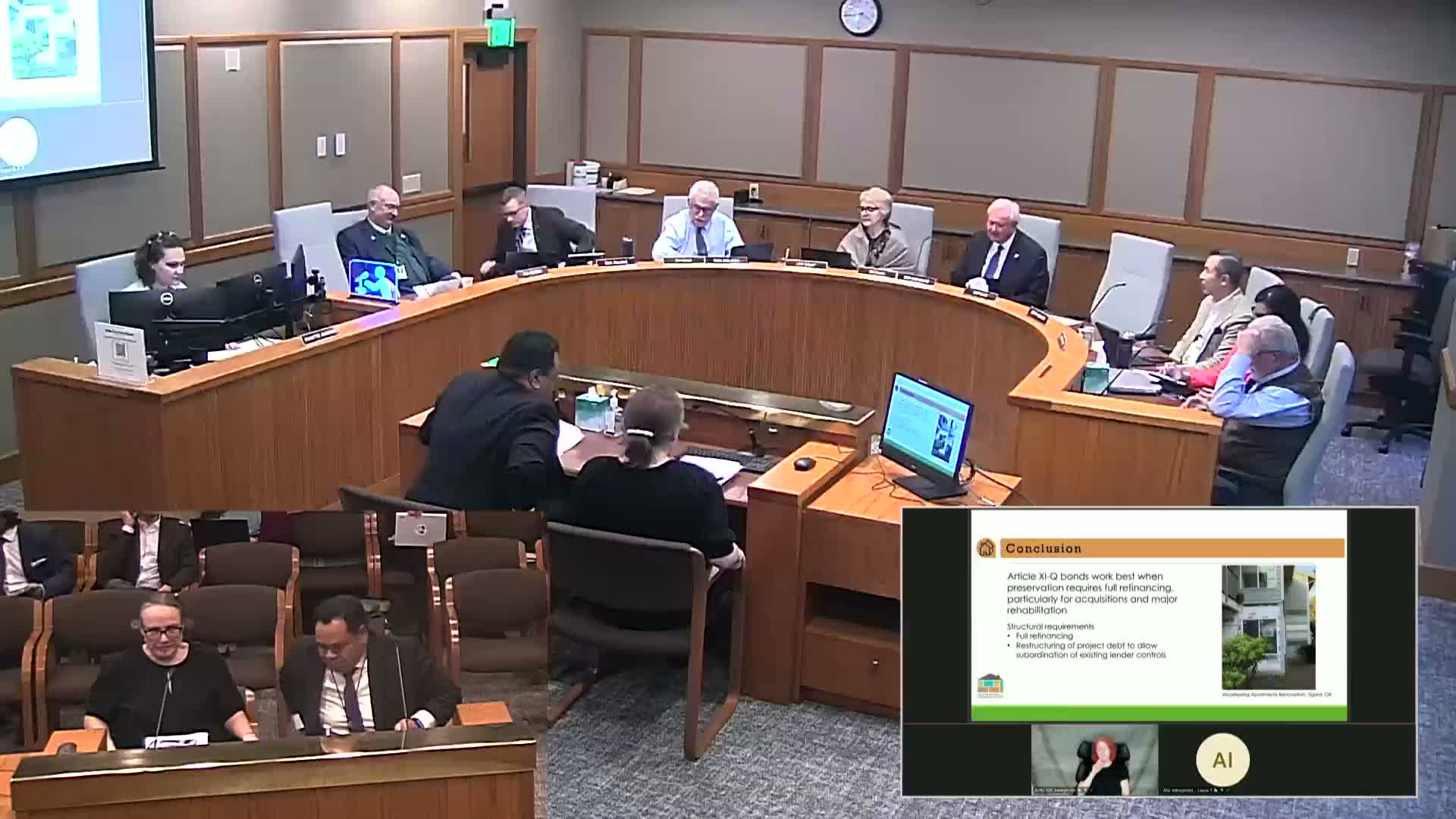
Chris Cummings, deputy director at Business Oregon, and Ed Taber, infrastructure and program services director, presented the agency’s report on the Housing Infrastructure Fund (HIF) to the Joint Ways and Means Transportation and Economic Development Subcommittee on Feb. 12.
Cummings summarized the program’s purpose: to make loans, grants or forgivable loans to municipalities and eligible entities to fund municipal infrastructure tied to housing development — water, wastewater, stormwater and transportation capacity among the eligible uses. He said the 2025 Legislature provided $10,000,000 in lottery bond proceeds for the program and that the bonds are expected to be sold in May 2026.
Taber described the competitive process (RFA open Oct. 17–Dec. 17) and said Business Oregon received 31 applications requesting just over $43,000,000 for infrastructure work. Based on scores and statutory distribution requirements that at least 25% go to communities under 30,000 and another 25% to communities in the next population tier, the agency recommended 11 awards. Taber summarized those recommendations: $3.2 million to projects in jurisdictions under 30,000 (enabling 317 housing units), $2.5 million to jurisdictions between 30,000 and 100,000 (enabling 231 units), and $4.2 million to projects in jurisdictions over 100,000 (enabling 174 units). The total infrastructure cost of the recommended projects is estimated at more than $26.4 million.
Cummings and Taber said the agency limited awards to one project per applicant and identified alternate projects in each population category if an awardee cannot contract. They noted the compressed application timeline likely reduced the number of eligible competitive submissions and that some partially funded projects told staff they can proceed with the reduced award; Business Oregon also said the Infrastructure Finance Authority can offer loan options if applicants need to borrow to cover gaps.
Courtney Rogers (DAS CFO) and Legislative Fiscal Office staff recommended acknowledging receipt. Co-chair Gomberg moved the LFO recommendation to forward the report; the motion carried by a 7–0 vote. Business Oregon asked the subcommittee for an expenditure limitation that would allow the agency to enter contracts with awardees once bond proceeds are available.