Get Full Government Meeting Transcripts, Videos, & Alerts Forever!
Get email alerts on the Affordable Housing Preservation topic
No spam. Unsubscribe anytime.
OHCS says Article 11Q financing can preserve affordable housing but often requires refinancing and state control
Summary
Oregon Housing and Community Services told a Ways and Means subcommittee that Article 11Q general obligation bond loans can support acquisition and rehabilitation to preserve affordable housing, but eligibility usually requires refinancing or state ownership controls rather than small, subordinate repairs.
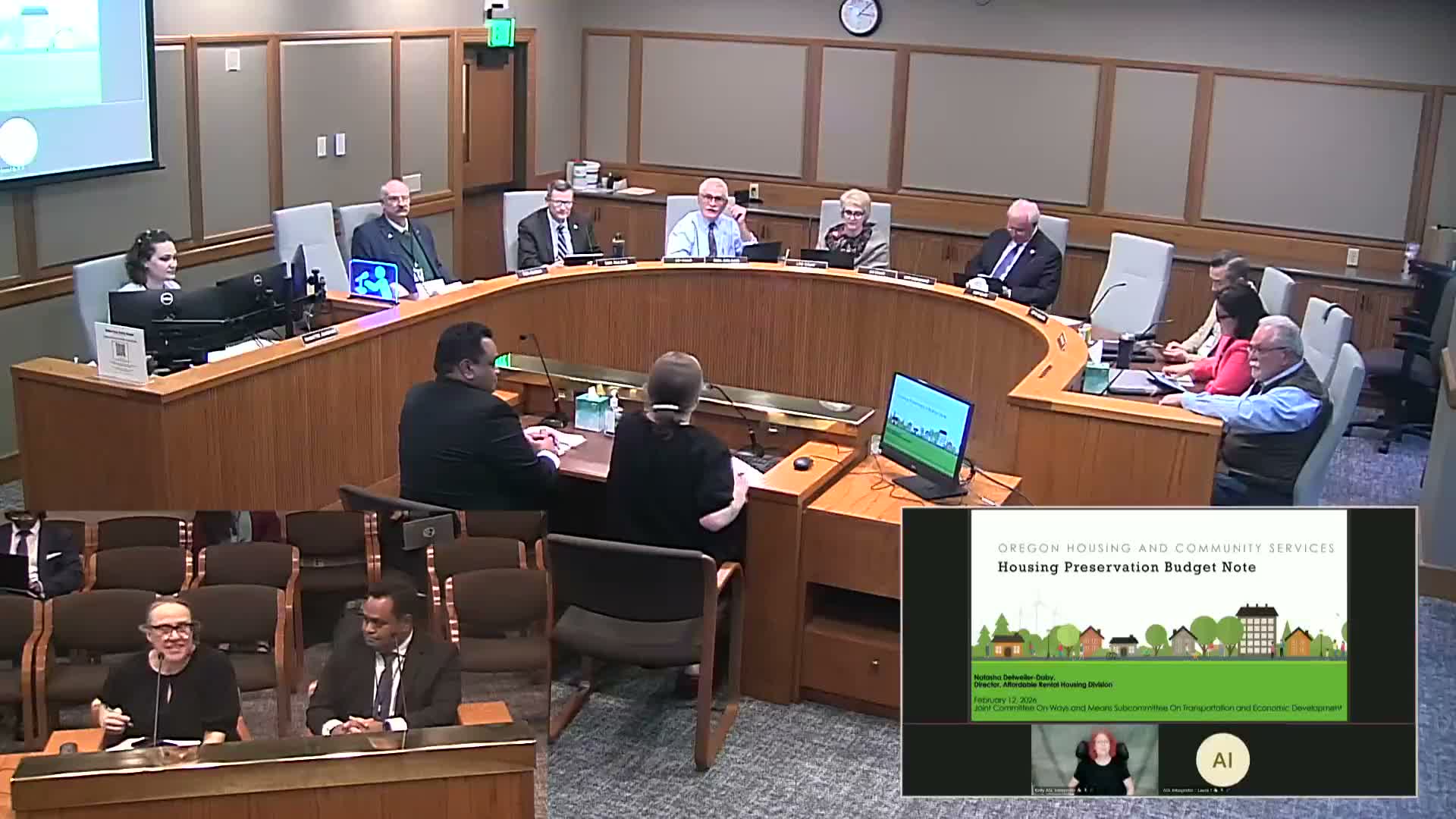
Natasha Detwiler Davie, director of the affordable rental housing division at Oregon Housing and Community Services, told the Joint Ways and Means Transportation and Economic Development Subcommittee on Feb. 12 that Article 11Q general obligation bond financing can be an important tool to preserve existing affordable rental housing across the state.
Detwiler Davie said the tool works best when the state’s loan is in first position or is part of a negotiated shared first-position structure with private lenders, because those arrangements let the state record and enforce affordability controls if a property faces distress. “For Article 11Q coupons, they are in the first position. We are able to share first position,” she said, adding that sharing requires intercreditor agreements that detail operational controls and rights in default.
The agency presented data intended to quantify the risk. OHCS identified 87 federally assisted properties with more than 2,700 units and roughly another 100 non-federal properties with over 5,000 units that could expire over the next 10 years; the agency also reported 38 properties (about 2,300 units) with significant capital needs. Detwiler Davie said last-biennium investments included $50 million for preservation, of which $35 million was dedicated to project stabilization; within 24 hours of opening applications for stabilization funds the agency received interest from 59 projects requesting about $78 million.
OHCS staff emphasized that Article 11Q financing typically requires a full refinancing of a project rather than a subordinate, single-item repair. “It would be looking at, let’s refinance that building… so we’re able to get that control that we are required to have for these resources,” Detwiler Davie said, noting that lighter-touch stabilization grants used previously are not generally feasible under Article 11Q rules unless a refinance is part of the transaction.
Committee members asked technical questions about how shared first-position loans affect private lenders’ underwriting and whether that increases costs. Detwiler Davie said the agency has not observed a systematic increase in interest rates tied to shared position, but it can narrow a lender’s risk tolerance and affect the size of debt a lender will underwrite.
The Legislative Fiscal Office recommended that the committee acknowledge receipt of the report. Co-chair Gomberg moved the recommendation; the committee voted to acknowledge the OHCS report and forward it to the full Ways and Means Committee by a 7–0 vote.
The agency will continue discussions with the Legislature about how Article 11Q financing might be applied for acquisition, rehabilitation or refinance projects aimed at preventing conversions to market-rate housing.