Get Full Government Meeting Transcripts, Videos, & Alerts Forever!
Get email alerts on the Industrial Zoning topic
No spam. Unsubscribe anytime.
Board recommends rules for concrete products in MIC district, narrows separation requirement to 425 feet
Summary
Staff proposed adding concrete products manufacturing/distribution as a conditional use in MIC zoning with strict buffers and a 1,000‑ft separation; after public comment and debate, the board recommended approval with the separation reduced to about 425 feet and with screening, setbacks and DEP permit requirements.
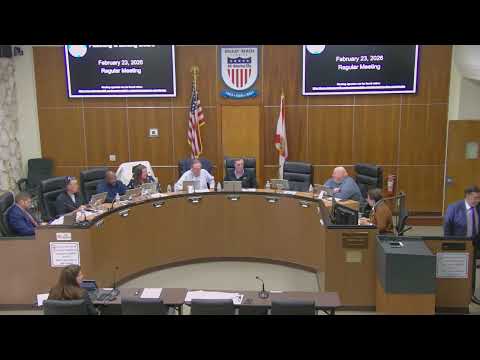
The Planning & Zoning Board on Feb. 23 recommended approval of a city‑initiated amendment to allow concrete products manufacturing and distribution as a conditional use in the mixed industrial and commercial (MIC) district — but with tighter development standards and a reduced separation distance than staff originally proposed.
Staff introduced draft regulations intended to govern unpermitted operations and avoid a cluster of concrete producers in corridors with nearby residential character. Proposed standards included a distance separation (staff originally proposed 1,000 feet), a minimum 30‑foot landscape setback on Congress/Atlantic frontages, limits on outdoor storage heights, screening (walls/berms/hedges and trees), proof of applicable DEP air‑quality permits, and a maximum lot size to discourage agglomeration.
Neil Schiller, representing Calabash Gunite, asked the board to reduce the separation requirement to 400 feet (he said his client's property measures ~451 feet from a CEMEX site using property‑appraiser distances) and argued that the conditional‑use process would allow the city to impose conditions if the use were allowed. Staff replied that any requested waiver would be processed with the conditional use so it would come before the public body for conditions and safeguards.
After extensive discussion about corridor character and the potential for proliferation, a motion was made to recommend approval of the ordinance with a reduced separation distance — the board settled on approximately 425 feet in the motion — and the recommendation passed on roll call. Staff said approval of the amendment would not automatically cure existing code enforcement actions (the operator at 135 North Congress would still need conditional‑use approvals and to satisfy site and permitting requirements).