Get Full Government Meeting Transcripts, Videos, & Alerts Forever!
Get email alerts on the Homelessness topic
No spam. Unsubscribe anytime.
Chico official describes 'Genesis' pallet shelter: 344 beds, case management, and $5 million operating cost
Summary
An outside presenter told the Yuba County board about Chico’s Genesis (pallet) shelter: 177 units (344 bed spaces), about 500 unique residents served, on-site case management, and a stated ongoing site operating cost of roughly $5 million per year; county COVID funds of $1.7M helped buy units.
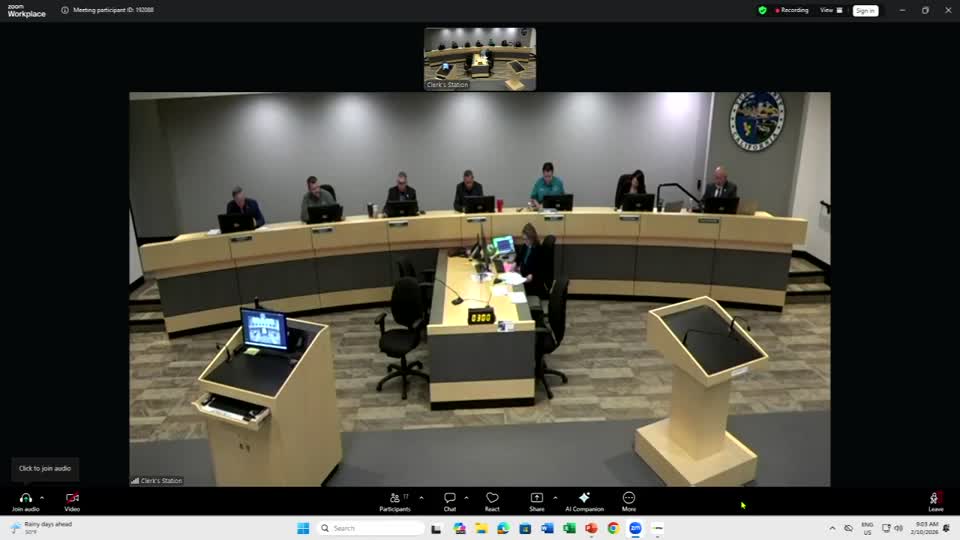
YUBA COUNTY — An outside presenter described Chico’s pallet‑shelter program (renamed Genesis) to the Yuba County Board of Supervisors on Feb. 14, outlining the shelter’s design, legal history, services and costs.
The presenter said Genesis opened in April 2022 and comprises 177 pallet units with a total of 344 bed spaces. He said roughly 500 unique individuals have stayed at Genesis since it opened and that the shelter’s operators identified about 78 people with long‑term (chronic) homelessness among those served. He described an average length of stay of about 341 days as of the end of year two.
On services, the presenter said each unit has power (PG&E routed power to every unit), heating and air conditioning (a condition attached to use of CARES Act/COVID funds), Wi‑Fi (donated by Comcast), on‑site case management, and two meals plus a snack provided daily. The presenter emphasized case management as central to the model: he said 330 people received case management in the program’s first year across approximately 2,358 sessions (transcript wording was garbled; this number is reported as presented).
On funding, the presenter stated Chico used $1.7 million in county COVID funds to support shelter units and that ongoing site operations were roughly $5 million per year. He also said the city obtained a $2.7 million state grant that helped supplant local funds and support operations across multiple years.
Legal and operational context: the presenter referenced the Martin v. Boise decisions and subsequent developments (cited the Grama Pass case) to explain why certain low‑barrier features were necessary under settlement terms; he said a federal judge limited the city’s ability to restrict drug use inside units, which shaped a low‑barrier shelter design. The presenter said security is on‑site and police respond when incidents occur.
Board members asked several operational questions: typical occupancy (the presenter said two‑thirds to three‑quarters full and that the units have never been at full 344‑bed capacity), whether the shelter drew people from outside Chico (presenter said evidence did not show large in‑migration), unit size (roughly 10x10 with two beds), and how pets are handled (two animals permitted; kennels provided; muzzling required when animals are outside the units).
Why it matters: the presentation detailed a model other local jurisdictions have considered, with explicit cost, service and legal tradeoffs. Supervisors asked whether similar approaches could be adapted in Yuba County and pressed staff on bed counts, case‑management intensity and funding permanence.
Caveats: several numerical items were stated in the presentation with inconsistent or unclear phrasing in the transcript (for example, a quoted figure of '78' is referenced both as a count and as a percentage at different points; a sessions total appears as '200 2,358' in the transcript). Where the transcript was unclear, the article notes the uncertainty rather than correcting or inventing figures.
Sources: presentation and Q&A recorded during the Feb. 14 board meeting.