Get Full Government Meeting Transcripts, Videos, & Alerts Forever!
Get email alerts on the House Bill 126 Public Nuisance topic
No spam. Unsubscribe anytime.
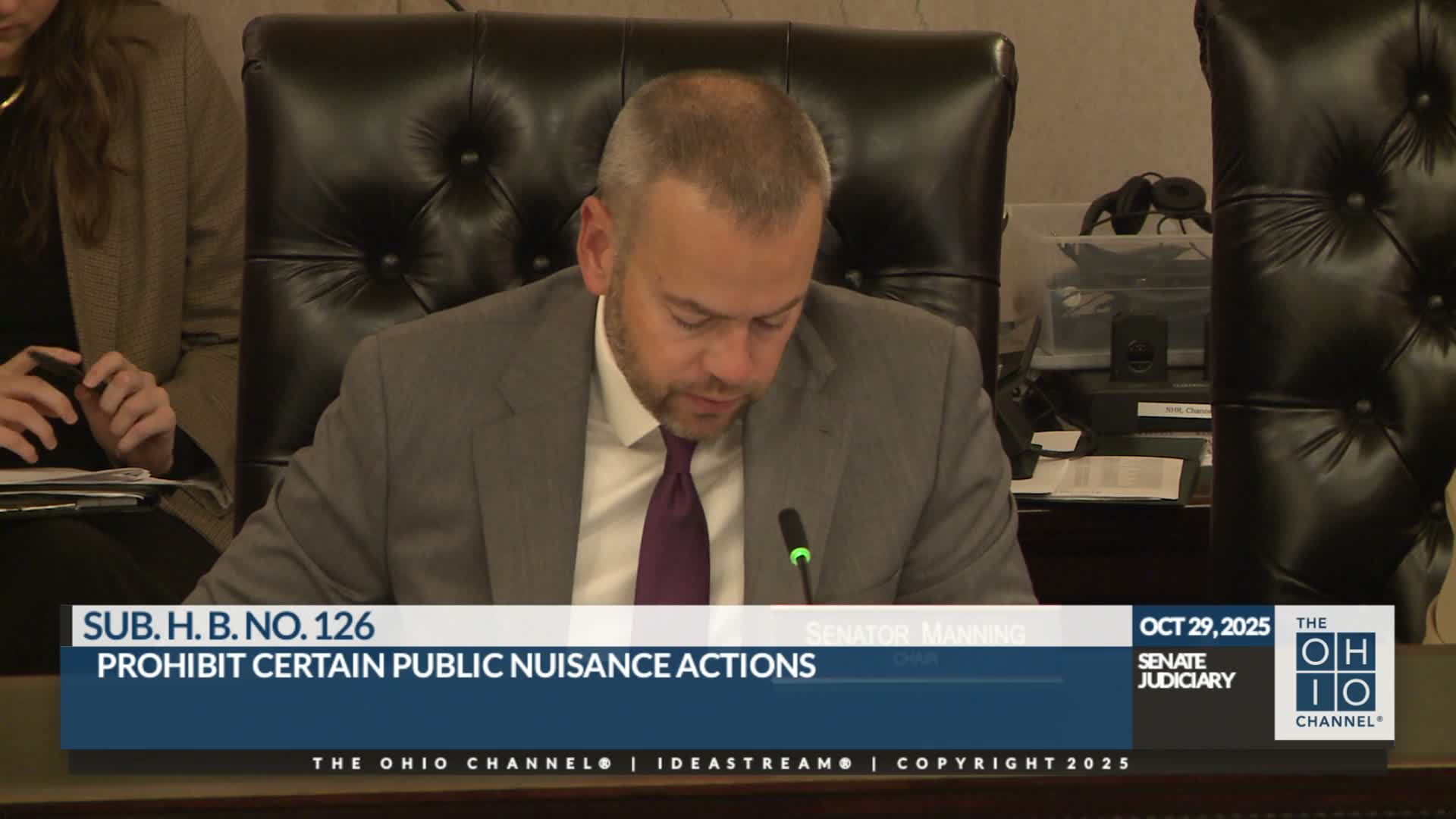
Opponents tell Ohio Judiciary panel HB 126 would gut public-nuisance remedies for governments
Summary
Opponents, including the Ohio Association for Justice and the Ohio Municipal League, told the State Judiciary Committee that House Bill 126 would remove common-law public-nuisance claims and leave municipalities without a viable means to recover abatement or economic losses from product manufacturers.
Dustin Herman, representing the Ohio Association for Justice, and Jonathan McGee of the Ohio Municipal League told the Ohio State Judiciary Committee that House Bill 126 would strip local governments of a key legal remedy for large-scale harms.
Herman said HB 126 ‘‘takes away one of the strongest legal avenues that governments have to hold product manufacturers accountable’’ and argued the bill would eliminate common-law public-nuisance claims that local governments have used to recover abatement and other costs in crises such as the opioid epidemic. He cited the opioid litigation and told the committee that public-nuisance settlements nationwide have produced billions in recoveries and ‘‘$1,000,000,000 coming into Ohio.’’
Jonathan McGee said the Ohio Municipal League opposes the bill because it could violate municipal home-rule authority and because, he said, the measure goes beyond codifying a recent Ohio Supreme Court opinion. McGee said the bill would also apply limitations to Section 715.44 of the Revised Code (statutory public nuisance) and leave municipalities without a recovery for economic loss under the Ohio Product Liability Act (OPLA).
During questioning, committee members asked whether common-law public nuisance was intended for these kinds of product-liability situations and how the Ohio Supreme Court’s recent rulings interact with statutory law. Herman replied the historical public-nuisance doctrine allows governments to pursue abatement and cost recovery where a wrong leaves a ‘‘mess the taxpayer has to clean up,’’ and he warned that removing that tool could leave cities and counties ‘‘helpless to defend themselves.’'
The witnesses recommended careful drafting if the Legislature wants to narrow public-nuisance claims rather than eliminate them, and urged the committee to preserve remedies that allow governments to recover the costs of cleanup and abatement.
The committee will take no immediate vote on HB 126; the item proceeded as the third hearing and included opponent testimony and questioning.