Get Full Government Meeting Transcripts, Videos, & Alerts Forever!
Get email alerts on the Competency Restoration topic
No spam. Unsubscribe anytime.
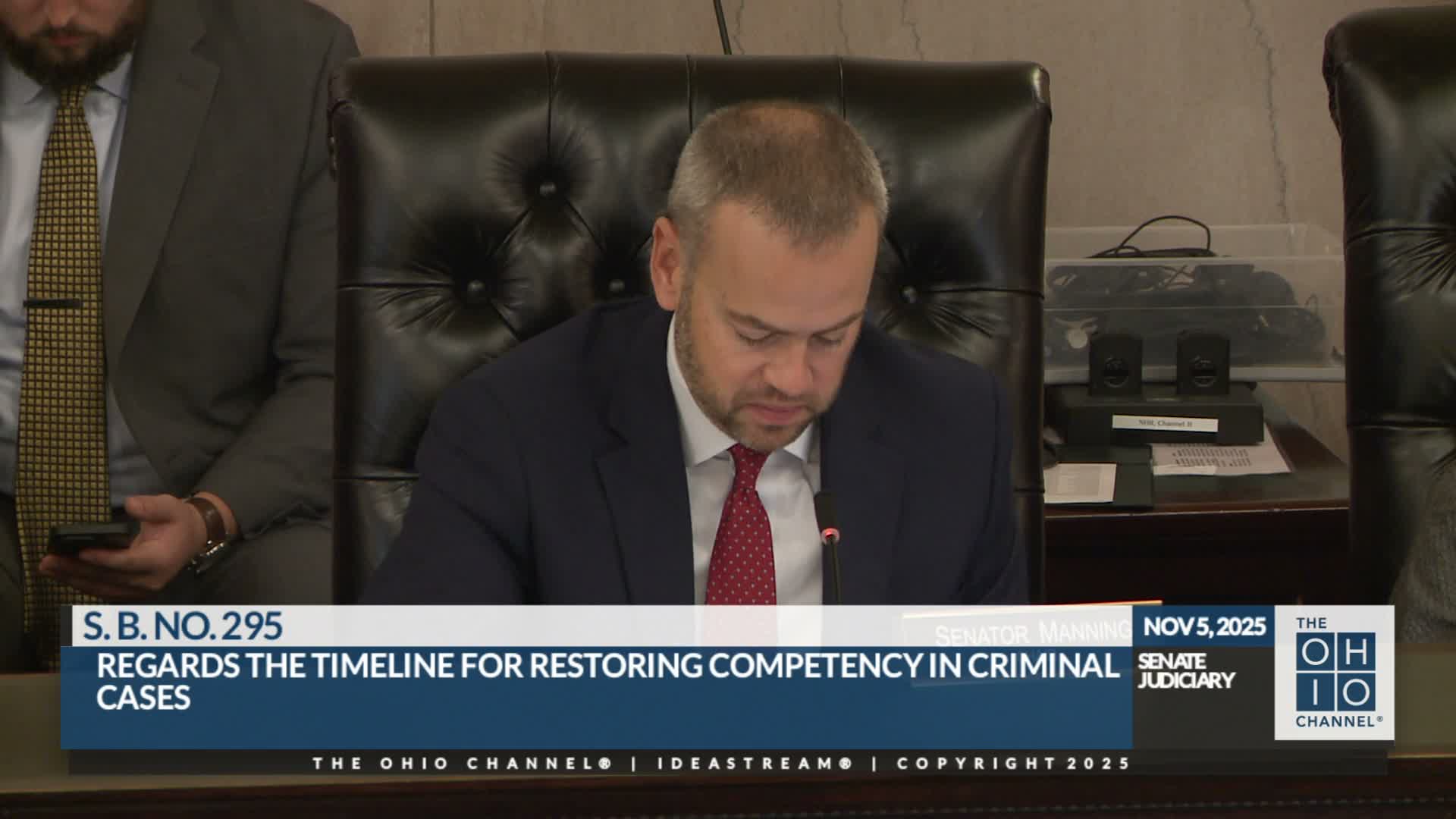
Prosecutors and family urge tolling and longer restoration window in Senate Bill 295 after deadly case
Summary
Cuyahoga County prosecutors and the parents of slain officer Jamieson Ritter urged the Senate Judiciary Committee to pass SB 295 to extend competency restoration timelines to five years for the most serious offenses, require timely notification when defendants refuse treatment, and codify tolling to prevent defendants from 'running out the clock.'
Cuyahoga County Prosecutor Michael O'Malley, appellate supervisor Daniel Van and other attorneys told the Senate Judiciary Committee that Senate Bill 295 addresses what they described as a loophole in Ohio's competency restoration process exposed by the Delonte Hardy cases, including the murder of Cleveland police Officer Jamieson Ritter.
Prosecutor O'Malley described the case as revealing "a dangerous loophole" in Ohio's one‑year restoration timeline and said hospitals did not notify the court when Hardy refused medication. Assistant Prosecutor Daniel Van said the bill would extend restoration windows to five years for the most serious offenses (aggravated murder, murder and other violent crimes punishable by life), codify tolling when defendants refuse or cannot consent to treatment, require timely communication to courts and prosecutors and apply retroactively to pending cases.
Committee members questioned the choice of a five‑year period, constitutional limits on indefinite restoration, and whether tolling would merely allow defendants to repeatedly start and stop restoration. Prosecutors said the 5‑year extension targets the most serious offenses, noted other states allow multi‑year periods and emphasized that the bill mandates a 14‑day notification to courts and prosecutors when a defendant fails to comply with treatment.
John and Karen Ritter, parents of Officer Jamieson Ritter, recounted the family’s loss and alleged that months passed after the defendant arrived at Central Ohio Behavioral Health without any notification that he was refusing medication. John Ritter said the family learned at a March 2025 hearing that the defendant "was not taking any medication as ordered by the court" and urged the committee to pass the bill urgently to prevent defendants from exploiting the restoration clock.
Committee members expressed condolences and engaged detailed legal questions; prosecutors said the bill seeks to balance victims' rights, defendants' care and judicial finality.