Get email alerts on the Housing Loans Audit topic
No spam. Unsubscribe anytime.
Sutter County supervisors pause plan to write off decades-old home-repair loans amid audit concerns
Summary
County staff told supervisors that missing documentation on roughly 28 deferred CDBG home-improvement loans has created a single-audit finding, and recommended writing off three loans tied to deceased recipients; the board voted unanimously to continue the matter so staff can pursue liens or other collection options and return with more detail.
Sutter County supervisors on July 8 put off a staff proposal to write off decades‑old deferred home‑improvement loans that lack required documentation, instead directing staff to pursue additional collection options and return with a fuller report.
Neil, a county development‑services representative, told the board that the county’s files show about 28 active deferred loans issued as early as 1996 but that the department currently has complete documentation for only 19. He said the state Housing and Community Development department (HCD) has flagged the missing paperwork as a single‑audit finding tied to the Community Development Block Grant (CDBG) program and that, without the records, Sutter County would be ineligible for HCD CDBG funds.
“The required documents are property insurance, flood insurance if needed, and payment of property taxes to the county,” Neil said. He described three loans where the original recipients have died and property ownership has changed, and he told supervisors HCD had outlined several options: collect the money, write off the loan balance, or seek to have new owners assume or pay the loans. Neil said staff recommended writing off the three loans as the quickest way to clear the audit finding but noted additional loans will come before the board.
Supervisors pressed staff on alternatives. One supervisor asked whether liens could be placed on properties; Neil said the county’s lien rights appear to have lapsed in some cases because the original borrowers died and title transfers did not result in county notice during escrow. Another raised whether title‑company errors could create an avenue for recovery; supervisors suggested staff explore title insurance or lender remedies.
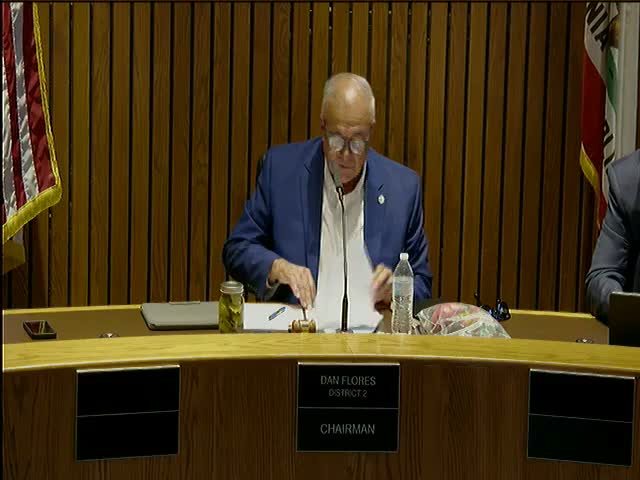
Staff said they have engaged a consultant (Adams Ashby) to review files and expected to return with a larger list of problematic loans and recommended next steps within two to three meetings. The board voted unanimously to continue the matter, with the chair instructing staff to bring back more information on pursuing liens, collections and the remaining loans that lack required paperwork.
The board later approved the rest of the consent calendar (items 1–15) after the continuation vote.
What happens next: Staff will provide a follow‑up staff report listing individual properties, outstanding balances and recommended actions. The county indicated it may give 30 days’ notice to borrowers it deems in default before pursuing legal collection actions, which could include liens or foreclosure steps if owners do not cure defaults.
AI generated
The text on this page is AI generated. Summaries, highlights, analysis, and video transcripts are all produced from the original source material.
AI can make mistakes, so if you spot one, and we will fix it for everyone.
Note: the source content is unaltered by us. Any content source we link to, be it a video, an audio recording, or a document, is presented exactly as its publisher released it. That publisher is usually a government body, sometimes an individual official or another organisation.