Get Full Government Meeting Transcripts, Videos, & Alerts Forever!
Get email alerts on the Hemp Regulation topic
No spam. Unsubscribe anytime.
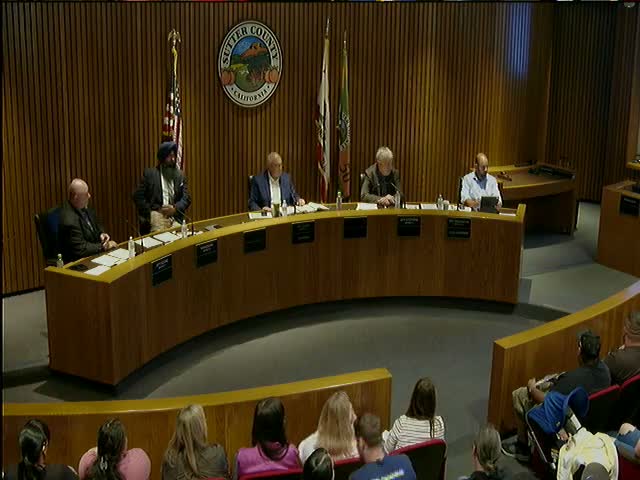
Sutter County supervisors weigh one-year, tightly regulated reopening of industrial hemp after heated public hearing
Summary
After hours of divided public comment and testimony from the agricultural commissioner and sheriff, Sutter County staff recommended allowing limited hemp cultivation and processing through a one-year licensed program with setbacks, a $7,500 deposit and strict enforcement; the board moved to approve but no final vote is recorded in the transcript.
SUTTER COUNTY — The Sutter County Board of Supervisors opened a special public hearing and heard more than two dozen speakers before a motion was put on the table to allow licensed industrial hemp cultivation and processing for a one-year trial period.
County Administrator Steve Smith told the board staff recommends introducing an ordinance that would modify interim urgency ordinance No. 17-29 to permit licensed hemp operations under strict conditions. "Cultivation or processing of hemp in violation of the ordinance is declared to be a public nuisance subject to abatement and the imposition of administrative penalties," Smith said while outlining requirements including zoning limits, a $7,500 deposit plus bond or security to cover enforcement costs, and minimum setbacks (a 2.5-mile/13,200-foot buffer from incorporated city limits, the Sutter Point specific plan boundary and sensitive facilities; and a 0.25-mile/1,320-foot buffer from off-site residences without owner consent).
The Agricultural Commissioner, Lisa Herbert, testified she remains strongly opposed to permitting hemp in the county. "Industrial hemp has consistently presented itself as a public nuisance, posing tangible risks to health, safety, and the broader well-being of our community," Herbert said, citing six years of enforcement challenges, staff intimidation, an attempted bribery incident and a roughly $415,827 program shortfall that she said has strained county resources. Herbert urged that if the board permits cultivation, it must require a comprehensive public report on the 2025 season before any decision to make the ordinance permanent in December.
Growers and business representatives urged the opposite. "We have worked closely with the ag department to ensure we are doing things the right way," farmer Tyler Timani of CNC Farming said, asking the board not to punish responsible operators for the actions of bad actors. Luke Wilson, a local hemp grower, emphasized economic benefits and contracts that sustain local jobs and suppliers: "We're generating sales, payroll, and income taxes, all of which benefit the county just like any of the other major crops grown in the county." Several vendors and small-business owners described revenue tied to hemp products and said the crop supports local employment.
Law enforcement flagged practical challenges. Sutter County Sheriff Brandon Barnes told the board bad actors have at times spiked THC levels to pass off marijuana as hemp and said some related incidents are under investigation; he warned enforcement will require resources and staff safety measures. "To put more on us without giving us the proper resources to combat the problem doesn't make a lot of sense," he said.
The proposed ordinance would permit cultivation and processing only by license, require deposits intended to cover county review, issuance, administrative and enforcement costs, and make failure to replenish used deposits grounds for revocation. Processing would be allowed under separate licensing rules; processing in a detached, fully enclosed, secure accessory structure with odor control could be exempted from some restrictions.
Board members expressed divided views. Some supervisors emphasized the county's "Right to Farm" traditions and the economic stress facing growers, urging measured support with strict penalties and town halls. Others said constituent complaints about odors, school impacts and enforcement burdens counsel caution; one supervisor urged taking the matter to a public vote. The transcript ends after a motion was made to adopt staff's recommendation with the agricultural commissioner's requested provision and to allow sheriff-provided deputy support for inspections; no second or roll-call vote appears in the provided record.
The ordinance would, as described by staff, expire on Dec. 16, 2025, unless extended; the board also discussed requiring a publicly available 2025 season evaluation prior to any permanent adoption. The staff report and ordinance text contain additional details on zoning, buffer calculations, license terms and enforcement mechanisms that the board and public referenced during discussion.
Next steps: the transcript captures the motion but not a recorded vote. If the board advances the ordinance, implementation would depend on licensing, deposit collection and any additional direction the board gives to staff about enforcement resources or public review requirements.