Get Full Government Meeting Transcripts, Videos, & Alerts Forever!
Get email alerts on the Drone Policy topic
No spam. Unsubscribe anytime.
Ohio committee hears competing views on bill to restrict drones from ‘covered foreign adversaries’
Summary
Witnesses at the Senate Transportation Committee debated Senate Bill 180, which would bar some state and local agencies from operating drones made or assembled by covered foreign adversaries. Proponents cited national-security risks and federal actions; opponents warned of risks to first-responder operations and local businesses.
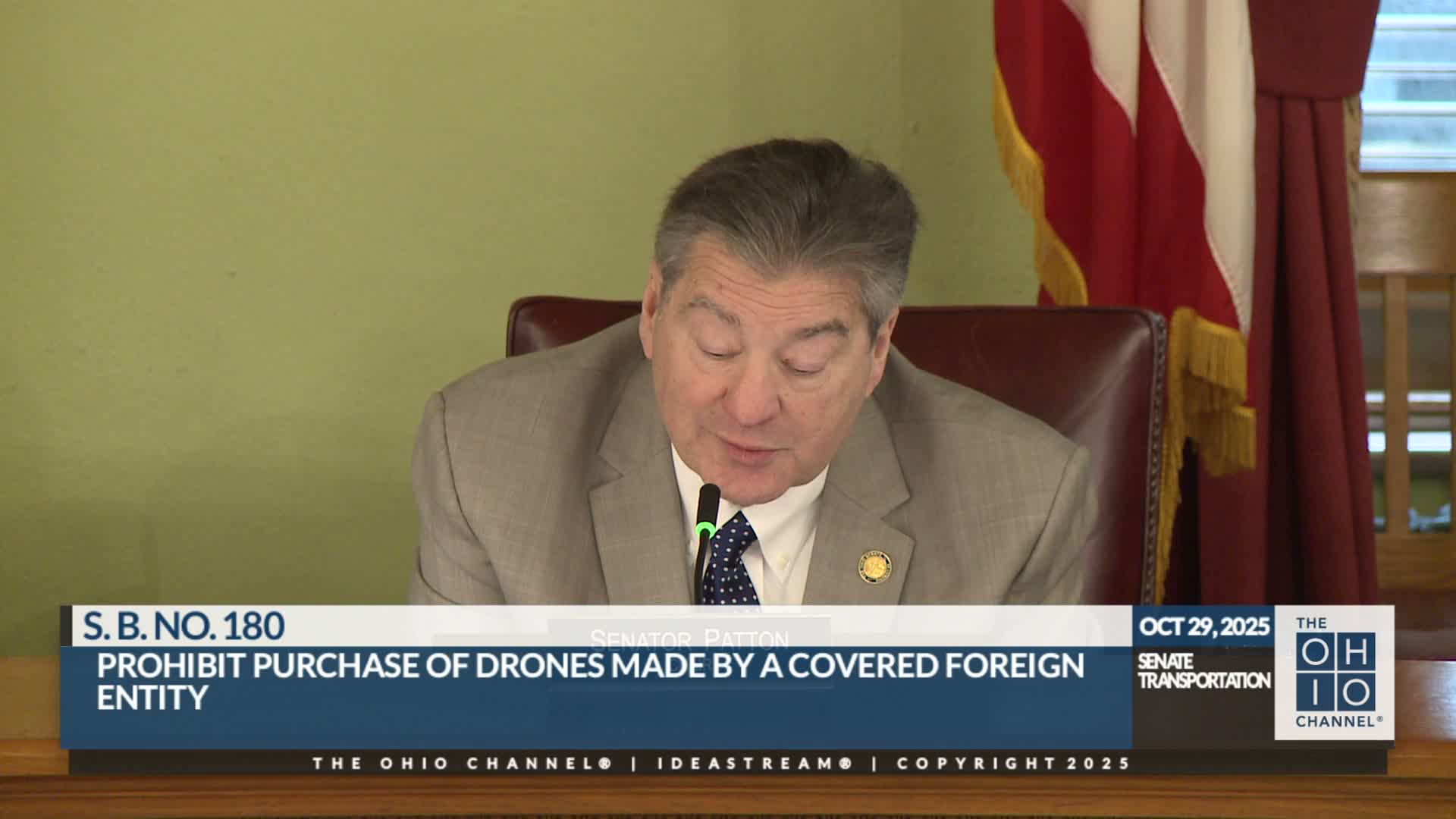
The Ohio Senate Transportation Committee heard testimony on Senate Bill 180 on the bill’s third hearing, with proponents urging tighter controls on drones they said pose national-security risks and opponents saying the measure would harm public-safety work and small businesses.
Mason Sisk, director of government affairs for the Association for Uncrewed Vehicle Systems International (AUVSI), told the committee the bill would transition state and local agencies away from operating small unmanned aircraft manufactured or assembled by "covered foreign adversaries." He said federal action already signals concern: "In the past two years alone, we've seen Congress enact the American Security Drone Act in 2023 and the countering CCP drones act of 2024," and he recommended aligning the bill’s definitions with those federal measures.
"This legislation is a critical step towards safeguarding Ohio's public safety infrastructure," Sisk said, arguing the U.S. drone industry faces cybersecurity and supply-chain threats from heavily subsidized foreign competition.
Les Bone, owner-operator of Elite Drone Services LLC, testified in opposition, saying the equipment slated to be restricted is routinely used in life‑saving work. He recounted a Mercer County search-and-rescue in which a DJI drone equipped with thermal imaging located an 89‑year‑old man after roughly 36 hours missing: "Without this specific technology… that man almost certainly would not have survived the day," Bone said. He warned that forcing agencies to abandon functioning fleets would waste taxpayer dollars and reduce operational capability.
Committee members sought technical detail. Chairman Patton asked whether the federal concerns were limited to trade practices or extended to remote access to collected data; Sisk pointed to a 2017 Chinese national intelligence law and recent changes in vendor behavior as sources of concern. Senator Shimpkin and others pressed on effective dates and device life spans; Sisk recommended a reasonable transition period and suggested state incentives—grant programs or tax breaks—to help agencies procure U.S.-made alternatives.
Sisk also cited an existing state pilot the committee had passed earlier this year: House Bill 96’s "drones for first responders" pilot, which included $2,500,000 and included a restriction that devices purchased under the program not originate from countries deemed national-security threats by the U.S. Secretary of State.
The bill as written would prohibit operation of covered platforms beginning May 1, 2027; witnesses differed on whether that timetable allowed agencies to replace equipment without creating operational gaps. Bone and other opponents argued domestic alternatives still lag on flight time, camera quality and reliability, and that rural or volunteer departments may struggle to afford replacements without state assistance.
The committee did not take a final vote on the bill during the hearing. The exchange focused on technical definitions, the proposed effective date, the availability and cost of U.S.-made equipment, and potential grant or transition programs.
The committee will consider written testimony (the clerk noted about 20 submissions) and may seek additional technical briefings before further action.