Get Full Government Meeting Transcripts, Videos, & Alerts Forever!
Get email alerts on the SB180 Drones topic
No spam. Unsubscribe anytime.
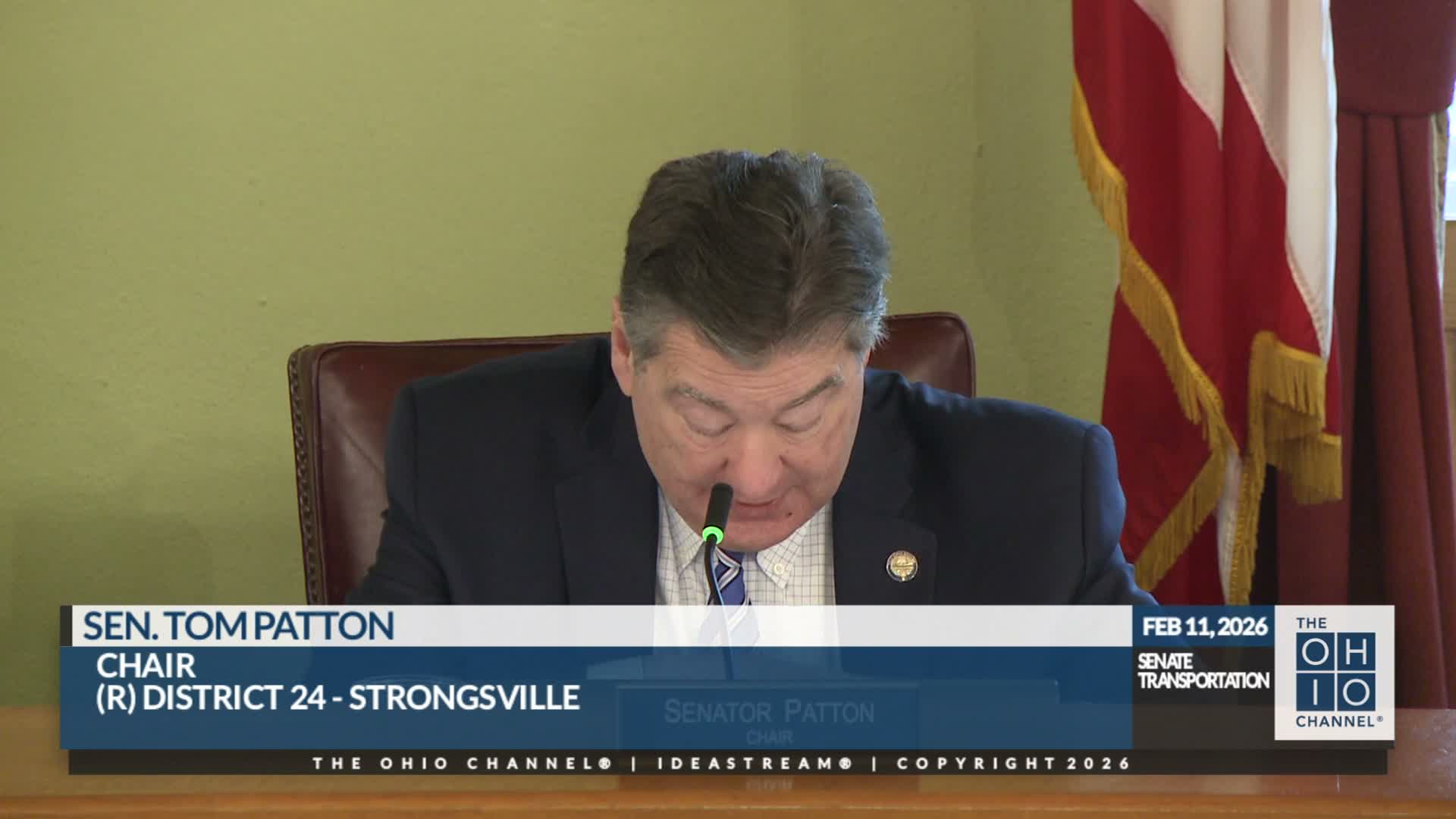
Senate committee hears public-safety warnings on SB 180 drone restrictions; witnesses urge funded replacement and alignment with federal action
Summary
Public-safety officials told the Senate Transportation Committee that Senate Bill 180, as written, would ground existing drone fleets, impose large unfunded replacement costs and create operational gaps; witnesses urged aligning state restrictions with recent federal FCC/NDAA actions and establishing funded replacement programs.
Columbus — At a Feb. 11 Senate Transportation Committee hearing, chiefs and public-safety representatives told lawmakers that Senate Bill 180’s restriction on foreign-made drones would, if implemented as written, ground existing emergency-response fleets and produce substantial unfunded costs for local agencies.
Scott Malacher, administrative officer with the Willoughby Fire Department and director of several Ohio public‑safety unmanned aircraft systems groups, testified that “Senate Bill 180 will prohibit the continued operation of existing public safety drone systems,” and said the law would “redistribute and amplify the risk” rather than reduce it. Malacher said public‑safety agencies use drones for search-and-rescue, hazmat, tactical operations and damage assessment, and that these systems are “mission critical” for saving lives.
Malacher pointed to recent federal action affecting drone approvals and said the Federal Communications Commission’s measures addressed future procurement without retroactively grounding existing systems. He urged the committee to “align Ohio law with FCC policy” and to remove operational bans on equipment that remains safe and useful through the end of its service life.
Malacher gave Lake County as a case study. He estimated a first‑year replacement cost for that county’s roughly 25 drones at “three quarters of $1,000,000” and a five‑year projected cost of $1,530,000, arguing that the statewide first‑year replacement cost could be in the $32–40 million range with annual sustainment of roughly $2.8–3.4 million.
Deputy Chief Jason Conklin of the Lindsay Volunteer Fire Department said his agency’s drone was funded through multiple grants and donations and that his volunteer department lacks the capital to replace grounded equipment at short notice. “We have one drone that we worked extremely hard to get and that would be grounded,” Conklin said, noting that many small or rural departments operate on tight, fixed budgets.
Chief Tyler Welsh of the Hebron Police Department described independent cybersecurity audits he said found no evidence of unauthorized outbound transmissions when drones were operated in local‑data modes. “To date, there has been no documented case of public safety drone data being compromised or exfiltrated due to manufacturer access,” Welsh said, citing past audits from Booz Allen Hamilton (2020), FTI Consulting (2024) and other testing referenced in his testimony.
Committee members repeatedly raised national‑security concerns, pointing to an incident in El Paso, Texas, where airspace was temporarily restricted after a reported drone incursion. Senator Chavez said the episode underscored worries about losing control of drones and the potential for adversaries to embed hidden functionality. Malacher and others responded that the principal risk for data exfiltration comes from data connectivity and that agency procedures — disabling cloud connectivity, retaining imagery on government servers, and using secure, agency‑managed networks — reduce that risk.
Witnesses recommended several amendments and policy steps: avoid retroactive operational bans; tie procurement limits to current federal lists and certifications; create a dedicated, fully funded 1‑for‑1 replacement program for taxpayer‑funded aircraft removed from service; and form a multidisciplinary working group of public‑safety, aviation and cybersecurity experts to develop best practices. They also offered to provide the committee with copies of the cited cybersecurity audits for further review.
The committee accepted, without objection, an amendment to SB 180 announced in committee as “AM‑sixteen 23,” which changes the date by which public entities must cease foreign‑made drone operations. Senators asked staff to obtain the underlying audit reports and to invite technical auditors to future hearings to clarify testing methodology and findings.
The hearing concluded with no final vote on SB 180. The committee is expected to consider further testimony and technical material before scheduling subsequent action.