Get Full Government Meeting Transcripts, Videos, & Alerts Forever!
Get email alerts on the HR1 Medicaid Reform topic
No spam. Unsubscribe anytime.
Ohio Medicaid Director Walks Lawmakers Through HR 1 Changes, Cites Savings and Implementation Challenges
Summary
Medicaid Director Scott Partika told a joint House–Senate committee that HR 1 will require more frequent eligibility checks, nationwide work requirements and changes to provider financing; he cited estimated state savings, warned of IT and county workload impacts and promised follow-up data.
Scott Partika, the newly appointed director of the Ohio Department of Medicaid, told a joint session of the House and Senate Medicaid committees that federal legislation known as HR 1 will trigger major operational and financing changes for the state's Medicaid program.
"HR 1 is, most likely one of the largest overhauls of how the federal government administers the Medicaid program in quite some time," Partika said in his prepared remarks, summarizing slides that laid out compliance deadlines, projected savings and implementation challenges.
Partika said HR 1 requires states to strengthen duplicate-enrollment detection and to have a process in place by Jan. 1, 2027, with a federal system expected by October 2029. He told lawmakers the department received a large federal data file identifying likely duplicate enrollments and that Ohio estimates roughly $11,000,000 in state-share savings next fiscal year from that work, with potential future state savings rising to tens of millions.
The director outlined a set of other federal changes that will affect Ohio's program. Adult-expansion eligibility redeterminations will be required every six months beginning Jan. 1, 2027, instead of annually; Partika estimated that change could yield about $40,000,000 in annual state savings, but said the timing of savings will depend on how and when caseworkers process redeterminations.
He also noted a federal home-equity limit of $1,000,000 for long-term care services and said Ohio's existing limit of $730,000 means that particular federal change would have no effect on state policy. Changes narrowing immigrant eligibility categories were projected to reduce program costs by about $13,000,000 next fiscal year. Retroactive coverage for hospitals and nursing homes would be shortened from three months to one month, a change Partika said will probably have only a small budgetary effect.
A major operational item is work requirements. Partika said HR 1 explicitly authorizes nationwide work requirements for the group A population and raises the federal age limit to 65. He said Ohio has experience from prior waiver work that positions the state to implement the new federal rules, but added that details and final federal rules remain in development.
The department is also watching the federal PERM (payment error rate measurement) regime closely. Partika told the committees that Ohio's historical PERM rate was roughly 40% around 2019–20 but that state improvements have reduced the rate to "just a little over 2%"; he warned that future PERM cycles could carry fines if a state's error rate exceeds 3.5%.
On financing, Partika said HR 1’s changes to provider-tax rules and a requirement of greater uniformity could expose Ohio to long-term revenue pressure. He noted a one-year extension in recent federal guidance but said without policy changes the state could face a potential $640,000,000 revenue shortfall in a later fiscal year. He also said state-directed payments (SDPs) and many hospital financing mechanisms were grandfathered under the final rule and that 16 of Ohio’s 24 SDP applications have been approved by CMS to proceed.
Lawmakers pressed the director on specifics. Senator Liston asked whether estimated savings for work requirements reflected differences between Ohio’s prior waiver and the federal approach; Partika said the $40,000,000 projection is driven largely by anticipated disenrollments under the federal policy. Representative Barwurst asked about the status of a rural-hospital tax pilot and nursing-home rate recalculations after a Supreme Court decision; Partika said CMS approval for the pilot remained pending and that the department was coordinating with the governor and nursing-home associations but had no distribution timeline for any funds.
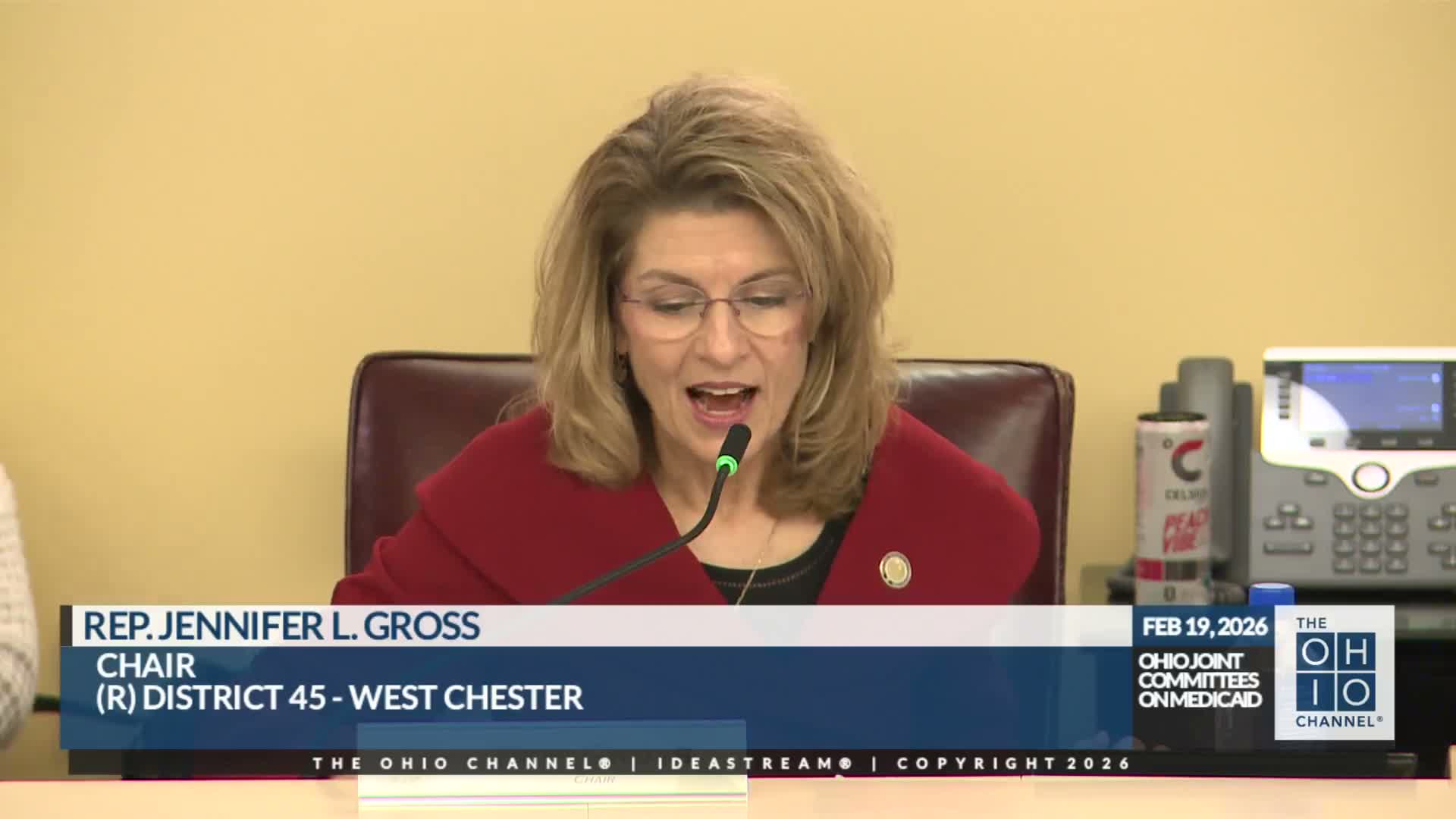
Members asked for more transparency on how recent hospital-directed payments and SDPs flow to provider types. Chair Representative Gross asked the department to provide a provider-level SDP inventory, annual reconciliation by provider class and a five-year forecast that separates baseline trends from SDP- and tax-financing impacts. Partika agreed to provide follow-up reports and data, and he pointed the committee to an existing House Bill 33 report as a starting point.
Partika said IT and county-capacity needs are important implementation items: Ohio’s eligibility and casework systems are being updated for the work-requirement changes, and the federal government has announced grant funding to support IT upgrades. He said the department will produce monthly, member-level impact projections as redeterminations occur.
The committee had no quorum for formal action and deferred appointments; Chair Gross said appointments and some business will be completed at the next meeting. The committee tentatively scheduled a late-March meeting in which the auditor's office and the attorney general's office will be invited to discuss audits, fraud findings and program integrity follow-up.
The hearing record shows the department provided concrete estimates and timelines while promising follow-up data on caseload projections, provider-level SDP impacts and IT cost estimates.