Get Full Government Meeting Transcripts, Videos, & Alerts Forever!
Get email alerts on the Property Tax Reform topic
No spam. Unsubscribe anytime.
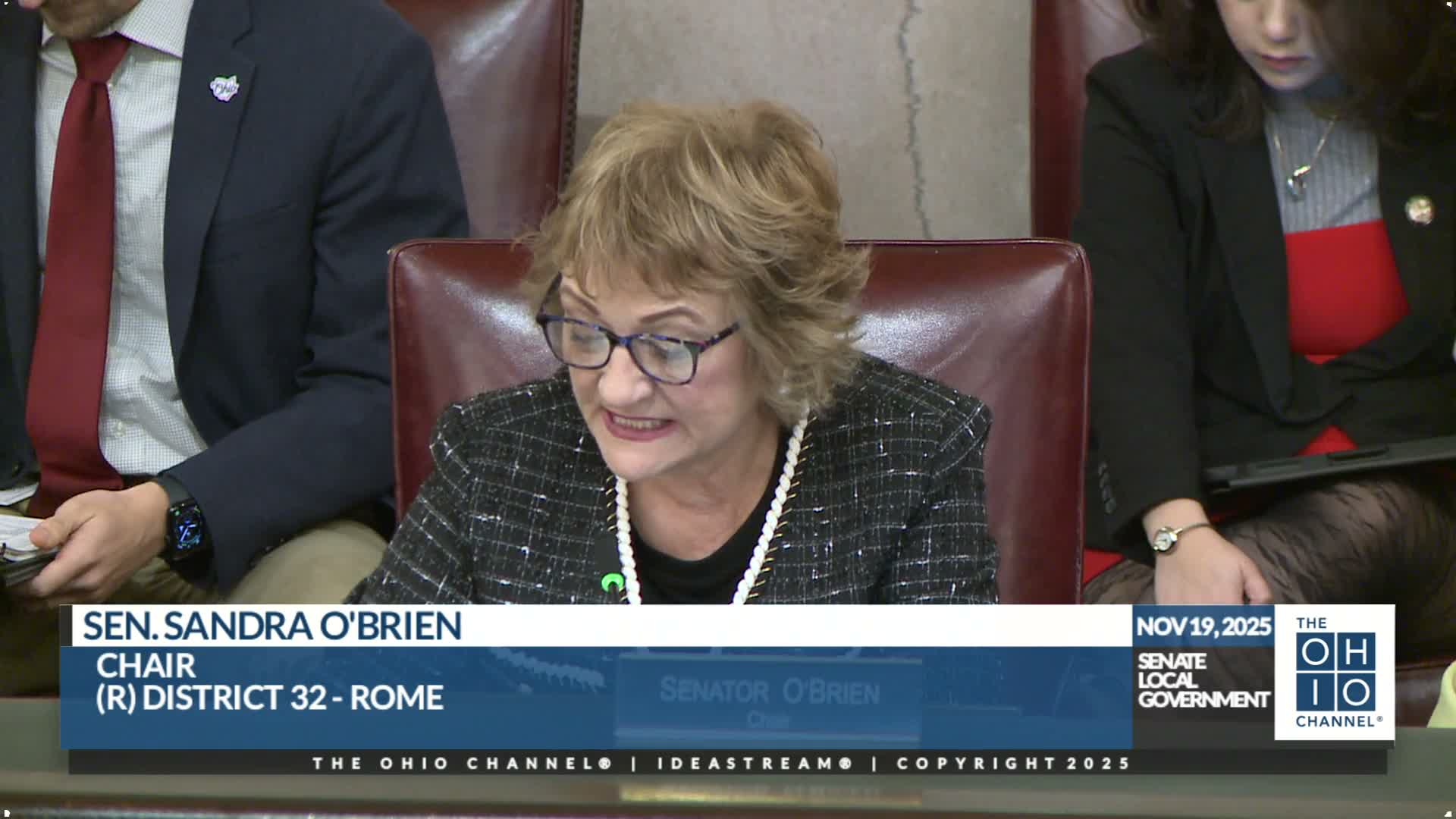
Senate Local Government Committee advances five property‑tax bills after amendment battles
Summary
The Senate Local Government Committee on Nov. 12 advanced multiple substitute House bills dealing with property-tax rollbacks, homestead exemptions, levy renewals and County Budget Commission authority. Lawmakers debated dozens of amendments; several were tabled and amended bills were sent to Rules and Reference.
COLUMBUS — The Senate Local Government Committee spent a lengthy session on substitute House bills addressing property-tax policy, advancing amended versions of multiple measures to the Committee on Rules and Reference while tabling many proposed changes.
The committee opened with substitute House Bill 186, where members adopted a technical amendment requiring county auditors to submit property-tax abstracts to both the county board of revision and the Department of Taxation. The committee also approved an amendment that phases changes to property‑tax rollbacks — raising the owner‑occupied rollback over four years to a final 15.38% in 2029, phasing out the 10% nonbusiness residential rollback to 0% by 2029, and preserving the full 10% rollback for agricultural property. Ranking Member Smith offered an amendment to delay the bill’s effective date to tax year 2026 and another aimed at addressing so-called “phantom revenue” in school funding; both were tabled. The committee then favorably reported the amended HB 186 to Rules and Reference by roll call, with the clerk recording a majority in favor and LSC authorized to harmonize changes.
At the fourth hearing on substitute House Bill 335, the committee accepted an amendment removing provisions that would let a school district or municipality voluntarily reduce inside millage collections to accompany an income-tax levy and protect that inside millage from other subdivisions. Senators offered a string of homestead-related amendments: one from Senator Hicks Hudson to expand a temporary homestead exemption with income-based credits (drawing on previously passed language), and another from Ranking Member Smith to repeal the data-center sales-and-use-tax exemption and use the revenue for hold-harmless payments to affected taxing districts. Smith argued the data-center exemption “is wildly inappropriate” and noted data centers’ high energy use as a reason to reconsider the break; the committee moved to table the repeal proposal. Multiple homestead amendments were also tabled. The amended HB 335 was reported to Rules and Reference and LSC was empowered to harmonize language.
Substitute House Bill 129 received amendments to allow certain school districts that levied substitute levies before 2026 to renew those levies as fixed-sum levies at up to the final-year amount for up to five years, with renewal options. Other amendments — including labeling some fixed-sum levies as emergency levies on ballots and guardrails for renewal mechanics — were discussed and several were tabled. The committee reported the amended HB 129 to Rules and Reference.
On substitute House Bill 309, the committee approved an amendment requiring the County Budget Commission (CBC) to provide a public-hearing opportunity for both the taxing authority and affected taxing units when considering whether to reduce a levy. The committee also adopted a change that allows the CBC to reduce voter-approved levies to avoid excessive collections after one year instead of five. Ranking Member Smith offered numerous amendments aimed at limiting CBC authority or protecting specific levies (including those for addiction/mental-health programs, public libraries, county boards of developmentally disabled services, municipal levies, township levies and joint vocational school districts); most of those proposals were tabled in roll-call votes. The committee reported the amended HB 309 to Rules and Reference and granted LSC authority to harmonize changes.
Throughout the hearing members repeatedly moved to table amendments, a procedural outcome used by the committee majority to dispose of proposals it did not adopt. Several amendments that would have restricted the CBC’s authority or expanded protections for particular local levies were described by sponsors as intended to protect voters’ expectations and services — for example, one proposal would have prohibited CBC adjustments to levies used to fund county addiction, drug-treatment or mental‑health programs; another would have barred adjustments to levies for public libraries.
Clerks recorded roll-call votes on the motions to report the amended bills. The committee chair closed the meeting by thanking members for their work on five property-tax bills and wishing attendees a happy Thanksgiving; the committee then adjourned.
What’s next: Each amended bill has been forwarded to the Committee on Rules and Reference; Legislative Service Commission staff were authorized to harmonize technical changes before the measures proceed.