Get Full Government Meeting Transcripts, Videos, & Alerts Forever!
Get email alerts on the Firearms Preemption topic
No spam. Unsubscribe anytime.
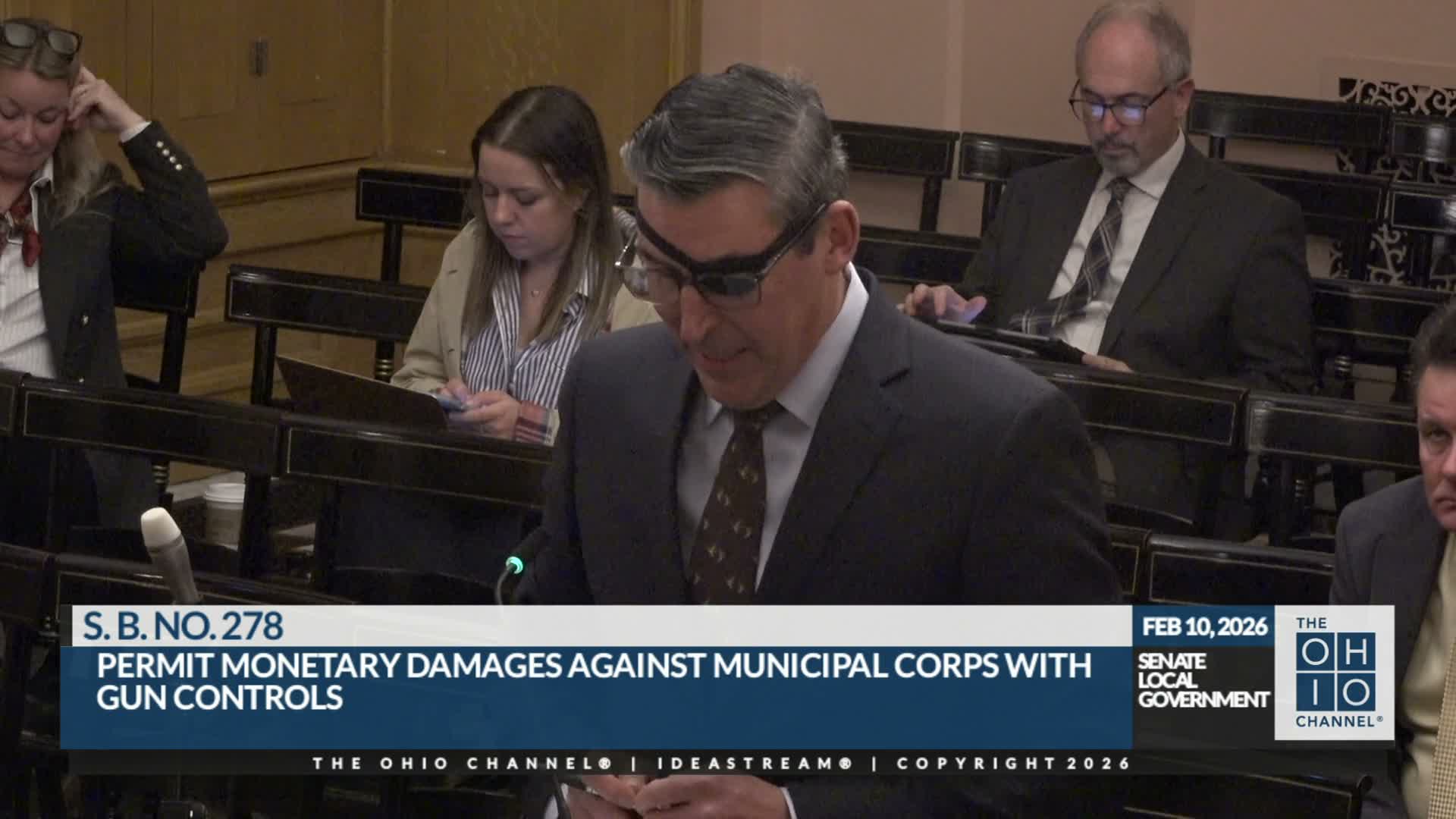
Senate committee hears testimony on SB 278 to expand damages for municipal gun-law violations
Summary
Proponent testimony argued SB 278 would strengthen Ohio's firearm-preemption enforcement by allowing punitive damages against municipalities that enact or enforce local gun regulations in violation of Ohio Revised Code Section 9.68; committee members asked for examples and questioned whether larger damages would deter local action.
Jim Samuels, legislative affairs director for the Buckeye Firearms Association, told the Senate Local Government Committee that Senate Bill 278 would "add teeth to the law" by expanding the damages a successful plaintiff may recover when a political subdivision violates state firearm preemption.
Samuels testified that Ohio Revised Code Section 9.68 already bars political subdivisions from regulating firearms, components, ammunition or knives and that, despite the statute and subsequent litigation, "cities continued to violate it." He said House Bill 228 (2019) allowed plaintiffs to recover direct financial damages such as legal fees but that such awards had not deterred municipal ordinances because "the meager, you know, legal fees as a penalty just don't seem to have been any type of a deterrent." He said SB 278 would add punitive or exemplary damages by inserting five words into the revised code, increasing the financial consequences for municipalities.
Committee members pressed Samuels for evidence. Senator Hicks Hudson asked for examples of municipalities that continued to enact local firearm rules after passage of House Bill 228 and questioned whether larger damage awards would be an effective deterrent given municipal budget constraints. "Can you provide through the chair examples of those municipalities... that have done that after the passage of... House Bill 228?" Hudson said. Samuels said he would provide a list and pointed to Columbus ordinances he described as being in violation of ORC 9.68, naming an ordinance from 2022 and one from 2023 that he said were headed to the Ohio Supreme Court.
Hudson cautioned that municipal budgets are often tight and that damages are commonly tied to measured loss, asking whether punitive awards would operate as the sponsor and proponents expect. The exchange ended with Hudson saying he respectfully disagreed about the likely effect and the chair noting no further questions.
The chair stated the item would "stand as the third hearing on Senate Bill 278." No motion to advance or vote occurred during the session.
What happens next: Proponent testimony concluded and committee members requested additional information (Samuels said he would provide a list of ordinances). The bill remains at the hearing stage.