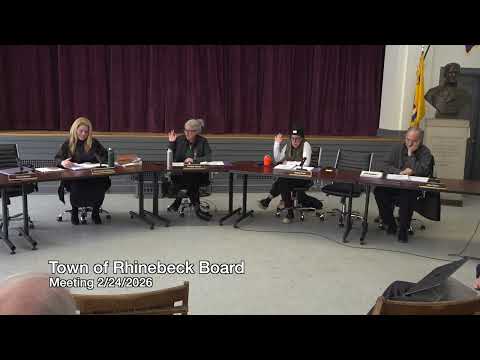
Residents raise water, sewage and traffic concerns over Ryan Bethel planning-board application in Rhinebeck
Loading...
Summary
Residents told the Rhinebeck Town Board on Feb. 23 they support more hospitality in principle but oppose the scale and infrastructure approach of the Ryan Bethel planning-board application, citing DEC comments that the applicant's discharge-permit materials are incomplete and warning of long-term water, sewage and traffic impacts.
Residents urged the Rhinebeck Town Board on Feb. 23 to scrutinize a pending planning-board application from Ryan Bethel, saying the project's scale and proposed on-site wastewater handling risked groundwater, neighborhood character and traffic safety.
Catherine Clark, speaking from 60 Loom Lane, told the board the project "more than doubles the water that's gonna be taken from the aquifer" and said the DEC letter included in the board packet indicates the applicant's discharge-permit materials are incomplete. "The DEC has informed the applicant that the materials are still incomplete as to their application to the DEC for a permit for a discharge permit," an attorney reviewing the letter told the room. Clark also said the nearest mapped stream is "not year round," and that raised doubts about the viability of the proposed sewage-treatment approach.
Christopher Cappo of 22 Kendall, who said he and neighbors are not opposed to hospitality in principle, said the issue is scale. "It feels sort of like it's being shoved into an area that doesn't really have the capacity for it," Cappo said, warning that approving a large project in that parcel could set a precedent and become "death by 1,000 cuts" as incremental approvals accumulate.
Board members and staff repeatedly cautioned that the town board cannot take a position on a pending planning-board application because the planning board is independent. The board's attorney clarified the DEC has requested additional information and that the application has "not been approved" and "not been denied." Michael Barfield, invited by the board to introduce the packet, summarized the procedural constraint: the planning board will review the record and act on the application.
Deputy Supervisor Debbie Hack and other board members said the town will pursue broader planning work to address tourism capacity and cumulative impacts. Hack and the chair noted other hospitality projects already proposed or underway in the area, and said the board intends to "find a planner who can work on" tourism-capacity and policy to guide future reviews.
Penny Levine, who said she experienced diminished well yield and murky water during a drought in 1998'1999, warned that climate change could increase risk to private wells. "My water quality was a little murky. It was also I wasn't getting as much volume that I normally did," Levine said, arguing that major projects should rely on municipal infrastructure where possible.
The board listened but made no formal decisions on the application at the Feb. 23 meeting; members emphasized the planning board is responsible for permitting decisions and the DEC should receive the clarifications it requested. The board later moved into executive session on unrelated personnel and attorney-client matters.