Get Full Government Meeting Transcripts, Videos, & Alerts Forever!
Get email alerts on the Committee Roundup topic
No spam. Unsubscribe anytime.
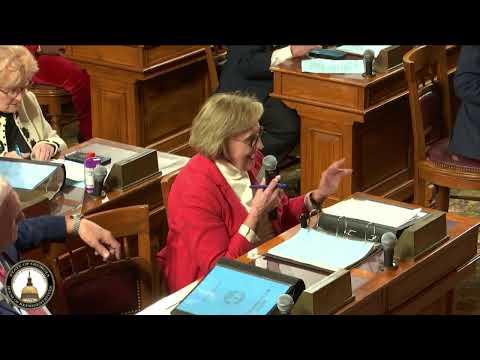
Rules Committee reviews credentialing reforms, school safety kits, vehicle rules and ketamine clinic standards; HB 629 moved
Summary
The Rules Committee heard multiple bills including SB 162 to speed medical credentialing and let hospitals share credentialing data, HB 1022 to ban misuse of electronic license plates and in-car tinting, school 'stop-the-bleed' kits legislation, and a bill to register ketamine clinics; House Bill 629 was moved with no opposition recorded.
The Rules Committee met to consider a slate of public-safety and regulatory measures and moved one bill forward without opposition. Senators and representatives discussed credentialing changes for health-care workers, proposals on vehicle technology, school safety kit funding, and regulatory standards for ketamine clinics.
Senator Huffstetler introduced Senate Bill 162, which she said had been restored to its original, shorter form after prior-session additions were removed. She described two main elements: allowing administrative approval so qualified clinicians may begin work before the full composite medical board meets, and permitting hospitals to input credentialing information so individuals can be credentialed across facilities. "This is why I refer to this as the Paul Brock Act," Huffstetler said, citing a dean who piloted a student credentialing system. Committee members and the sponsor said the new board director and system upgrades have cut credentialing delays from months to about "30 days," and that the change could allow near-immediate deployment when a facility faces short staffing.
Supporters framed SB 162 as a technical and workflow fix rather than a change to licensure standards. In response to questioning about scope, the sponsor said the measure would not alter payer or insurance credentialing and stressed the hospital credential is distinct from the composite medical board license. A committee member noted the substitute language is permissive in some places ("may" rather than "shall"), and the sponsor replied that hospitals would not be forced to participate but that most have expressed interest.
Representative Clifton presented HB 9573, the "miniature truck" bill, saying it returns the House's original language after Senate amendments were removed and that the governor supports the House version. Clifton said the bill would allow these vehicles on county and city roads unless a locality marks a route to prohibit them, and he left details of local signage and enforcement to local governments.
Joe McDonald presented HB 944 as an annual update aligning state enforcement with federal commercial-vehicle guidelines, characterizing it as primarily a date change for the enforcement guidance used by motor-carrier regulators.
A presenter described HB 1022 as a public-safety measure addressing new in-car electronic tinting technology and electronic license plates. The sponsor said the bill would repeal the 2017 authorization for electronic plates and prohibit tampering or tinting that blocks law enforcement sightlines; the proposal sets penalties of $500 for a first offense and $1,000 for subsequent offenses. The presenter cited current legal tint limits as "around 32% plus or minus 3" and noted the new technology can vary tint from near-clear to fully opaque, raising enforcement and safety questions.
A substitute bill to add "stop-the-bleed" kits and training to school CPR/AED programs was presented; the sponsor said kits would be provided free from a national source and placed an appropriation backstop in the bill so state funds could cover kits if external funding changed.
Members also heard a proposal to regulate ketamine treatment clinics, with the sponsor saying ketamine is FDA-approved for anesthesia only and expressing concern about clinics offering other uses without anesthesiology-level training and equipment. The sponsor said existing facilities would be grandfathered (owners would not be forced to divest) but would be required to register with the medical board and meet standards for equipment and advanced airway training; the sponsor estimated "about 20 plus" clinics statewide.
On committee business, the chair called House Bill 629 and the record shows "a motion and a second" with no opposition voiced. The chair reminded members the budget was on the floor and announced the Rules Committee will not meet tomorrow.
What happens next: Most of the bills presented will return for further committee consideration or floor scheduling per the House calendar; SB 162 and measures with appropriation implications were discussed as needing implementation details and any necessary appropriations before statewide rollout.