Get Full Government Meeting Transcripts, Videos, & Alerts Forever!
Get email alerts on the Utility Disconnection Protections topic
No spam. Unsubscribe anytime.
House hearing on HB 641 spotlights power-disconnection risk for medically fragile customers; committee asks for rewrite
Summary
A House Energy, Utilities & Telecommunications Committee hearing on HB 641 heard testimony from a resident who said a power cut endangered her life and from EMC representatives who urged local governance. The chair asked the bill author to craft a narrower substitute; no vote was taken.
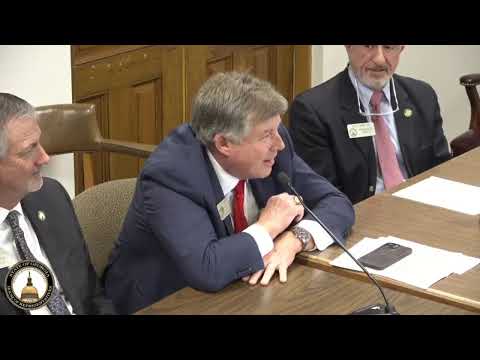
Representative Lamb presented House Bill 641 to the House Energy, Utilities & Telecommunications Committee, saying the measure would extend an existing Public Service Commission rule (referred to in testimony as "Georgia rule 5 15 dash 3 dash 2.03") to electric utilities not regulated by the PSC — including municipal utilities, electric membership corporations (EMCs) and MEAG entities.
The author said the PSC rule, effective since 11/27/1979, requires a residential customer who notifies a utility and provides a physician, county board of health, hospital or clinic statement to identify the illness, estimate its expected duration and certify that disconnection would aggravate the condition. Under current PSC-regulated practice, the rule delays disconnection for the shorter of the illness duration or one month (potentially as short as 20 days under some circumstances); HB 641 would apply the same floor to non-PSC utilities.
Tina Marie Marston, a Griffin resident who uses a left ventricular assist device (LVAD), testified in favor of HB 641. "I always have to have two batteries... Also, in the event that something happens with my batteries, I can plug myself to the wall. So it's imperative that I have power, to sustain life," Marston said, describing an instance when Griffin Utilities disconnected her power while she was receiving emergency medical care and the additional financial and reconnect fees that followed.
Marston told the committee she pursued the matter with Griffin staff, the electric director, the mayor and city commissioners and obtained the customer service handbook; she said Griffin initially had a seven-day post-due grace period that had been adjusted in its procedures. Committee members pressed for details about what documentation would qualify as a "serious illness" and whether the term is defined in statute; Representative Lamb said the code does not define "serious illness" and that he mirrored the PSC rule — which likewise relies on documentation from licensed health-care providers rather than a statutory definition.
Jason Bragg, speaking for EMC members, said he understood the bill's intent but opposed amending the Territorial Act to impose a statewide, one-size-fits-all rule. "We believe the best approach to deal with that is with our member elected boards," Bragg said, adding that a survey of EMC members showed roughly 85% either have a policy in place or handle medical hardships on a case-by-case basis. He urged the committee to leave policy decisions to local co-op boards and warned of the cooperative costs borne by members if unpaid balances are shared.
Committee members and witnesses discussed how accrued charges are treated during an abeyance period; Representative Lamb and witnesses said settlements vary by case — charges may be written down, reduced, or handled with no interest depending on the utility and the circumstances. Members also asked about medical-priority lists and whether utilities contact customers flagged as medically vulnerable before cutting power; EMC representatives said many co-ops maintain such lists and attempt to contact members before disconnection.
Several committee members suggested a compromise: allow a state-level narrowly tailored floor for life-threatening situations while carving out a safe harbor for utilities that already maintain equivalent local protections. The committee chair declined to take a vote, asked Representative Lamb to work with committee leadership to draft a substitute that addresses those concerns, and left the matter in committee for further work.
The hearing closed with no formal action taken and the chair adjourning the committee.