
Santa Barbara County moves to tighten sidewalk-vending rules, approves six-month enforcement pilot
Get AI-powered insights, summaries, and transcripts
Subscribe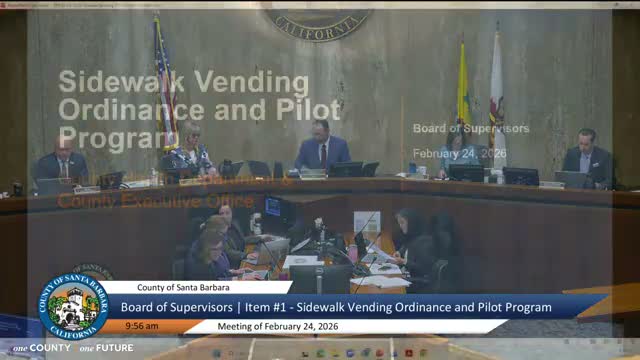
Summary
After months of complaints about unpermitted food operations and safety hazards near schools and highways, the Board of Supervisors approved a six-month pilot and directed staff to refine ordinance language to bar vending within 500 feet of schools during school-sponsored events.
Santa Barbara — The County of Santa Barbara tabled and then approved a revised proposal on Feb. 24 to regulate sidewalk vending and to fund a six-month enforcement pilot, citing food-safety and traffic-safety concerns.
County staff told the Board that state laws (SB 946 and SB 972) limit local authority to time, place and manner restrictions and that a 2025 change (SB 635) further restricts local use of vendors’ criminal histories. Wade Horton of the CEO’s office said the ordinance would require a seller’s permit, business license and health permit and would limit vending to paved sidewalks and pedestrian paths intended for foot traffic. "Adopting the ordinance will clarify definitions, locations, hours, and enforcement authority," Horton said.
Public-health staff described safety risks tied to unpermitted vending — including open-flame cooking near high-hazard areas and roadside vending along state highways that create traffic hazards — and proposed an outreach-and-enforcement team of environmental health staff, public works staff and a deputy sheriff. Lars Seifert of Environmental Health said the pilot would run April–October 2026, target 3–5 vendors per compliance event, and cost $42,022.10 (primarily overtime and storage for impounded equipment and food).
Restaurant owners and local business representatives — especially from Santa Maria — urged aggressive enforcement. "Restaurants have employed the community," said Lourdes Luna, who said her family has operated a Santa Maria restaurant for 34 years and that unpermitted operations have reduced her business. Others described risks from home-based "pop-up" restaurants and alleged illegal alcohol sales.
Board members pressed staff on enforcement near schools and during evening events. Supervisor Hartman asked that the ordinance explicitly bar vending near schools during school-sponsored events; staff agreed to tighten that language to prohibit vending within 500 feet of any school during times students are present for school-sponsored events. Chair Nelson and others emphasized the need for coordinated enforcement with CHP and city code-enforcement teams and asked staff to evaluate evening/weekend deployment of environmental health personnel to reduce overtime costs.
The board adopted staff recommendations for the pilot and directed staff to return with the revised ordinance language. The motion to adopt the recommended actions (as amended) passed unanimously.
What happens next: County staff will implement the six-month pilot starting in April 2026 and return to the board with outcomes and any recommended ordinance amendments after the pilot.