
Atlanta BeltLine outlines new pilots, $8M gift and housing progress amid sharp council questions over transit priorities
Get AI-powered insights, summaries, and transcripts
Subscribe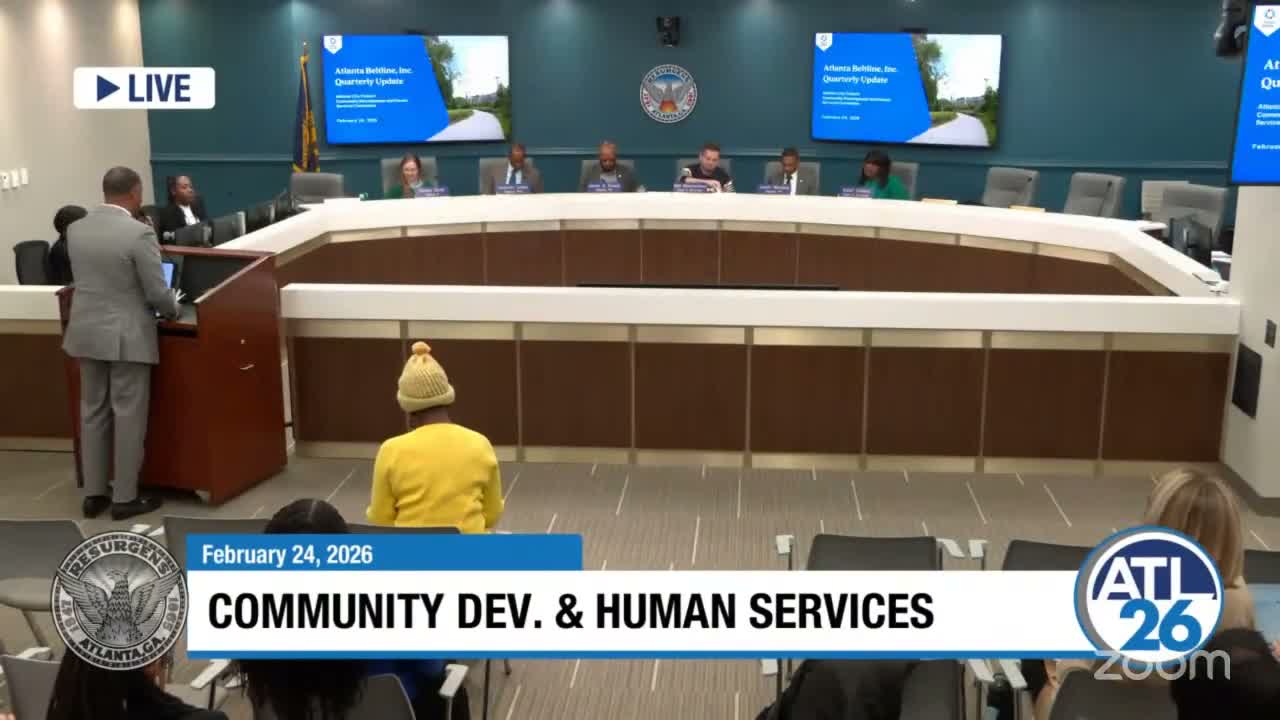
Summary
Clyde Higgs, president and CEO of the Atlanta BeltLine, told the Community Development Human Services Committee the agency has secured roughly $1.7 million for a West Side autonomous vehicle pilot, an $8 million private gift for Shirley Franklin Park and $25 million in USDOT funding for a Northeast trail segment, but council members pressed for clarity on whether BeltLine rail remains a priority and how MARTA's project list will be decided.
Clyde Higgs, president and CEO of the Atlanta BeltLine, told the committee Feb. 24 that the BeltLine has secured about $1,700,000 from the Transit Link Authority for a one-year autonomous vehicle pilot on the West Side and an $8,000,000 philanthropic gift to build a pump track and trails at Shirley Franklin Park.
The presentation highlighted construction progress on multiple trail segments, a restored $25,000,000 USDOT grant for Northeast Trail Segment 3, and a stated achievement of roughly 80% of the BeltLine's 5,600-unit affordable-housing goal inside the tax allocation district. Higgs said the BeltLine has amassed nearly 100 acres for future housing and commercial affordability and reiterated a target to complete the full loop by 2030.
Why it matters: Council members framed the update within an urgent transit debate. Several lawmakers criticized the Program Governance Committee (PGC) and MARTA for what they described as unclear or late communications about project reprioritization, and they pressed BeltLine leadership about whether rail remains central to the project's mission.
Council members asked detailed operational questions about timing, funding and governance. Council member Liliana Bakhtiari noted public concern after press reporting about a May vote that redirected a streetcar project; she pressed Higgs on whether the BeltLine still envisions rail as part of the overall transit strategy. Higgs said the BeltLine is aligned with mass transit goals and repeatedly framed the agency's role as the implementation partner that will deliver projects once MARTA and the PGC set the priorities.
Higgs emphasized a multi-modal approach: —We're talking about mass transit,— he said, adding that future mobility will likely include heavy and light rail, autonomous vehicles, bike lanes and micro-mobility. He also described work on infill stations and the need for durable operations-and-maintenance arrangements as trail miles come online ahead of the FIFA World Cup.
Council members sought specific timelines. Higgs said South Side trail work is expected to be ready by May—June 2026, several segments will be bid this calendar year, and more technically complex segments could take 30—36 months once contracted, but he reaffirmed the 2030 loop completion goal.
Funding and legal limits drew questions. Higgs explained that Special Service District (SSD) bond proceeds are limited by the bond documents to trail design and construction and that most BeltLine local funding comes from TAD dollars; federal and philanthropic sources supplement the remainder.
The committee's discussion underscored a political crossroads: members urged faster, clearer coordination between the BeltLine, MARTA and the mayor's office so that a single prioritized project list can guide implementation and reduce repeated pivots in project planning.
What's next: Higgs said the BeltLine will continue community engagement, advance projects funded ahead of major events and implement the mobility pilot if MARTA and other partners approve the related votes and technical steps.