Lifetime Citizen Portal Access — AI Briefings, Alerts & Unlimited Follows
County outlines Prop 1 transformation: BHSA conversion, bond awards and an integrated plan
Loading...
Summary
Behavioral Health staff presented an update on implementation of Proposition 1: conversion from the Mental Health Services Act to the Behavioral Health Services Act, the countyreceipt of a conditional $22.16 million BCHIP award for local treatment beds, and an integrated plan under 30-day review that refocuses programs toward higher-need populations and new reporting and revenue rules.
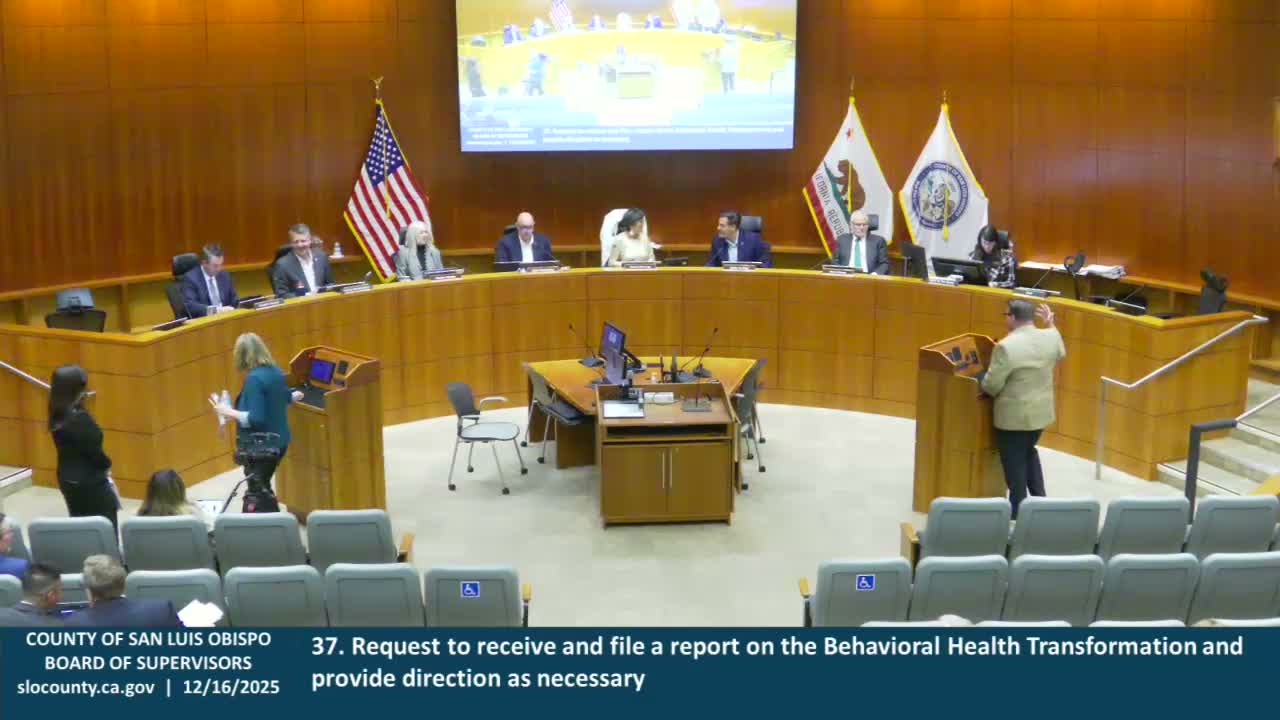
San Luis Obispo County behavioral health officials briefed the Board of Supervisors on the sweeping changes driven by Proposition 1, including the scheduled conversion of Mental Health Services Act (MHSA) funds into the Behavioral Health Services Act (BHSA), new bond-funded infrastructure grants and a statewide integrated-planning and reporting framework.
Frank Warren and Raven Lopez of the countybehavioral health team told the board that the stateled reforms narrow some county-managed prevention authority, require enhanced accountability, and create new buckets of funding focused on higher-severity behavioral health needs, housing for people with serious behavioral-health conditions and evidence-based practices. The proposal shifts a portion of prevention and early-intervention programming to the California Department of Public Health and increases state-level oversight and common metrics for all behavioral-health funding.
The county also reported a successful conditional award under the Behavioral Health Continuum Infrastructure Program (BCHIP): staff applied for and were conditionally authorized to receive approximately $21.6 million to expand local treatment capacity, a priority identified in the countygaps analysis. Morgan Terrell said the county will return in early 2026 with agreements required to accept and spend those capital funds.
The board was given a preview of the countyintegrated plan, a new state-required document that consolidates behavioral-health funding sources and metrics into one publicly reportable framework. The plan, posted for a 30-day public review, ties county programs to 14 statewide measures and will require counties to demonstrate how funding aligns with outcomes. Staff emphasized that MHSA-era programs will need revenue maximization (Medi-Cal billing) and in many cases reconfiguration to fit BHSA categories; some local prevention programs have already been off-ramped to preserve core services.
Raven Lopez, director of fiscal policy for the California Behavioral Health Directors Association (CBHDA), explained statewide changes and urged the county to pursue reimbursement strategies and workforce investments. County staff highlighted an early pilot under the California Youth and Behavioral Health Initiative (CYBHI) to embed clinicians in schools and to leverage newly reimbursable services.
Supervisors praised the staff for rapid implementation but requested follow-up reports on the integrated plan budget, contractual changes for evidence-based practice requirements, and coordination with housing and social-service partners to ensure the bond-funded housing dollars are paired with care. Staff said they will return to the board with the integrated plan after public comment and with BCHIP acceptance documents in early 2026.