Get Full Government Meeting Transcripts, Videos, & Alerts Forever!
Get email alerts on the Water Groundwater topic
No spam. Unsubscribe anytime.
San Luis Obispo supervisors adopt voluntary Fallowed Land Registry to curb Paso Basin pumpage
Summary
The Board of Supervisors on Feb. 3 approved a voluntary Fallowed Land Registry (the Miller program first phase) to encourage growers to reduce irrigated acreage and track results with satellite ET data, amend the county Ag Offset Ordinance and adjust Williamson Act rules to protect participants' tax and planting rights.
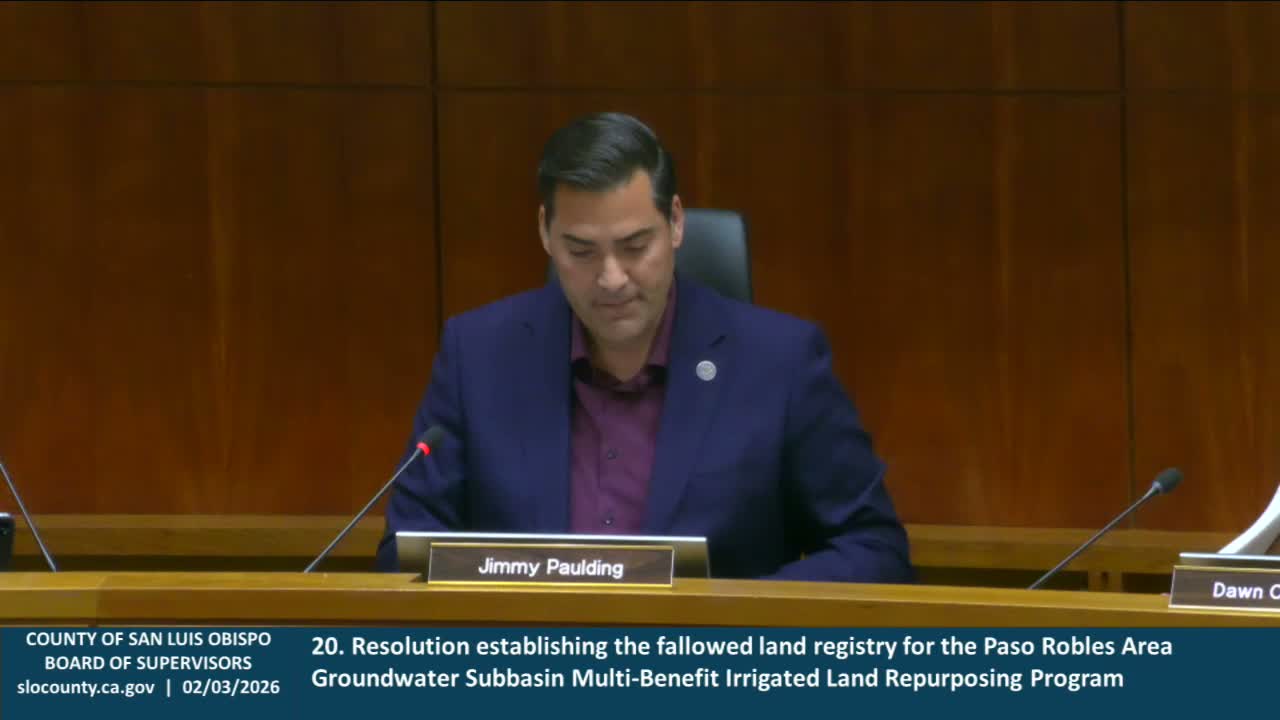
The San Luis Obispo County Board of Supervisors voted Feb. 3 to establish a voluntary Fallowed Land Registry as the initial phase of a Multi‑benefit Irrigated Land Repurposing Program (MILLER) designed to reduce groundwater extraction in the Paso Robles Groundwater Basin.
County groundwater director Blaine Raley presented the registry as a primarily voluntary tool that lets landowners register a “farming unit” (a contiguous or semi‑contiguous set of parcels managed as one operation) and designate at least two acres to be fallowed. Raley said the program will use satellite‑based evapotranspiration (ET) data for annual verification and asked the board to amend the county’s agricultural offset ordinance and Williamson Act rules so enrolled properties are not penalized for temporary fallowing. “We wanted to give the grower all the flexibility possible to make those decisions … and still result in a reduction in groundwater extraction,” Raley told the board.
Why it matters: Paso Robles is one of the state’s 21 critically overdrafted basins under the Sustainable Groundwater Management Act (SGMA), and local agencies must show progress toward sustainability by 2040. Raley told supervisors the basin’s monitoring network has been expanded from the 23 representative monitoring wells used in the original Groundwater Sustainability Plan (GSP) to roughly 113 wells, 49 of which have or will have instrumentation for near‑real‑time data.
What the registry will do: Enrollees file an online application, delineate the fallowed area with a mapping tool and certify neutral water use for their farming unit. County staff will run annual ET analyses against a benchmark composed of the three highest ET years from the previous five‑year period; properties that do not meet the registry’s self‑certification standard may be removed. The board also approved administrative steps to (1) exempt registered fallowed lands from the five‑year planting lookback under the Ag Offset Ordinance and (2) amend Williamson Act rules so enrollment will not automatically jeopardize contract benefits.
Support, concerns and next steps: Agricultural groups and the Paso Robles Wine Country Alliance praised the registry as a practical, low‑friction tool to reduce irrigated acreage without immediate mandatory cutbacks. Praga/GSAs and board members said the voluntary program is the preferred first step; supervisors emphasized that mandatory pumping reductions remain on the table if voluntary measures do not produce the necessary reductions. Several speakers from the public raised technical and equity concerns about ET accuracy, dry‑well mitigation and trust in the oversight process. Raley and board members said the county and the Paso Robles Area Groundwater Authority (PRAGA) will continue outreach, expand monitoring and develop a domestic well mitigation framework. “This voluntary program is the number‑one activity that we’re taking to actually bring balance to the basin,” Supervisor Gibson said.
Board action and vote: Supervisor Gibson moved the staff recommendations and the board approved them (roll call: Gibson yes, Paulding yes, Moreno yes, Ortiz Legg yes; Supervisor Pashong abstained). The motion authorized the establishment of the registry and directed staff to implement the related ordinance and procedure amendments. Raley said the county will continue tracking proposed state legislation (including bills that would affect conversion of farmland to solar) and coordinate any necessary local amendments.
What to watch: PRAGA will host public workshops Feb. 10 (in person) and Feb. 11 (online) to discuss the authority’s approaches and funding options; the board and PRAGA will continue to refine monitoring, the dry‑well mitigation framework and potential future incentives or funding mechanisms.