Get Full Government Meeting Transcripts, Videos, & Alerts Forever!
Get email alerts on the Charter Review topic
No spam. Unsubscribe anytime.
San Mateo County charter review committee opens, hears Brown Act training and sets May 1 deadline for recommendations
Summary
The newly formed San Mateo County Charter Review Committee convened Jan. 29, received legal training on county charters and the Brown Act, and was told it must submit recommendations to the Board of Supervisors by May 1, 2026 to meet ballot deadlines.
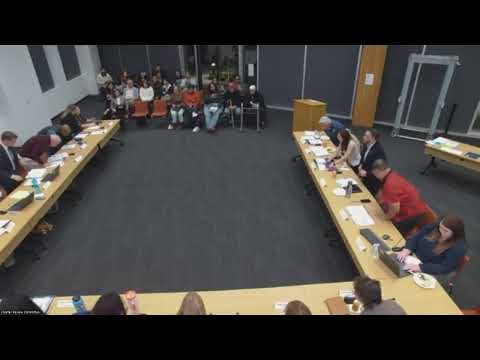
The San Mateo County Charter Review Committee met on Jan. 29 for an organizational session that combined legal training and a briefing on the committee's timeline and scope. Supervisor Noelia Corzo, serving as president of the Board of Supervisors this year, opened the meeting and urged members to "work together" and bring forward any issues they believe are important for the charter review process.
Deputy County Attorney Brian Pettit gave a detailed overview of county charters and the amendment process, saying the San Mateo County Charter "is the bedrock and the constitutional law of our county." He reminded the committee that any changes to the charter are advisory at the committee level: the board may choose whether to send amendments to voters and any amendment ultimately requires majority voter approval.
Pettit also reviewed the Brown Act, California's open-meetings law, telling members, "You are a legislative body," and explaining that meetings must be open to the public except for narrowly defined exceptions. He described how serial communications ("daisy chains" or "hub-and-spoke" contacts) can constitute an impermissible meeting and noted the committee was authorized by the Board of Supervisors to meet via teleconference if the committee itself approves such procedures.
The committee was given administrative details it must follow: it has 19 appointed seats, a quorum is 10 members, and recommendations that the committee advances to the board require at least 10 affirmative votes. Staff told members the committee must submit its recommendations to the Board of Supervisors by May 1, 2026 to allow sufficient time for ordinances and ballot preparation for the Nov. 3 election.
Pettit reviewed topics suggested by supervisors and others for possible charter amendments. Items presented as examples included removing the sunset on the board's authority to remove an elected sheriff for cause (Charter Section 4.12.5), requiring an annual review of the board handbook or a demographic report on county residents, clarifying procedures for filling vacancies in elected offices, considering whether to convert certain elected positions (such as controller, coroner, or treasurer-tax collector) to appointed positions, and examining whether the board president's role should be changed to strengthen regional executive interactions.
Staff advised members that subcommittees (fewer than a quorum) could be formed at the next meeting to investigate issues in more depth and report back. Members were asked to submit any ideas by noon Friday so staff could compile proposals for the Feb. 3 meeting; members of the public may also bring proposals to the Feb. 3 meeting during the public comment period.
The committee will next meet on Feb. 3, when it is expected to identify the list of issues it will pursue and form subcommittees to research them further.