Get Full Government Meeting Transcripts, Videos, & Alerts Forever!
Get email alerts on the Charter Review Outcomes topic
No spam. Unsubscribe anytime.
San Mateo County charter review committee picks five topics for study, defers others
Summary
The Charter Review Committee voted to study (1) vacancy appointment procedures, (2) a board governance review, (3) an independent district‑lines commission, (4) standards around row‑officer consolidation and language access, and (5) a Human Rights and Equity Commission. Several other proposals failed or were deferred for more detail.
The San Mateo County Charter Review Committee agreed on Feb. 3 to send five proposed charter topics to subcommittees for study, narrowing a long list of board and committee suggestions ahead of a May reporting deadline to the Board of Supervisors.
The committee voted to research whether section 4.15 of the charter should be amended to set clearer procedures when the Board appoints someone to fill a vacancy in an elected office; to examine annual or periodic reviews of board governance practices and a possible governance handbook; to establish an independent district‑lines commission to redraw supervisorial districts after each federal census; to study standards (including a professional‑qualifications audit) before consolidating unrelated elected offices and to examine expanded language‑access and equity requirements; and to evaluate codifying a county Human Rights and Equity Commission. County staff will support subcommittees drafting background, legal constraints and options.
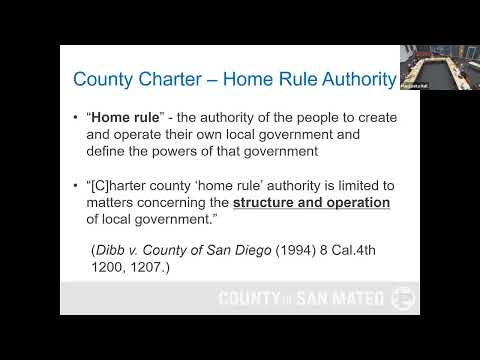
Brian Pettit, deputy in the county attorney’s office, told the committee that charter amendments must be consistent with the California Constitution and state law, which limit charters to matters of structure and operation. "Home rule is the authority of the people to create and operate their own local government," Pettit said, and the committee’s work is to identify which governance matters are appropriate for charter language.
The committee rejected or declined to advance several other proposals at the meeting. A motion to study whether certain currently elected county offices (controller, coroner, treasurer‑tax collector) should instead be appointed did not secure enough support. A proposal to remove the sunset on Measure A’s charter provision allowing the board to remove a sheriff for cause drew strong debate and failed to pass; opponents warned such a change would contradict how the measure was described to voters. "The messaging on Measure A…was this is a one‑time temporary fix for a very specific problem," committee member Julie Lind said during debate.
Members also voted down, or tabled pending clearer wording, proposals to require charter‑level dedicated funding for community centers, to add nondiscrimination/gender‑identity language in the charter, and to add more prescriptive language on the Charter Review Committee process itself.
Several members flagged legal and practical limits during debate: Pettit reminded the group that matters such as declarations of emergency and many anti‑discrimination protections are primarily governed by state law and existing county ordinances or policies. At least one member noted recent local headlines and concerns about sheriff accountability could make the removal‑for‑cause provision a timely item to study further even if it did not advance at this meeting.
Next steps: the committee formed five subcommittees and invited volunteers to chair them; staff will circulate membership lists and suggested materials. Committee chairs will coordinate research, meet with county staff as needed and report back to the full committee at subsequent meetings. The committee’s deliverable calendar is driven by election deadlines: materials for any charter amendment must be submitted well before the Nov. 3 general election.