Get Full Government Meeting Transcripts, Videos, & Alerts Forever!
Get email alerts on the Zoning Rezoning topic
No spam. Unsubscribe anytime.
Live Oak council approves first readings on four zoning ordinances; Circle K redevelopment draws public questions on safety and cleanup
Summary
The City of Live Oak council gave first readings to four zoning ordinances, including a rezoning tied to a proposed 24-hour Circle K at Howard and Walker; residents voiced concerns about loitering near a neighborhood park and staff said a state cleanup program will address prior contamination.
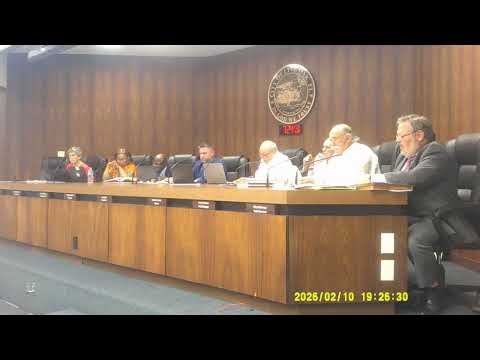
The City of Live Oak council on Feb. 25 conducted first readings on four zoning-related ordinances, clearing the way for later approvals and additional hearings on development details. The most substantial discussion centered on a rezoning request tied to a proposed Circle K redevelopment at the corner of Howard and Walker.
The council read Ordinance 15-54, a small-scale future land use amendment covering 0.74 acres, then opened and closed the public hearing and accepted the first reading. Speaker 3 moved to accept the first reading, with Speaker 2 seconding the motion.
Council members then read and approved first readings of Ordinance 15-55 (rezoning about 0.22 acres from residential single-family to commercial neighborhood) and Ordinance 15-56 (rezoning roughly 0.228 acres), both with no public speakers during the hearings.
Ordinance 15-57, which proposes a change from Commercial General to Commercial Intensive on approximately 0.283 acres within the city’s corporate limits and inside the community redevelopment area (CRA), drew public comment and a more extended exchange with the applicant.
Quinn Skersky and nearby residents said the parcel touches existing properties and that redeveloping the corner ‘‘would be a good addition’’ and could help clean up the block. Michelle Patel, a property owner who identified herself for the record, told the council the change would allow an expansion of an existing convenience site and said, “We’re just trying to expand the store.”
One resident who was sworn for comment said she had polled neighbors and reported “about 70% that’s asking for it, and 30% is just concerned” about a proposed 24-hour operation producing loitering near a neighborhood park and raising policing questions.
An applicant representative described the plan as a four-parcel redevelopment (two front, two back) at the former gas station and car-wash site. The representative said the project is intended to be a 24-hour Circle K operation, that the developer welcomes police presence, and that work on the site would also address existing environmental contamination.
“Cleanup is probably the only thing that will delay construction,” the applicant said, adding the representative has met with state cleanup staff (referred to in the transcript as "FDP") and the site has been elevated under an EDI program to accelerate remediation so the property can return to productive use.
City staff explained the next steps: George Curtis said gasoline and fueling stations with pumps trigger a special-exception review before the planning and zoning board (board of adjustment), which will evaluate the site plan, traffic flow, parking and other operational details; that board’s action would be the final decision on any fueling station special exception.
A council member asked whether electric vehicle charging stations were planned; the applicant said Circle K has not yet decided to include EV chargers at this location. Council members noted that EV infrastructure could draw additional tourist traffic and be an economic benefit.
On safety, council and public witnesses said retail thefts and parking-lot arguments occur occasionally at 24-hour retail sites but said more serious incidents are uncommon; speakers suggested better lighting and regular police presence could mitigate concerns.
Procedurally, the council confirmed it had no disqualifying ex parte communications on items 6d–g and admitted maps, reports and staff materials from the planning packet into the record for those items.
What happens next: each ordinance received a first reading and will return for subsequent proceedings; the Circle K proposal will require a later special-exception hearing before the planning and zoning board for approval of pumps and related operational details, and the remediation timeline depends on the state cleanup program.