Get Full Government Meeting Transcripts, Videos, & Alerts Forever!
Get email alerts on the State Of The Union Overview topic
No spam. Unsubscribe anytime.
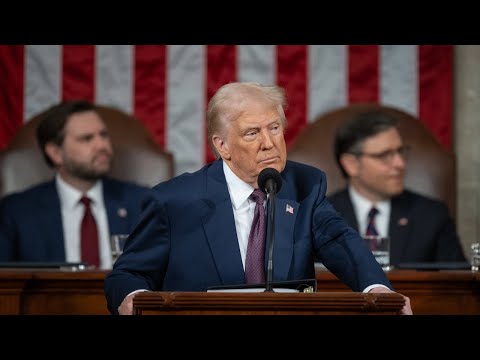
President outlines sweeping immigration, trade and regulatory agenda in State of the Union address
Summary
In a joint session of Congress, the president reviewed dozens of executive actions and proposed major policy shifts — stricter border enforcement and detention for dangerous noncitizens, reciprocal tariffs, tax cuts, a $5 million citizenship pathway and new defense spending — and asked Congress for implementing funding and legislation.
The president addressed a joint session of Congress, presenting an expansive policy agenda that emphasized border enforcement, trade protectionism, regulatory rollbacks and stepped-up defense spending. He framed the opening of his term as a rapid period of action and said ‘‘America is back.’’
The address catalogued executive steps already taken: the president said he had signed nearly 100 executive orders and taken more than 400 executive actions in his first weeks. He said he declared a national emergency on the southern border and deployed the U.S. military and Border Patrol ‘‘to repel the invasion of our country.’’ The president stated that illegal border crossings had dropped to ‘‘by far the lowest ever recorded’’ since those deployments. He asked Congress to send funding for a detailed request he said would eliminate threats and support what he called ‘‘the largest deportation operation in American history.’’
On trade and industry, the president announced reciprocal tariffs beginning April 2 and said he had imposed a 25% tariff on foreign aluminum, copper, lumber and steel, presenting tariffs as a tool to protect U.S. manufacturing, agriculture and national security. He credited large private-sector investment announcements as signs that his policies are attracting industry back to the U.S.
On taxes and immigration, the president proposed tax cuts and a new high-fee immigration pathway he called a ‘‘gold card,’’ saying, ‘‘For $5,000,000, we will allow the most successful job-creating people from all over the world to buy a path to U.S. citizenship.’’ He said such immigrants would pay U.S. taxes and create jobs.
The president said he reversed numerous prior administration policies and international commitments, citing withdrawals from the Paris Agreement, the World Health Organization and the U.N. Human Rights Council. He also said he had made English the official language by executive order and announced several symbolic renamings of geographic features.
He used personal stories to illustrate policy priorities: victims of violent crimes allegedly involving unauthorized migrants, a student athlete he said had been injured in competition against a male competitor, and public servants and volunteers who he said exemplified American resilience. He urged Congress to enact permanent laws consistent with his executive actions, including criminal penalties related to medical procedures for minors and bans on males in women’s sports.
The president framed defense and infrastructure initiatives as central to his plan. He asked Congress to fund a ‘‘Golden Dome missile defense shield’’ and to support a revived U.S. shipbuilding industry through a new White House office and tax incentives.
Throughout the speech, the president presented numerical claims — on historic program fraud, Social Security database anomalies, and investment totals — as statements of fact. These claims are quoted or summarized here as expressed in the speech and are not independently verified in the transcript. The president repeatedly asked Congress to act promptly on his funding requests and legislation.
The address concluded with an appeal to national renewal and a repetition of the administration’s rhetorical theme that a ‘‘golden age’’ has begun.